In this article
For many online shops in Bangladesh, the weeks before Eid ul-Fitr bring a large share of the year’s orders, and Eid ul-Adha, Pohela Boishakh and Durga Puja bring smaller peaks of their own. The opportunity is obvious, and so are the problems: stock runs out, couriers are overloaded, messages pile up, and a parcel that arrives the day after Eid can turn a happy customer into an angry one. The shops that do well in festival season are rarely the ones with the biggest discounts. They are the ones that plan early, promise only what they can deliver and stay calm in the last week. This guide gives a practical timeline you can adapt to your own shop.
From my own work: In my work with online sellers, the festival problems I hear about most are not about marketing ideas. They are about operations: a supplier delay, a courier that stopped taking parcels earlier than expected, or an inbox nobody could keep up with in the final days before Eid.
Know your dates, and confirm them
Eid ul-Fitr and Eid ul-Adha follow the Islamic lunar calendar, which moves about 11 days earlier each year compared with the Gregorian calendar. The exact day in Bangladesh depends on moon sighting and is confirmed only shortly before. Based on the lunar calendar, Eid ul-Fitr in 2027 is expected around the second week of March, and Eid ul-Adha around the middle of May. Treat these as approximate, and confirm the official announcement and public holidays in Bangladesh as each Eid approaches.
- Eid ul-Fitr follows Ramadan. Clothing, shoes, cosmetics, jewellery, gifts and home decor usually see the strongest demand.
- Eid ul-Adha often brings demand for kitchen items, storage, spices, home goods and clothing, though usually less fashion-led than Eid ul-Fitr.
- Pohela Boishakh is on 14 April in Bangladesh, a fixed date that suits red and white clothing, traditional items and gifts.
- Durga Puja and winter wedding season are further peaks for many fashion and gift sellers.
Mark all of these in your content calendar at the start of the year, so you are never surprised by a festival.
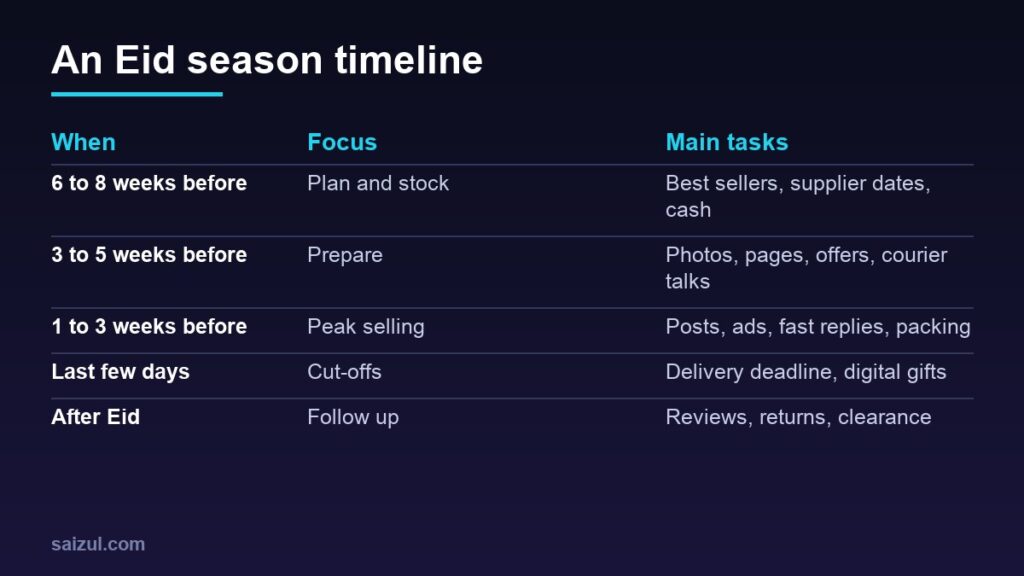
Stage 1: Plan stock and cash (6 to 8 weeks before)
- Look at last season’s numbers if you have them: best sellers, sizes that sold out, what was left over.
- Choose a focused Eid collection rather than ordering a little of everything. Fewer products with good stock in every size beat many products that sell out on day two.
- Confirm supplier dates in writing and build in a buffer. Suppliers are busy too.
- Plan your cash. Stock, packaging, ads and extra help all need money before the sales arrive. Work out how much you can safely spend.
- Set up stock tracking across Facebook, your website and any marketplace; see inventory management for online stores.
Stage 2: Prepare the shop (3 to 5 weeks before)
Photos and pages
- Shoot the whole collection in one or two sessions, in good daylight, with close-ups and the product in use. See product photography with a smartphone.
- Create an Eid collection page or album, with clear prices, sizes and stock.
- Update product descriptions with fabric, measurements and care; see product descriptions that sell.
- Test your checkout on a phone and check that the site can cope with more visitors; see website speed and sales.
Delivery and payments
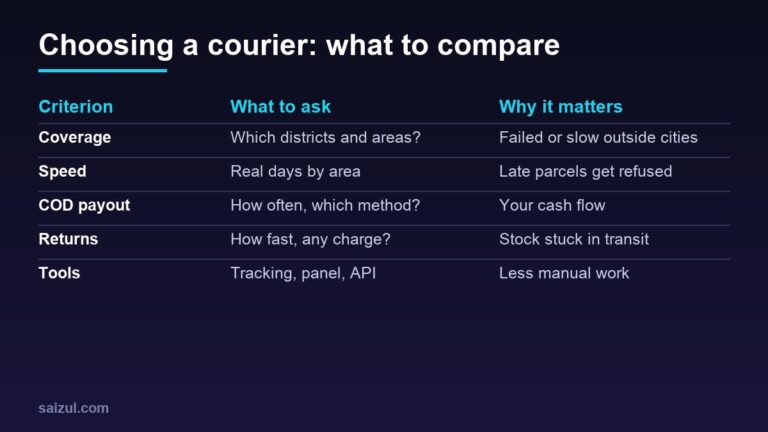
- Talk to your courier early. Ask about extra pickup slots, expected delays and the last date they can deliver before Eid in Dhaka and outside Dhaka. Many services slow down or pause around the holidays.
- Set your own order cut-off dates a little earlier than the courier’s, and publish them clearly on posts, pinned messages and your website.
- Encourage advance payment to reduce refused parcels in a busy period, while keeping cash on delivery for buyers who need it. See cash on delivery management and accepting online payments.
Check the basics are in order
Festival season is when new sellers appear and payment providers and customers look more closely at who they are buying from. If you are a new online business in Bangladesh, the government’s DBID site says new businesses should apply for a Digital Business Identification number before starting on a digital platform, that the service is free and that processing can take up to 60 working days (DBID application information). Do not leave it until the week before Eid.
Stage 3: Plan fair offers
- Choose offers your margin can carry: free delivery above an order value, a gift with purchase, a bundle price, or a small discount for advance payment. Check the numbers with how to price products.
- Be honest about prices. Do not raise a price just to show a bigger “discount”. Customers compare, and screenshots travel fast.
- Give every offer an end date and stick to it.
- Put the offer on Google too. If you have a Google Business Profile, an offer post needs a title and start and end dates and times, and can include a coupon code, a link and terms (create posts on Google). My guide to Business Profile optimization covers the rest of the profile.
Stage 4: Promote in the weeks before Eid
Social media
- Start showing the collection three to five weeks before, not in the final week when everyone else is shouting.
- Use a mix: collection reveals, styling ideas, size help, customer photos shared with permission, and delivery deadline reminders.
- During Ramadan, many people browse late in the evening and after sehri. Watch your Insights for when your followers are actually active, and schedule posts and reply cover for those hours.
- Keep your page tone respectful of the season.
Ads
- Start with a test budget early, find the ads and products that bring orders, then increase spending on those as Eid approaches.
- Ad costs often rise in busy seasons as more sellers compete, so watch the cost per order, not just reach.
- Stop or change ads for products that sell out, and stop delivery-dependent ads after your cut-off date.
- If you use Google Ads, ad scheduling lets you choose the hours and days your ads show and adjust bids for specific times (about ad scheduling), which helps if you can only answer calls at certain times.
For setup help, see Facebook ads for beginners, Pixel and Conversions API setup and Google Ads for small business.
Repeat customers
Your past buyers are the easiest sales. Send them an early look at the collection by WhatsApp or email, with permission and without spamming. See WhatsApp Business for e-commerce and email marketing automation.
Stage 5: Handle the peak weeks
- Get help early for packing and messages, and train them before the rush.
- Use reply templates for price, sizes, delivery charge and time, payment and returns; see customer service for online stores. My guide to Messenger automation helps with routine questions.
- Confirm orders by phone or message before shipping, especially cash on delivery orders.
- Update stock several times a day and mark sold-out items quickly.
- Pack carefully, even when rushed. A damaged parcel before Eid is worse than a late reply.
Stage 6: The last few days
- Announce clearly when the last guaranteed delivery date has passed.
- After the cut-off, switch to items that do not depend on delivery before Eid: gift vouchers, pre-orders for after Eid or pickup if you have a location.
- Post your holiday hours and when deliveries will restart, on social media and on your Google profile.
- Do not promise delivery dates you cannot control.
Stage 7: After Eid
- Thank customers, and ask for reviews from those whose orders went well. See how to get more Google reviews.
- Handle exchanges and returns quickly and fairly; see the returns and refunds policy guide.
- Clear leftover stock with a modest post-Eid offer rather than deep discounts that train customers to wait.
- Write down what sold, what ran out, what was late and what the ads cost per order. That note is your plan for next year.
Common mistakes
- Ordering stock too late and launching the collection in the final week.
- No published order cut-off date.
- Fake “discounts” on raised prices.
- Promising delivery before Eid after the courier deadline.
- No one answering messages during the busiest evenings.
- Spending the whole ad budget on reach instead of orders.
Quick checklist
- Festival dates marked, with Eid dates confirmed as they are announced.
- A focused collection, supplier dates in writing and a cash plan.
- Photos, collection page and checkout ready three to five weeks ahead.
- Courier deadlines confirmed and your own cut-off dates published.
- Fair offers with end dates, also posted on Google.
- Posts and ads started early, timed to when followers are active.
- Extra help, reply templates and order confirmation for peak weeks.
- Post-Eid reviews, returns, clearance and notes for next year.
Need help with this on your own site or business?
I build and secure WordPress sites, web apps and AI automations end to end, in Bangla and English: a free discovery call, a written scope with a fixed quote, a focused first version, then testing, deployment and monitoring.
See the portfolio and the AI agent services, or tell me what you need.
FAQ
When should an online shop start preparing for Eid?
Six to eight weeks before is a comfortable start for planning stock and cash, with photos, pages and offers ready three to five weeks before, so promotion can start well ahead of the final rush.
When is Eid in 2027?
Eid dates depend on moon sighting. Based on the lunar calendar, Eid ul-Fitr 2027 is expected around the second week of March and Eid ul-Adha around mid-May. Confirm the official dates in Bangladesh as each Eid approaches.
What is a good Eid offer for a small online shop?
Offers your margin can carry and customers trust: free delivery above an order value, a gift with purchase, bundle prices or a small discount for advance payment, each with a clear end date.
How do I avoid late deliveries before Eid?
Ask your courier for its last delivery dates inside and outside Dhaka, set your own order cut-off a little earlier, publish it clearly and switch to gift vouchers or after-Eid delivery once it passes.
Sources

Md Saizul Amin
Digital Systems Strategist · AI Agent Developer · 9+ years in digital & ITMd Saizul Amin is a digital systems strategist and AI automation engineer from Dhaka, Bangladesh. With 9+ years across IT, web development and digital marketing, he writes practical guides on technology, business, education and online growth — and builds the same kinds of systems (AI agents, websites, SEO and ad campaigns) for clients in Bangladesh, the UK and the USA.
Specialist in
Credentials & experience
- 🎓B.Sc. in Computer Science & EngineeringBangladesh University of Business & Technology (BUBT), 2017–2021
- 🤖AI Automation Engineer · Web Developer · SEO SpecialistUnique Mark Limited, Birmingham UK — 2024 to present
- 🌱IT SpecialistGreen Fund Initiative Inc., USA — 2024 to present
- 🏥Junior IT Consultant — Ministry of Health (DGHS)Built the first national Shareable Health Record website; supported 6,000+ facilities
- 🧭Head of ITWEDO Bangladesh — led IT for 50+ staff, 2021–2023