In this article
Many small online stores set prices by looking at a competitor and going a little lower. It feels safe, but it ignores your own costs, and it is the main reason shops with plenty of orders still end the month with no money. A price has to cover everything it takes to get one order delivered and paid, and then leave a profit. Here is the method I recommend, with numbers you can replace with your own.
From my own work: When I review a store’s numbers with the owner, the product cost is almost always known and the cost per delivered order almost never is. Returns and advertising are the two items most often missing from the price.
Step 1: List every cost per order
Cost-plus pricing means adding up your costs and then adding profit on top (Shopify’s pricing guide walks through the same idea). The mistake is counting only the purchase price. Count these per order:
- Product: purchase or production cost, including import, transport to you and wastage.
- Packaging: box or poly bag, tape, label, invoice, thank-you card.
- Delivery: whatever part of the courier charge you pay yourself, for example if you offer free delivery.
- Payment fees: gateway or mobile-wallet charges on prepaid orders, and the courier’s COD fee on cash orders.
- Returns: an allowance for parcels that come back.
- Advertising: ad spend divided by delivered orders.
- Overheads: salaries, rent, software and hosting, spread across a month’s orders.
Step 2: Work through an example
The figures below are illustrative, in taka, for a product the customer pays delivery on separately. Replace each line with your own data.
| Cost per delivered order | Amount |
|---|---|
| Product | 400 |
| Packaging | 25 |
| COD or payment fee | 10 |
| Returns allowance | 17 |
| Advertising | 150 |
| Total cost | 602 |
How the returns allowance works: suppose that out of every 10 parcels you send, 1 comes back, and each return costs you 150 in two-way courier charges and repacking. The 9 delivered orders have to pay for that: 150 divided by 9 is about 17 per delivered order.
How the advertising line works: if you spend 15,000 on ads in a month and 100 orders are actually delivered, the cost is 150 per order. Use delivered orders, not placed orders. If you are new to ads, see Facebook ads for beginners.
If you sell this product at 990, the profit is 990 − 602 = 388 per delivered order, before overheads.
Step 3: Understand margin vs markup
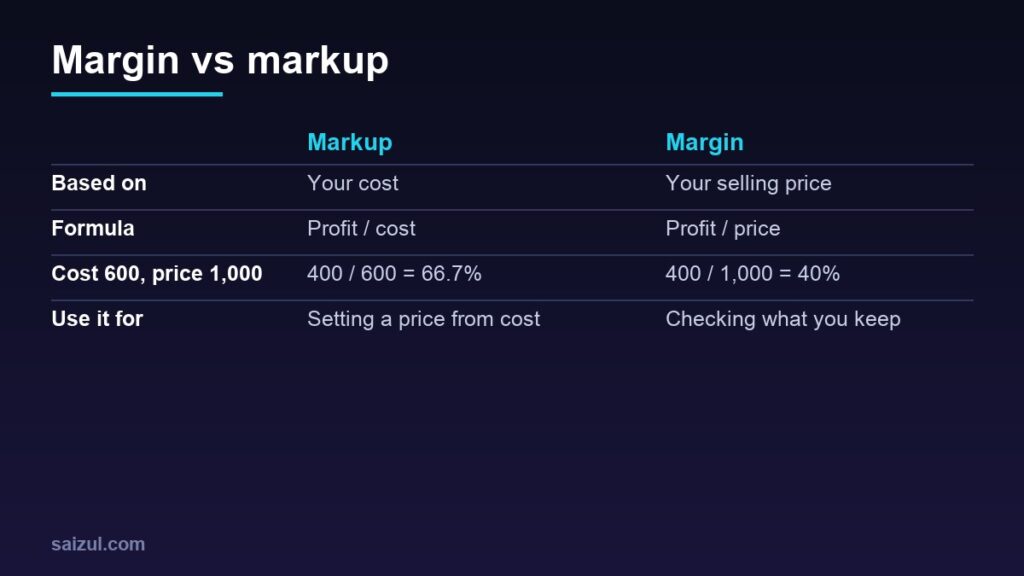
Both describe the same profit, measured against different bases:
- Markup = profit ÷ cost. Here: 388 ÷ 602 = about 64%.
- Margin = profit ÷ selling price. Here: 388 ÷ 990 = about 39%.
Confusing the two is expensive. A supplier who says “add 50%” means markup; a 50% markup is only a 33.3% margin.
| Markup on cost | Resulting margin |
|---|---|
| 25% | 20% |
| 50% | 33.3% |
| 100% | 50% |
To set a price from a target margin, use: price = cost ÷ (1 − margin). For a 40% margin on a cost of 602: 602 ÷ 0.60 = about 1,003. Multiplying the cost by 1.40 gives only 843, which is a 40% markup and a margin under 29%.
Step 4: Check the price against the market
Costs give you the floor. The market tells you how far above it you can go.
- Compare with sellers offering the same quality, delivery speed and return policy, not with the cheapest listing you can find.
- If your cost-based price is far above the market, lower the costs (supplier, packaging, ad efficiency) rather than selling at a loss.
- If you offer something others do not, such as a warranty, faster delivery or better support, say so clearly. Good product descriptions justify a higher price.
Step 5: Use psychological pricing honestly
How a price is presented affects how it feels (psychological pricing strategies). The common techniques:
- Charm pricing: 990 instead of 1,000. Works well for everyday items.
- Round prices: 1,000 or 2,500 can suit premium or gift products.
- Anchoring: showing the regular price beside the sale price. The regular price must be one you really charged.
- Bundles: three items at a combined price raise the order value and spread the delivery and ad cost over more products.
- Free delivery threshold: “free delivery above 1,500” encourages a larger cart. Check that the margin on the larger order covers the courier charge.
Step 6: Discount without destroying profit
A discount comes straight out of profit, because your costs do not shrink with the price. In the example, a 20% discount takes the price from 990 to 792. The cost is still about 602, so the profit falls from 388 to 190. You would need roughly twice as many orders to earn the same total profit.
- Calculate the profit after discount before announcing any offer.
- Prefer bundles, free delivery thresholds or a small gift to a flat percentage off.
- Keep sales short and occasional. Permanent discounts teach customers to wait.
- If you list products on Google, submit the regular price and the sale price correctly (sale price attribute); my Merchant Center setup guide covers the feed.
Review prices regularly
Supplier rates, courier charges, ad costs and return rates all move. Recheck the cost table every month or whenever one of them changes, and adjust the price or the costs before the margin disappears.
Need help with this on your own site or business?
I build and secure WordPress sites, web apps and AI automations end to end, in Bangla and English: a free discovery call, a written scope with a fixed quote, a focused first version, then testing, deployment and monitoring.
See the portfolio and the AI agent services, or tell me what you need.
FAQ
What is a good profit margin for an online store?
It depends on the category, the return rate and the ad cost. Calculate your full cost per delivered order first; a price that leaves no room for returns and ads is too low whatever the percentage looks like.
Should my price include the delivery charge?
Either approach works. If delivery is free, add your average courier cost to the cost table; if the customer pays it, show it clearly before checkout.
Is it a good idea to price lower than competitors?
Only if your costs allow it. Competing on service, delivery speed and trust is usually safer for a small store than competing on price alone.
Sources

Md Saizul Amin
Digital Systems Strategist · AI Agent Developer · 9+ years in digital & ITMd Saizul Amin is a digital systems strategist and AI automation engineer from Dhaka, Bangladesh. With 9+ years across IT, web development and digital marketing, he writes practical guides on technology, business, education and online growth — and builds the same kinds of systems (AI agents, websites, SEO and ad campaigns) for clients in Bangladesh, the UK and the USA.
Specialist in
Credentials & experience
- 🎓B.Sc. in Computer Science & EngineeringBangladesh University of Business & Technology (BUBT), 2017–2021
- 🤖AI Automation Engineer · Web Developer · SEO SpecialistUnique Mark Limited, Birmingham UK — 2024 to present
- 🌱IT SpecialistGreen Fund Initiative Inc., USA — 2024 to present
- 🏥Junior IT Consultant — Ministry of Health (DGHS)Built the first national Shareable Health Record website; supported 6,000+ facilities
- 🧭Head of ITWEDO Bangladesh — led IT for 50+ staff, 2021–2023