In this article
Every online seller who offers cash on delivery knows the feeling: a parcel goes out, the rider calls, and the customer says they never ordered it, or that they have changed their mind, or they simply do not answer. The parcel comes back, you pay the delivery and return charges, and the product sits in the courier’s warehouse for days. Most advice on this problem jumps straight to tactics: call every customer, ask for an advance. Those help, but they treat every failed order the same. In practice, fake and returned orders have different causes, and each cause has a different fix. This guide shows how to find out why your own COD orders fail, and then how to fix the biggest causes first.
From my own work: When a seller asks me to help with returned COD parcels, I usually start by asking for a simple list of the last few weeks of failed orders with a reason next to each one. Very often nobody has written the reasons down, and once they do, one or two causes stand out that nobody had noticed.
If you have not set up the basics yet, such as order confirmation calls, advance delivery charges for risky orders and weekly courier reconciliation, start with my guide to cash on delivery management for online stores. This article builds on it and focuses on diagnosis: finding where the bad orders come from.
Fake orders and returned orders are not the same problem
| Type | What it looks like | Usual cause |
|---|---|---|
| Fake order | Wrong number, made-up name or address, nobody ever meant to buy | Pranks, competitors, bots on website forms, careless ad clicks |
| Changed mind | A real buyer, but they cancel or refuse at the door | Slow delivery, impulse buying, found it cheaper elsewhere |
| Not as expected | Buyer opens the parcel and refuses it | Photos, sizes or colours that do not match the product |
| Unreachable | Rider cannot reach the buyer or find the address | Vague address, wrong number, buyer travelling |
| Surprise cost | Buyer refuses because the amount is higher than expected | Delivery charge not shown clearly, unclear total |
A rule such as “ask everyone for an advance” may stop the first type but will also drive away genuine buyers in the other types, whose problem was something else entirely.
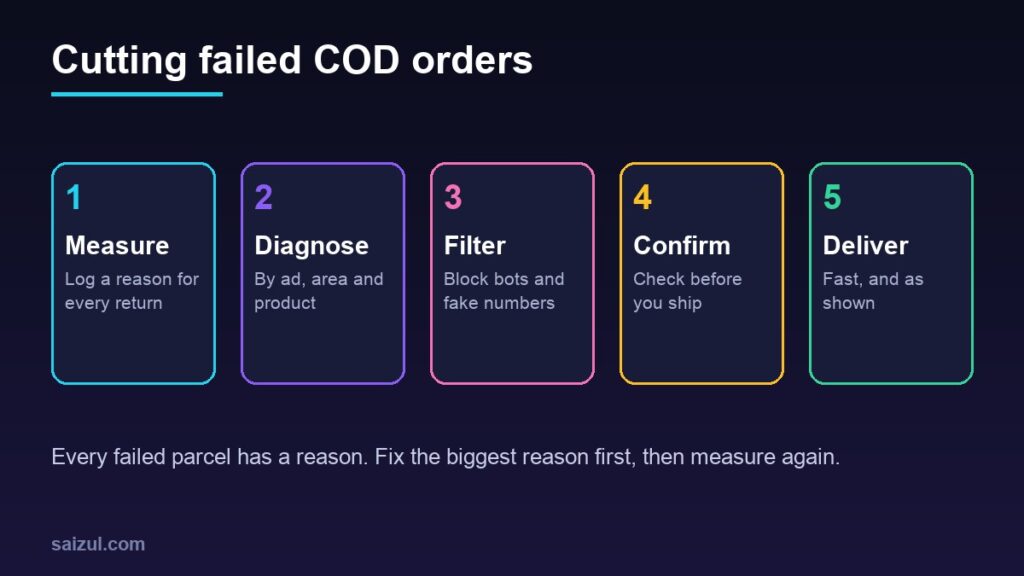
Step 1: Record a reason for every failed order
You cannot fix what you do not measure. Start a simple sheet, or a custom field in your store, and fill it in for every cancelled, refused or returned COD order:
- Order number, date and value.
- Where the order came from: which ad, which post, Messenger, WhatsApp, website, marketplace.
- District and area.
- Product and variation.
- Days between order and delivery attempt.
- The reason, in one of a few fixed categories: fake, changed mind, not as expected, unreachable, surprise cost, other.
Get the reason from the rider’s note in the courier panel, and where possible from a short, polite call to the customer. Keep the categories few and fixed so you can count them. After two to four weeks, you will have enough data to see patterns.
Step 2: Find where the bad orders come from
Sort the sheet and compare the failure rate, meaning failed orders divided by all COD orders, for each group:
- By source. An ad that brings many cheap orders but a high failure rate can cost more than an ad with fewer, solid orders. Compare cost per delivered order, not cost per order.
- By area. Some districts or areas may have more unreachable or refused parcels. That points to address quality, delivery speed or courier coverage in that area.
- By product. A product with many “not as expected” refusals usually has a listing problem, not a customer problem.
- By delivery time. If failures rise sharply for orders that took longer to arrive, speed is part of your problem.
- By time of order. Late-night orders from comments or quick forms are sometimes more impulsive. Check whether that is true for your shop before acting on it.
Pick the one or two groups with the most failed orders and work on those first.
Step 3: Stop fake orders before they reach you
On your website
If your website has an order form or checkout, some fake orders may come from bots or from people testing your form. A few measures help:
- Add bot protection to checkout and order forms. Google’s reCAPTCHA v3 works in the background without a puzzle for the visitor and returns a score between 0.0, very likely a bot, and 1.0, very likely a good interaction. Google suggests starting with a threshold of 0.5 and adjusting after you review your traffic, and says the token must be verified on your server (reCAPTCHA v3). Many form and store plugins include this as a setting.
- Validate phone numbers so a Bangladeshi mobile number has the right length and prefix before the order is accepted.
- Make the address fields specific: district, area or thana, and a full address with a landmark.
- Limit COD where it is risky. WooCommerce’s built-in cash on delivery method lets you choose which shipping methods and rates offer COD (Cash on Delivery documentation), so you can offer it in your main delivery zones and ask for online payment elsewhere. The same page notes that COD orders are set to Processing until payment is collected, so make sure your team ships only confirmed orders.
My WordPress security checklist covers other form and login protection.
On Facebook, Messenger and WhatsApp
- Do not accept orders from a comment alone. Move the buyer to a message where they give the name, number and address themselves.
- Send a written order summary with the total, including delivery, and ask the buyer to confirm it. See WhatsApp Business for e-commerce and Messenger automation.
- Keep an internal note of numbers linked to fake orders. Use it only to decide whether to ask for advance payment, and never post or share customer details publicly.
Use the courier’s own checks
Some Bangladeshi couriers now show sellers a buyer’s delivery history. For example, Steadfast’s website describes a “Delivery Risk Check” that shows how many parcels a buyer has taken and returned (Steadfast services). Check whether your courier offers something similar, and use it alongside your own records.
Step 4: Reduce “changed my mind” refusals
- Ship faster. The longer the gap between order and delivery, the more time the buyer has to cool off or buy elsewhere. Pack and hand over confirmed orders the same or next day.
- Keep in touch. Send a message when the parcel is handed to the courier, with the tracking link and the exact amount to keep ready.
- Look at your ads. Ads that promise “huge discount, order now” can attract impulse orders. Ads that show the real product, the real price and the delivery charge tend to bring buyers who already know what they are getting. See Facebook ads for beginners.
- Optimise for purchases, not just messages, where your tracking allows it, so ad delivery learns from people who actually buy. See Pixel and Conversions API setup.
Step 5: Fix “not as expected” returns at the listing
When a product has many refusals at the door, compare the listing with the product in your hand:
- Are the photos edited so much that the colour looks different? Add one unedited daylight photo. See product photography with a smartphone.
- Is there a size chart with real measurements in centimetres or inches, not just S, M, L?
- Does the description state the material, weight and what is included? See product descriptions that sell.
- Is the quality of the current batch the same as the one in the photos?
State your opening and exchange policy clearly, so the rider and buyer know what is allowed at the door. My guide to returns and refunds policies helps you write it.
Step 6: Cut “unreachable” and “surprise cost” failures
- Show the delivery charge for inside and outside your city on the product page and in the order summary.
- Ask for a second phone number for higher-value orders.
- Confirm the address and landmark during the confirmation message.
- Tell the buyer the expected delivery day, and remind them the day before if your courier allows it.
Step 7: Put the remaining risk into your numbers
You will never reach zero failed orders. Work out what the failures that remain cost you each month and include that in your pricing and your ad targets. My guide on how to price products for an online store shows how to include a returns allowance in your margin.
Step 8: Track the results every month
- Failure rate for all COD orders, and for each of your top sources, areas and products.
- Share of each reason, so you can see which fixes worked.
- Cost per delivered order for each ad or channel.
- Average days to delivery by area.
Change one or two things at a time, then compare the next month with the last. Otherwise you will not know which change made the difference.
Common mistakes
- Treating every failed order as a fake order.
- Asking every customer for an advance, and losing genuine buyers.
- Judging ads by cost per order instead of cost per delivered order.
- Ignoring listing problems behind “not as expected” refusals.
- Leaving website order forms open to bots.
- Sharing customer “blacklists” publicly.
Quick checklist
- A reason recorded for every failed COD order, in fixed categories.
- Failure rate compared by source, area, product and delivery time.
- Bot protection, phone validation and clear address fields on your website.
- COD limited to zones and orders where it works for you.
- Written order summaries confirmed by the buyer before dispatch.
- Fast handover to the courier and a tracking message with the amount due.
- Listings checked for products with many refusals.
- A monthly review of failure rate and cost per delivered order.
Need help with this on your own site or business?
I build and secure WordPress sites, web apps and AI automations end to end, in Bangla and English: a free discovery call, a written scope with a fixed quote, a focused first version, then testing, deployment and monitoring.
See the portfolio and the AI agent services, or tell me what you need.
FAQ
What is a normal COD return rate?
It varies widely by product, price, area and how orders are taken, so a figure from another shop is not very useful. Measure your own rate, by source and product, and aim to bring it down month by month.
Should I stop offering cash on delivery?
For most small shops in Bangladesh, no. Many buyers prefer COD. It is usually better to keep it and reduce the causes of failed orders, and to ask for advance payment only for higher-risk orders or areas.
How do I stop fake orders on my website?
Add bot protection such as reCAPTCHA to checkout and order forms, validate phone numbers, require a specific address, and confirm every COD order before shipping.
How do I know which ads bring fake orders?
Record the source of every order and the result of every delivery. Then compare the cost per delivered order for each ad, not just the cost per order.
Sources

Md Saizul Amin
Digital Systems Strategist · AI Agent Developer · 9+ years in digital & ITMd Saizul Amin is a digital systems strategist and AI automation engineer from Dhaka, Bangladesh. With 9+ years across IT, web development and digital marketing, he writes practical guides on technology, business, education and online growth — and builds the same kinds of systems (AI agents, websites, SEO and ad campaigns) for clients in Bangladesh, the UK and the USA.
Specialist in
Credentials & experience
- 🎓B.Sc. in Computer Science & EngineeringBangladesh University of Business & Technology (BUBT), 2017–2021
- 🤖AI Automation Engineer · Web Developer · SEO SpecialistUnique Mark Limited, Birmingham UK — 2024 to present
- 🌱IT SpecialistGreen Fund Initiative Inc., USA — 2024 to present
- 🏥Junior IT Consultant — Ministry of Health (DGHS)Built the first national Shareable Health Record website; supported 6,000+ facilities
- 🧭Head of ITWEDO Bangladesh — led IT for 50+ staff, 2021–2023