In this article
In a small online store, customer service is not a department. It is the owner answering Messenger at night, a team member calling about a late parcel, a reply under a Facebook post. Customers judge you on those moments more than on your logo. A fast, polite answer turns a question into an order, and a well-handled complaint often keeps a customer who would otherwise leave a one-star review. This guide sets out a simple system: which channels to cover, how fast to reply, templates you can adapt, and a calm process for complaints.
From my own work: When I set up inboxes and automations for online sellers, the biggest gains rarely come from software. They come from writing down the answers to the ten most common questions, agreeing who replies when, and deciding in advance what the store will offer when something goes wrong.
Step 1: Decide which channels you will cover
Every channel you open is a promise to answer there. For most small stores in Bangladesh that means Facebook Messenger, post comments and WhatsApp, plus phone and email. Instagram messages and marketplace chats come next if you sell there.
- List every place customers can contact you, including old pages and numbers printed on packaging.
- Close or redirect the ones nobody checks. An unanswered channel is worse than no channel.
- Use one shared inbox where possible. Meta Business Suite brings Facebook and Instagram messages together, and the WhatsApp Business app handles chats on one number. See WhatsApp Business for e-commerce.
- Show your hours on your page and website so customers know when to expect a reply.
Step 2: Set response time targets you can keep
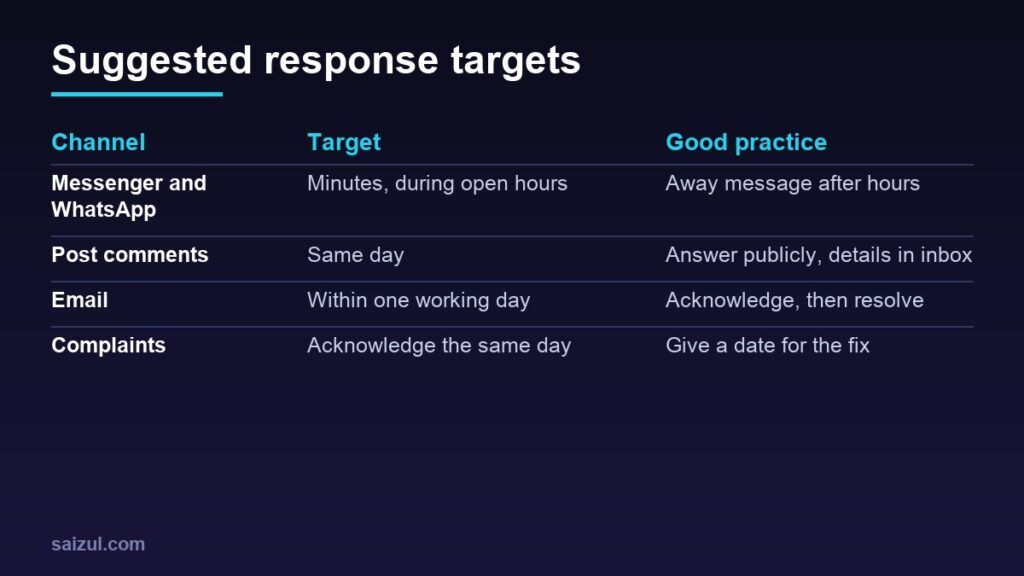
There is no official standard for small stores, so the targets in the image above are a starting point, not a rule. What matters is that you choose targets, tell the team and measure them.
- Chat during open hours: aim for minutes, not hours. Many buyers message several pages and order from the first that answers clearly.
- After hours: an away message that says when you will reply is better than silence.
- Email: within one working day is a common, reasonable target.
- Complaints: acknowledge the same day, even if the fix takes longer.
One platform rule to know: on Messenger, a business generally has a 24-hour window to reply to a customer’s message, with some exceptions such as a separate human agent window of 7 days (Messenger Platform policy). Slow replies can mean you lose the chance to reply normally at all.
Step 3: Write reply templates for common questions
Templates save time and keep answers consistent. Save them as quick replies in Meta Business Suite or WhatsApp Business, and always adapt them to the person: use their name and answer their actual question.
| Situation | Template to adapt |
|---|---|
| Price question | Hi [name], this item is [price] taka. Delivery inside Dhaka is [charge] and takes [days]. Would you like to order? I just need your name, address and phone number. |
| Order confirmation | Thank you, [name]. Your order for [item] is confirmed. Total with delivery: [amount], cash on delivery. Expected delivery: [date]. |
| Delivery delay | Sorry, [name], your parcel is delayed because [reason]. The new expected date is [date]. If you prefer to cancel, tell me and I will arrange it. |
| Out of stock | Sorry, [item] is out of stock. It should be back by [date]. Shall I keep one for you, or would you like to see [similar item]? |
| After hours | Thanks for your message. We are available from [hours] and will reply first thing tomorrow. |
Never promise what you cannot check: stock, delivery dates and refunds should be confirmed before you state them.
Step 4: Handle complaints with a simple process
When something goes wrong, a fixed process stops the conversation becoming an argument.
- Acknowledge quickly. Thank them for telling you and say you will sort it out.
- Get the facts. Order number, photos of the item or parcel, what they expected.
- Apologise for the experience without arguing about blame in the first reply.
- Offer a clear remedy from your policy: replacement, exchange, partial refund or full refund, with a date.
- Do what you said and confirm when it is done.
- Record the cause so you can fix the pattern: a supplier, a courier, a size chart, a photo that misleads.
Your options are much easier to offer when they are written down. My guide to product returns and refunds shows how to write that policy.
Delivery delays and refunds
Late parcels cause more complaints than anything else, so be proactive. Tell the customer about a delay before they ask, give a new date, and offer to cancel if they prefer.
The rules depend on where you sell. In the United States, the FTC’s mail and internet order rule requires sellers who cannot ship on time to tell the buyer promptly and offer the choice of accepting the delay or cancelling for a refund (FTC business guide). In Bangladesh, the Digital Commerce Operation Guidelines set delivery and refund time limits for online sellers, and customers can complain to the Directorate of National Consumer Rights Protection under the Consumer Rights Protection Act. Check the current versions of these rules, or ask a lawyer, before writing your own policy.
Cash on delivery adds its own problems, such as refused parcels and fake orders. See cash on delivery management for ways to reduce them.
Replying to public complaints and bad reviews
- Reply calmly in public, then move details to private messages. Other customers read how you respond.
- Do not share personal details such as phone numbers or addresses in a public reply.
- Do not argue or accuse. State the facts briefly and what you have offered.
- On Google, replies are public, appear as from your business, and the reviewer is notified and can still edit the review (reply to reviews). A fair reply sometimes leads to an updated review.
- Report reviews that break the platform’s rules, such as fake or abusive ones, instead of fighting them in the replies.
For building more positive reviews, see how to get more Google reviews.
Where automation helps
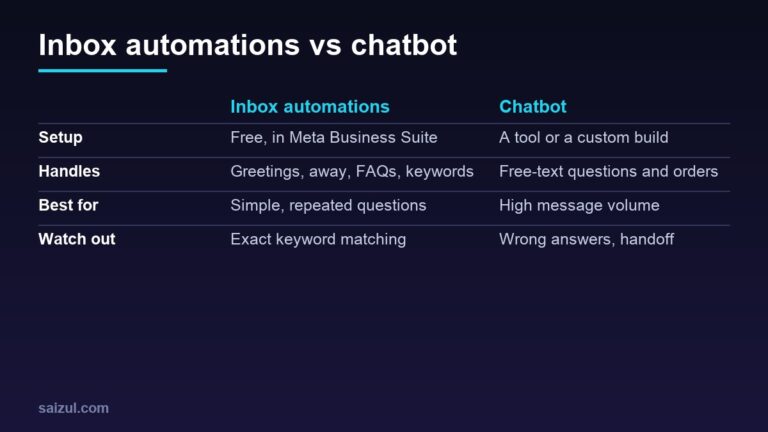
Automated greetings, away messages and answers to frequent questions can cover nights and busy sale days. Keep complaints and anything involving money with a person. If you get many repeat questions, my guide to a Messenger chatbot in Bangla explains how to automate safely, with a handoff to a human.
What to track
- Average first response time on each channel.
- The most common questions, which tell you what to add to product pages and posts.
- Complaints by cause: courier, product quality, wrong item, size.
- How many complaining customers order again. Good recovery shows up here; see customer retention strategies.
Quick checklist
- Every contact channel listed, with unused ones closed.
- Response targets written down and shared with the team.
- Quick replies saved for the ten most common questions.
- A six-step complaint process and a written returns policy.
- Delay messages sent before customers ask.
- Calm public replies, with details moved to private messages.
Need help with this on your own site or business?
I build and secure WordPress sites, web apps and AI automations end to end, in Bangla and English: a free discovery call, a written scope with a fixed quote, a focused first version, then testing, deployment and monitoring.
See the portfolio and the AI agent services, or tell me what you need.
FAQ
How fast should an online store reply to messages?
Aim for minutes during your open hours on chat channels, and use an away message after hours. Choose targets you can actually keep and measure them.
Should I use templates for customer replies?
Yes, for common questions, but always personalise them with the customer’s name and their actual question, and check facts like stock before sending.
How should I respond to a bad review?
Reply calmly and briefly in public, offer to resolve it, and move personal details to a private message. Report reviews that break the platform’s rules.
Should I refund an unhappy customer even if the courier caused the problem?
The customer bought from you, so resolve it with them according to your policy, then take the issue up with the courier separately.
Sources

Md Saizul Amin
Digital Systems Strategist · AI Agent Developer · 9+ years in digital & ITMd Saizul Amin is a digital systems strategist and AI automation engineer from Dhaka, Bangladesh. With 9+ years across IT, web development and digital marketing, he writes practical guides on technology, business, education and online growth — and builds the same kinds of systems (AI agents, websites, SEO and ad campaigns) for clients in Bangladesh, the UK and the USA.
Specialist in
Credentials & experience
- 🎓B.Sc. in Computer Science & EngineeringBangladesh University of Business & Technology (BUBT), 2017–2021
- 🤖AI Automation Engineer · Web Developer · SEO SpecialistUnique Mark Limited, Birmingham UK — 2024 to present
- 🌱IT SpecialistGreen Fund Initiative Inc., USA — 2024 to present
- 🏥Junior IT Consultant — Ministry of Health (DGHS)Built the first national Shareable Health Record website; supported 6,000+ facilities
- 🧭Head of ITWEDO Bangladesh — led IT for 50+ staff, 2021–2023