In this article
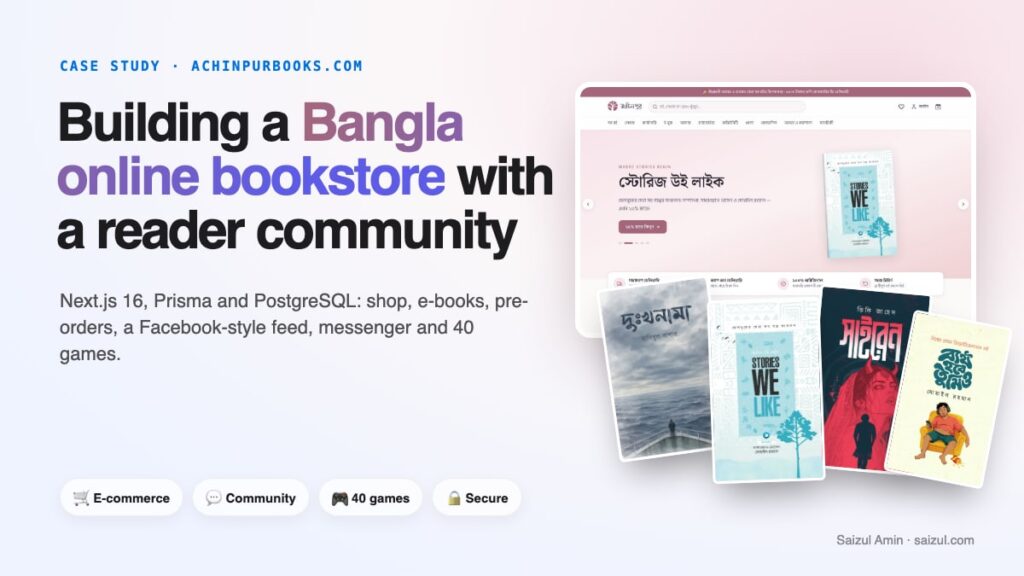
Most Bangla online bookstores look the same: a grid of covers, a cart and a checkout. Readers visit when they want to buy something, then disappear until the next book fair. When Achinpur Prokashoni asked me to build their website, they wanted something different: a bookstore that readers would open every day. The result is achinpurbooks.com, a Bangla-first store with e-books and pre-orders, plus a Facebook-style reader community, a built-in messenger and 40 Bangla games. This article explains how I built it, which technology I chose and why, what went wrong along the way, and what I would tell anyone planning an e-commerce site in Bangladesh.
From my own work: I have built shops, news portals and booking systems for clients in Bangladesh, the UK and the US. Achinpur was the first project where the brief was not “sell more books” but “give readers a reason to come back”. That one sentence shaped every technical decision below.
The project in short
- Client: Achinpur Prokashoni, a Bangladeshi publisher of fiction, humour and non-fiction.
- Live site: achinpurbooks.com, fully launched on 5 November 2026.
- My role: product design, full-stack development, server setup, security and launch, working directly with the publisher’s team.
- What it includes: a storefront for printed books and e-books, pre-orders, offers and memberships, a reader community, a messenger, 40 games and an admin panel with moderation.
- Stack: Next.js 16, React 19, TypeScript, Tailwind CSS, Prisma and PostgreSQL, deployed with Docker and Caddy on one VPS.
The visual tour, with screenshots of every part, is on the Achinpur Books case study page. This article is the build story behind it.
Why a bookstore needs a community
A publisher releases a handful of new books a year. If the website only sells, most visitors have no reason to return between releases, and every launch has to start again from zero with Facebook ads. A community changes that. Readers post what they are reading, argue about endings, follow their favourite authors and get notified when a new book is announced. The store becomes the place where the conversation happens, so when the next book opens for pre-order, the audience is already there.
That is why Achinpur Books has three parts that share one account and one database: the store, the community and the messenger, with a games section on top to bring in new people.
The technology stack, and why
For a project this size, the biggest risk is complexity: several services, several codebases and monthly bills for each. I chose a stack that keeps everything in one application.
| Layer | Choice | Why |
|---|---|---|
| Framework | Next.js 16 (App Router) | Server rendering for SEO, Server Actions instead of a separate API, and built-in caching. |
| Language | TypeScript | The same types for the database, the server and the screens, which catches mistakes before customers do. |
| Database | PostgreSQL with Prisma | Books, orders, members, posts, chats and moderation live in one relational database with versioned migrations. |
| Styling | Tailwind CSS | Fast to build a consistent, mobile-first design system. |
| Hosting | Docker Compose and Caddy on one VPS | Automatic HTTPS, simple deploys, and a predictable monthly cost with no per-user SaaS fees. |
| Extras | Web Push, sharp, Zod | Phone notifications, image processing for covers, and input validation on every server action. |
There is no paid AI service and no third-party community platform. Everything, including the games, runs on the publisher’s own server.
Building the storefront for Bangladesh
Bangla first, not Bangla translated
The whole interface is written in Bangla, with Bangla numerals for prices, counts and dates. Search works with Bangla text, and the fonts are chosen so that conjunct letters (juktakkhor) render correctly. English appears only where readers expect it, such as English book titles under the Bangla ones.
Cash on delivery first, online payment ready
Most customers in Bangladesh still prefer to pay when the parcel arrives, so the checkout is built around cash on delivery: delivery zones, gift wrap, order numbers and order tracking by number and phone. The SSLCommerz integration (bKash, Nagad and cards) is already in the code, so online payment can be switched on as soon as the merchant account is approved, without another round of development.
Offers that always add up
The publisher wanted bundles, coupons, reading coins with referrals, a free book on orders over ৳2,000 and paid memberships with their own discount. Stacking all of these naively creates prices nobody intended. I kept two clear rules: members get the member discount and nothing else, and everyone else gets the general offers. The pricing logic lives in one place on the server and runs again at checkout, so the number in the cart is always the number that is charged.
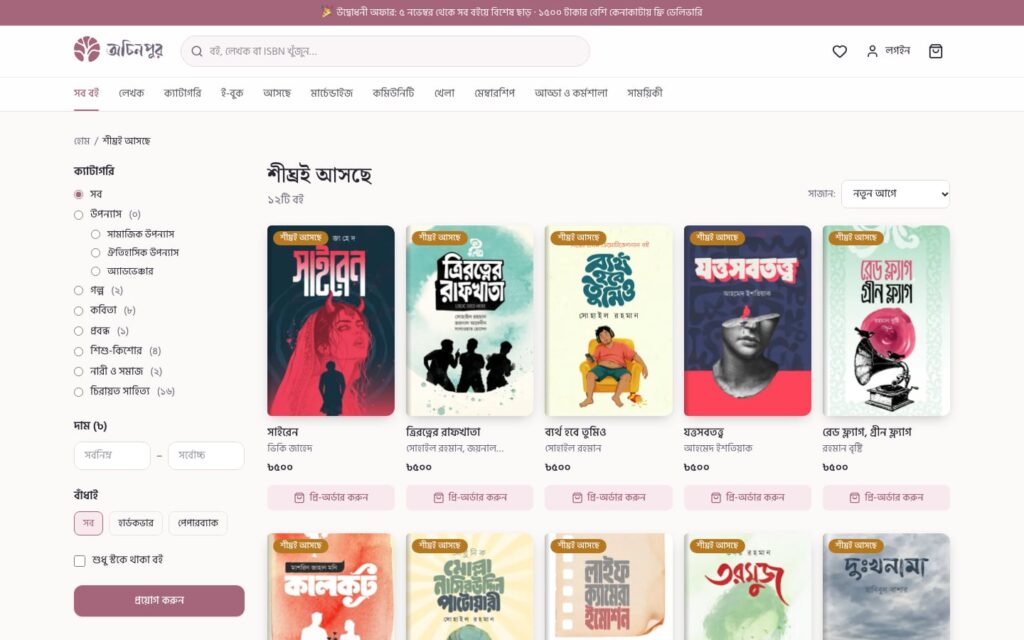
Pre-orders and “coming soon”
New titles are marked “coming soon” but can still be ordered. Each pre-ordered item is tagged in the order, on the invoice and in the admin panel, so the warehouse knows exactly what to hold until the book is printed. When the book arrives, staff untick one box and it becomes a normal title.
E-books that are hard to pirate
E-books are read online, page by page. Pages are served as watermarked images only to people who bought the book, never as a downloadable file. It is not perfect protection (nothing is), but it stops the casual “send me the PDF” sharing that hurts small publishers most.
The reader community and messenger
A feed people already know how to use
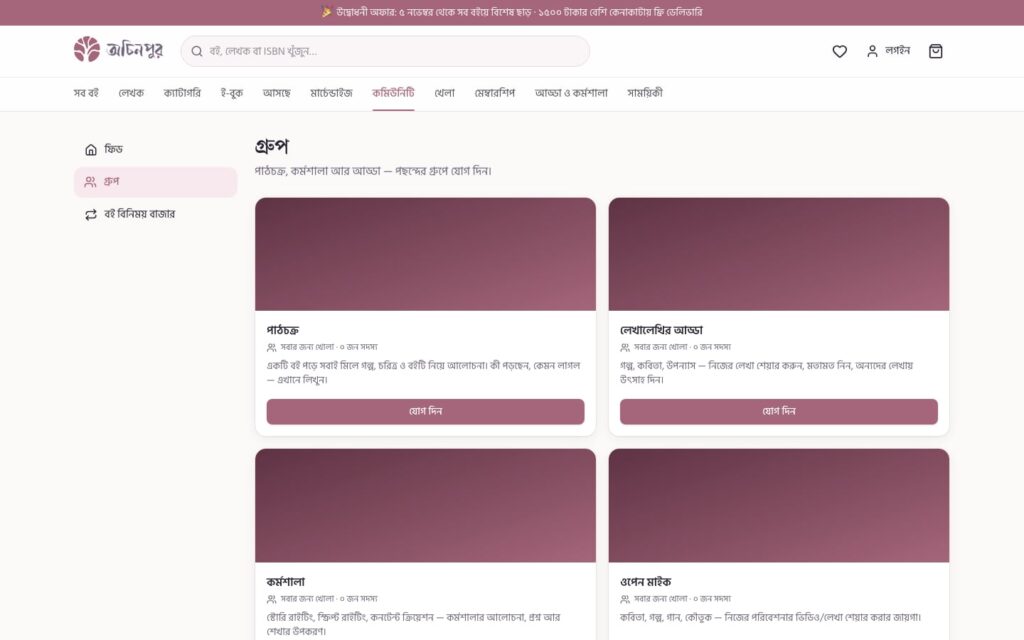
Readers already spend hours on Facebook, so the community borrows its patterns: a feed with posts, emoji reactions, comments with photos and voice notes, reshares with a caption, 24-hour stories, groups and profile hover cards. On top of that there are book-specific post types: polls, favourite quotes, “now reading” updates, a book exchange market and weekly discussion prompts.
Mentions that link to books and authors
Typing @ suggests readers, authors, books and e-books. In the post, each mention becomes a link to that profile or book page, which quietly turns conversations into product discovery. One lesson here: the first version stored mentions as a short code and showed that code in the editor and in link previews on WhatsApp. Readers found it confusing. Now the editor shows only the highlighted name, like Facebook, while the link is kept behind it, and every preview, notification and admin list shows plain names.
Notifications that do not spam
Notifications are grouped the way people expect: “Rafi and 3 others reacted to your post” instead of four separate alerts. They appear under a bell in the header and, if the reader allows it, as push notifications on the phone.
A messenger built in
Readers can message each other or create group chats, send photos, links and voice messages, mention people or everyone in a group, and unsend a message for everyone within an hour. On a computer, chats open as small windows at the bottom of the screen; on a phone, the chat takes the full screen like a messaging app, and only the messages scroll.
Games as a growth channel
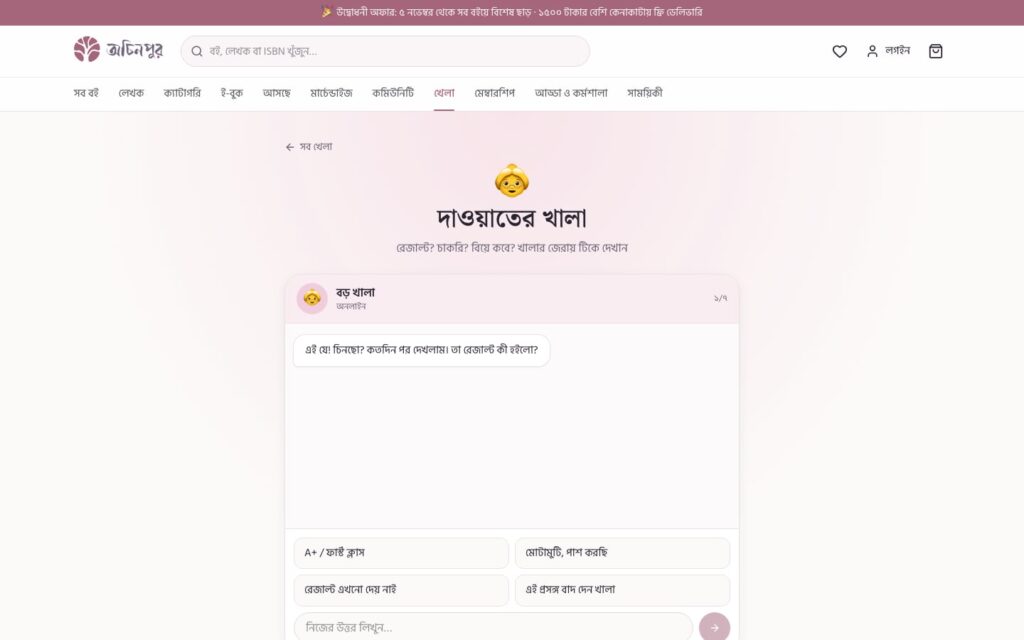
The games section, called Khela, went public before the store did. While the shop was still in maintenance mode, people were already playing and sharing. There are now 40 Bangla games: book quizzes, a daily emoji puzzle, a memory game and a set of chat-style roast games where characters like a nosy aunt at a wedding, a matchmaker or a rickshaw driver question you and react to every answer, even ones you type yourself. Every game ends with a result image drawn in the browser, sized for Facebook.
No paid AI is involved. Results come from rules and the player’s own answers, which keeps the running cost at zero and makes the games fast on low-end phones. Shared result images carry the site address, so every share is a small free advert.
An admin panel the team can actually use
A small team runs the whole site, so the admin panel has to cover everything without code: books and e-books, authors, stock, the pre-order switch, discounts by percent or by fixed price, orders and invoices, hero slides with book covers, a page builder, blog posts, events, polls, bundles and coupons. Staff accounts have roles, so a fulfilment person sees orders but not settings.
Community moderation is built in. When someone reports a post or a profile, the super admin gets a notification. Staff can warn a user, mute specific actions such as posting, commenting, reacting or messaging for a set number of days, hide a profile or ban an account, and the user sees exactly what applies to them, and why, on a profile status page.
Security before launch
Before the full launch I ran a security review of every server action and route. It found real issues, which is the point of doing it:
- Query injection through server actions: an action that expected an ID could be sent an object instead, which the database layer read as a filter. Every action now rejects unexpected input types before touching the database.
- Ticket exposure: booking an event with someone else’s phone number could reveal their ticket. Duplicate bookings now show a generic message unless the ticket belongs to you.
- Open redirect after login: a crafted link could send someone to another site after signing in. Redirects now accept only paths on the same site.
- Private media: chat photos and voice messages are now served only to members of that conversation, and disappear when unsent.
Around that sit the usual layers: a strict Content Security Policy and other security headers, rate limits on logins and codes, session versioning so staff can sign everyone out, nightly database and file backups, and a maintenance mode that staff can bypass with a secret cookie.
Hosting, speed and SEO
The site runs as Docker containers behind Caddy on a single VPS, with automatic HTTPS and a Cloudflare CDN ready to put in front. Pages are rendered on the server and cached by tag, so a book page is fast for everyone and updates as soon as the admin changes a price. Covers are converted to WebP, with small thumbnails for lists.
For search engines, every book page includes structured data for the book, its price and its availability, including pre-order. There is a sitemap, sensible robots rules, Open Graph images for sharing, and private pages such as the cart and account are kept out of search and out of shared caches.
One operational lesson: frequent deploys quietly filled the server disk with old Docker build cache, about 27 GB of it, within a few weeks. A weekly cleanup job now keeps the cache small, alongside the nightly backup.
What I learned
- Ship the fun part first. Opening the games before the store built an audience and real feedback while the shop was still being polished.
- Keep one codebase. A single Next.js app with one database made it possible for one developer to ship store, community and chat features in days, not months.
- Design for the phone first. Most visitors arrive from Facebook on a phone. Bottom navigation, sticky buy buttons and a full-screen chat matter more than desktop polish.
- Audit before you launch. The security review found issues that normal testing never would have.
- Make payments switchable. Building SSLCommerz in from the start means online payment is a settings change, not a new project.
FAQ
How long does it take to build a site like Achinpur Books?
The storefront and admin were usable within the first weeks, and the full platform with community, messenger and games launched on 5 November 2026. A simpler store without the community can be ready much faster; the timeline depends mainly on how many features you need on day one.
Why Next.js instead of WordPress and WooCommerce?
WooCommerce is a good choice for a standard shop. Achinpur needed a real-time community, a messenger, games and custom offer rules, which would have meant many plugins fighting each other. One custom Next.js application was simpler, faster and cheaper to run.
Can customers pay with bKash or Nagad?
The checkout is built for SSLCommerz, which covers bKash, Nagad and cards. At launch the publisher started with cash on delivery, and online payment can be switched on once the merchant account is ready.
Is the site fully in Bangla?
Yes. The interface, numbers and dates are in Bangla, search works with Bangla text, and the design was tested on low-cost phones.
Does the community need a separate app?
No. The community and messenger are part of the website, and the site can be installed on a phone’s home screen like an app, with push notifications.
Can you build something similar for my business?
Yes. I build custom e-commerce sites, communities and web apps for businesses in Bangladesh, the UK and the US. Send me a short brief and I will reply with a plan and an estimate.
See every screen on the Achinpur Books case study, browse my other work in the portfolio, or visit the live site at achinpurbooks.com.

Md Saizul Amin
Digital Systems Strategist · AI Agent Developer · 9+ years in digital & ITMd Saizul Amin is a digital systems strategist and AI automation engineer from Dhaka, Bangladesh. With 9+ years across IT, web development and digital marketing, he writes practical guides on technology, business, education and online growth — and builds the same kinds of systems (AI agents, websites, SEO and ad campaigns) for clients in Bangladesh, the UK and the USA.
Specialist in
Credentials & experience
- 🎓B.Sc. in Computer Science & EngineeringBangladesh University of Business & Technology (BUBT), 2017–2021
- 🤖AI Automation Engineer · Web Developer · SEO SpecialistUnique Mark Limited, Birmingham UK — 2024 to present
- 🌱IT SpecialistGreen Fund Initiative Inc., USA — 2024 to present
- 🏥Junior IT Consultant — Ministry of Health (DGHS)Built the first national Shareable Health Record website; supported 6,000+ facilities
- 🧭Head of ITWEDO Bangladesh — led IT for 50+ staff, 2021–2023