In this article
In Bangladesh, a huge number of small businesses sell entirely through a Facebook page. Customers see a post, send a message, agree a price and the parcel goes out by courier. It works, it costs almost nothing to start, and many sellers wonder whether they need a website at all. Others build a website too early, spend money on it and then get no visitors. Both mistakes are common. The honest answer is that the right choice depends on your stage, your products and how much you want to depend on one platform. This guide compares the two plainly and suggests a path that suits most small sellers.
From my own work: Many of the website projects I take on come from sellers who already do well on Facebook. They are rarely leaving Facebook. They want a place for their full catalogue, a way to take orders without answering every message by hand, and something that still works if their page has a bad week.
What we mean by a “Facebook shop”
People use the phrase in two ways, and it matters which one you mean:
- Selling through a Facebook page, often called f-commerce: you post products, buyers message you, and you take orders in Messenger or WhatsApp. This is what most Bangladeshi sellers do.
- Meta’s Shops feature: a catalogue on Facebook and Instagram that sends buyers to a checkout. Meta says Shops are only available to businesses located in supported countries, and when I checked its list in November 2026 Bangladesh was not on it (supported countries for Shops). Meta also says that since September 2025, Shops use website checkout, meaning customers are directed to your own website to complete the purchase (changes to Shops and checkout).
So even where Shops are available, they now assume you have a website. For a seller in Bangladesh, the real comparison is a Facebook page with message orders versus your own website, or both. My Instagram shop setup guide covers Shops in more detail.
What a Facebook page does well
- Fast and free to start. You can open a page and post products today.
- Your buyers are already there. People scroll Facebook every day; you do not need to make them visit somewhere new.
- Conversation sells. Many buyers want to ask about size, colour or delivery before ordering, and Messenger makes that easy.
- Good for testing. You can see which products get interest before investing in stock or a website.
- Video and Reels can reach people who do not follow you yet. See how to grow a Facebook business page.
Where a Facebook page falls short
- You do not control it. Reach, features and policies are decided by Meta and can change. A restricted page or a hacked account can stop sales overnight.
- Products get buried. Older posts disappear down the timeline, and buyers cannot easily browse your full range by category, size or price.
- Ordering is manual. Every order needs messages back and forth, which takes staff time and causes mistakes as you grow.
- Little presence on Google. People who search Google for a product are unlikely to find a specific post on your page.
- Trust for bigger orders. Some buyers, especially for higher prices, want to see a proper website with policies, contact details and a real address.
What your own website does well
- You own it. Your domain, your content and your customer list stay yours, whatever happens to any one platform. See how to choose a domain name.
- A full catalogue. Categories, filters, search and stock levels let buyers find what they want without asking.
- Orders without the back and forth. A cart and checkout take the name, address and phone number in a consistent format, show the delivery charge and can take online payments. See accepting online payments in Bangladesh.
- Found on Google. Product and category pages can appear in search results for what people type. Google says it primarily finds pages through links from pages it has already crawled, and that some changes take effect in a few hours while others can take several months (SEO Starter Guide). Search traffic builds slowly, but it does not stop when you stop paying for ads.
- Better tracking. You can see which products, pages and ads lead to orders; see Google Analytics 4 for beginners.
Where a website falls short
- It costs money and time to build and maintain: domain, hosting, design, updates and security. See what a small business website costs and the website maintenance checklist.
- Nobody comes automatically. A new website has no visitors until you send them there through social media, ads, search or messages.
- You still need to answer questions. A website reduces messages but does not remove them.
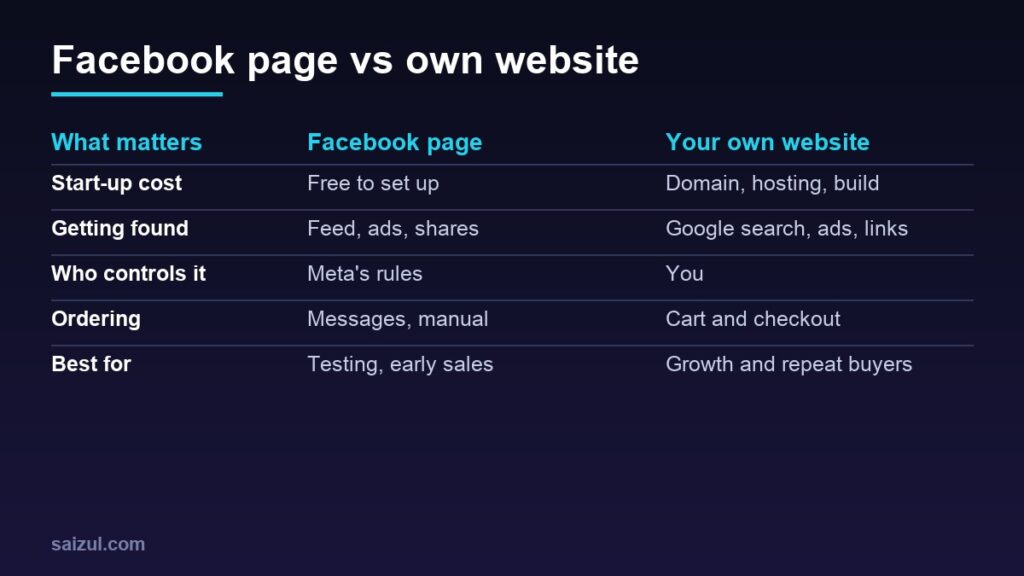
Side by side
| Question | Facebook page | Your own website |
|---|---|---|
| Cost to start | Free, plus any ads | Domain, hosting and build, plus ongoing upkeep |
| Who sets the rules | Meta | You, within the law and your payment providers’ rules |
| How buyers find you | Feed, Reels, shares, ads | Google search, ads, links from social media and messages |
| How orders arrive | Messages, typed by hand | Checkout with consistent details |
| Browsing many products | Hard beyond a few dozen | Easy with categories and filters |
| Customer data | Mostly inside Meta’s apps | In your own order system |
Which one do you need right now?
Start with a Facebook page if
- You are testing a product idea and do not know yet what will sell.
- You have a small range, under a few dozen products.
- You can personally answer messages quickly.
- Your budget is very tight.
Add a website if
- You regularly get more messages than you can answer well.
- You have more products than buyers can find by scrolling.
- Customers ask for your website, or you lose larger orders on trust.
- You want to appear on Google for the products you sell.
- You want to take online payments or run Google Shopping ads. See the Merchant Center setup guide.
- You want a backup in case something happens to your page.
The path that suits most small sellers: both, in order
- Start on Facebook and prove that people buy. Keep a simple sheet of orders, best sellers and questions.
- Register your domain early, even before you build the site, and set up a business email.
- Build a simple store when message volume or range demands it. Start with your best sellers, clear categories, delivery and returns pages. WooCommerce vs Shopify helps you choose a platform.
- Link them together. Put the website in your page’s contact details and pinned post, and link posts and ads to the matching product page.
- Keep Facebook for discovery and conversation, and let the website handle browsing, ordering and payment.
- Bring buyers back through WhatsApp or email, which you control, rather than relying only on page reach. See customer retention strategies.
If you are just starting out, my guide to starting an e-commerce business in Bangladesh covers the wider setup, including marketplaces such as Daraz.
Common mistakes
- Building an expensive website before testing whether the products sell.
- Running a busy shop on one Facebook page with no backup.
- Launching a website and never linking to it from the page or ads.
- Letting a developer register the domain in their own name.
- Using a website only as a catalogue, while still taking every order by hand.
- Trying to get around Shops country rules by choosing a country you do not operate in.
Quick checklist
- Your stage is clear: testing, growing or established.
- A Facebook page with complete details, a pinned post on how to order and quick replies.
- Your domain registered in your own name.
- A website planned once messages, range or trust demand it.
- Posts and ads linking to the matching product page.
- Delivery, returns and contact pages on the website.
- A customer list on WhatsApp or email that you control.
Need help with this on your own site or business?
I build and secure WordPress sites, web apps and AI automations end to end, in Bangla and English: a free discovery call, a written scope with a fixed quote, a focused first version, then testing, deployment and monitoring.
See the portfolio and the AI agent services, or tell me what you need.
FAQ
Can I sell online in Bangladesh without a website?
Yes. Many small sellers sell only through a Facebook page and Messenger or WhatsApp. A website becomes more useful as your range, order volume and need for trust grow.
Is Facebook Shops available in Bangladesh?
When I checked Meta’s supported countries list in November 2026, Bangladesh was not included. Meta updates the list, so check its help page for the current position.
Will a website get me more sales than Facebook?
Not on its own. A website needs visitors from social media, ads, search or messages. Its value is in easier ordering, a full catalogue, search visibility and ownership, which help sales grow over time.
Should I stop posting on Facebook once I have a website?
No. For most sellers, Facebook stays the main place for discovery and conversation. Use it to send people to the right product pages on your website.
Sources

Md Saizul Amin
Digital Systems Strategist · AI Agent Developer · 9+ years in digital & ITMd Saizul Amin is a digital systems strategist and AI automation engineer from Dhaka, Bangladesh. With 9+ years across IT, web development and digital marketing, he writes practical guides on technology, business, education and online growth — and builds the same kinds of systems (AI agents, websites, SEO and ad campaigns) for clients in Bangladesh, the UK and the USA.
Specialist in
Credentials & experience
- 🎓B.Sc. in Computer Science & EngineeringBangladesh University of Business & Technology (BUBT), 2017–2021
- 🤖AI Automation Engineer · Web Developer · SEO SpecialistUnique Mark Limited, Birmingham UK — 2024 to present
- 🌱IT SpecialistGreen Fund Initiative Inc., USA — 2024 to present
- 🏥Junior IT Consultant — Ministry of Health (DGHS)Built the first national Shareable Health Record website; supported 6,000+ facilities
- 🧭Head of ITWEDO Bangladesh — led IT for 50+ staff, 2021–2023