In this article
Brand identity sounds like something for big companies with design agencies. For a small business, it is much simpler: it is how people recognise you and remember you. The name on the parcel, the logo on your Facebook page, the colours on your website, the way you reply to a message. When these are consistent, a customer who saw your post last week recognises your ad today, and a buyer who received a parcel remembers where to order again. When they are not, every touchpoint looks like a different shop. This guide shows how to build a simple, consistent identity without a large budget, and how to avoid the legal and practical problems that catch many small businesses later.
From my own work: When I build websites for small businesses, I often receive the logo as a single low-resolution image taken from a Facebook profile photo, with no colour codes and no fonts. We can always make it work, but having the files and a few simple rules ready saves time on every design job that follows.
What brand identity includes for a small business
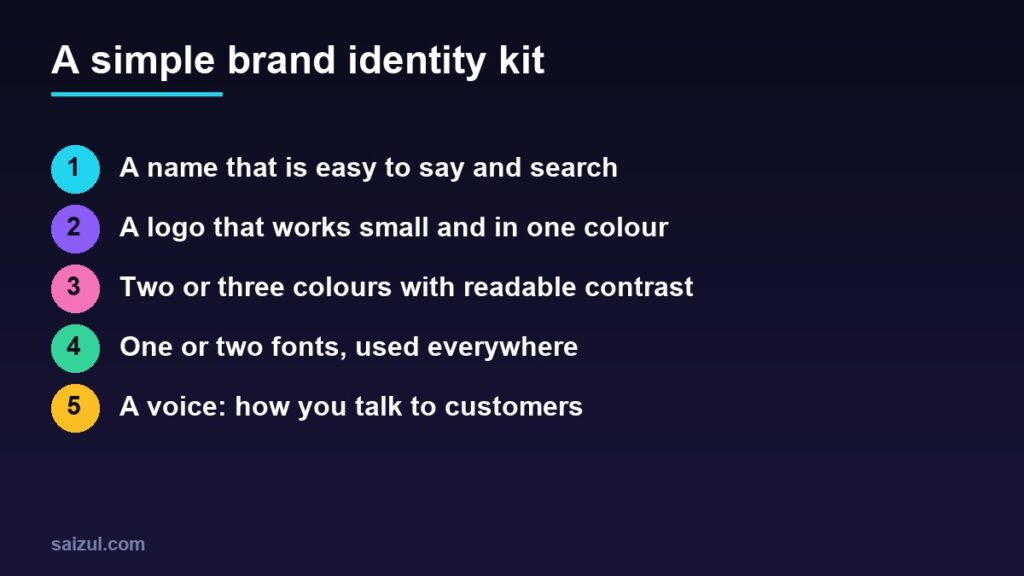
- Name: what you are called, and the domain and social handles that go with it.
- Logo: a mark that identifies you, in a few versions for different uses.
- Colours: a small palette you use everywhere.
- Fonts: one or two typefaces for headings and text.
- Voice: how you write and speak to customers.
- Applications: how all of this looks on packaging, posts, your website and invoices.
Your brand is also what you promise and deliver: product quality, delivery speed and how you treat customers. Identity only helps people recognise you. The experience is what makes them come back.
Step 1: Choose a name and check it
What makes a good name
- Easy to say, spell and remember, in both Bangla and English if your customers use both.
- Short enough for a domain, a social handle and a small label.
- Not so narrow that it limits you later. “Dhaka Cotton Kurti” is hard to stretch if you start selling bags.
- Different enough from competitors that buyers do not confuse you.
Check before you commit
- Search Google, Facebook, Instagram and marketplaces for the name and close spellings. If another business in your field uses it, choose again.
- Check the domain and handles. See how to choose a domain name. Register the domain in your own name as soon as you decide.
- Check trademarks. WIPO describes a trademark as a sign capable of distinguishing the goods or services of one enterprise from those of others, and says that at the national or regional level, protection can be obtained through registration with the relevant trademark office (WIPO trademarks). WIPO’s Global Brand Database lets you search millions of trademark records from many countries.
- In Bangladesh, trademarks are handled by the Department of Patents, Designs and Trademarks, whose website lists trademark forms and online services (DPDT). If you plan to invest seriously in the name, check the current process there or ask a trademark agent or lawyer.
Changing a name after a year of building followers, reviews and packaging is far more expensive than spending an afternoon checking it first.
Step 2: Get a logo that works everywhere
Most of the time, your logo is seen small: a profile photo on a phone, a favicon in a browser tab, a sticker on a parcel. Design for that first.
- Keep it simple. One clear shape or a well-set wordmark. Fine detail disappears when small.
- Test it in one colour, black on white and white on a dark background. If it only works in full colour, it will fail on stamps, receipts and embroidery.
- Make it readable at the size of a profile picture.
- Get the right versions: a full logo, a square or round version for social profiles, and a small icon.
- Get the right files: a vector file such as SVG, AI or PDF for printing and scaling, plus PNG files with transparent backgrounds for everyday use.
- Own it. If you hire a designer, agree in writing that you own the final logo and receive the source files. Avoid logos copied from templates that thousands of others use.
If you design it yourself, a free design tool is enough to start; see my note on the best free Canva alternative. A simple, clean logo used consistently is better than an elaborate one that changes every few months.
Step 3: Pick a small colour palette
- One main colour that people will associate with you.
- One accent colour for buttons, offers and highlights.
- Neutrals for text and backgrounds: a dark grey or near-black, white and a light grey.
Write down the exact codes, such as HEX values for screens and CMYK for print, so every designer and printer uses the same colours.
Make sure text stays readable. The W3C’s accessibility guidelines set a minimum contrast ratio of 4.5:1 for normal text and 3:1 for large text, which they define as at least 18 point, or 14 point bold (contrast minimum). Free online contrast checkers will tell you whether your text colour on your background colour passes. Bright yellow text on white, or light grey on light pink, usually fails, and customers on phones in sunlight will struggle to read it.
Step 4: Choose one or two fonts
- One font for headings and one for body text is enough; many small brands use one font family in different weights.
- Choose fonts that are easy to read on a phone.
- If you publish in Bangla, choose a Bangla font that pairs well with your English font and renders properly on websites and phones.
- Check the licence. Free, openly licensed fonts are widely available and safe for websites and print.
- Use the same fonts on your website, posts, price lists and packaging.
Step 5: Define your voice
Voice is how your business sounds in captions, product descriptions, replies and packaging inserts. Pick three words that describe it, and one thing you are not. For example:
| Brand | Voice is | Voice is not |
|---|---|---|
| Handmade jewellery | Warm, personal, careful | Pushy or loud |
| Electronics accessories | Clear, factual, helpful | Full of jargon |
| Kids’ clothing | Friendly, reassuring, practical | Childish or careless about safety |
- Decide whether you write mainly in Bangla, English or both, and how formal you are: আপনি or তুমি, “Dear customer” or first names.
- Write a few sample replies for common questions, so everyone on your team sounds the same. See customer service for online stores.
- Use the same voice in product descriptions; see product descriptions that sell.
Step 6: Apply it everywhere
- Social profiles: the same name, logo version and cover style on Facebook, Instagram and WhatsApp Business. See how to grow a Facebook business page.
- Website: logo, colours and fonts in the theme settings, not added by hand on each page.
- Google Business Profile: the same name and logo; see Business Profile optimization.
- Packaging and inserts: a sticker, a thank-you card or a printed bag is often the moment buyers remember most.
- Photos: a consistent background and light make your posts recognisable; see product photography with a smartphone.
- Templates: a few post templates for offers, new arrivals and announcements, so you are not designing from scratch each time.
Step 7: Write a one-page brand guide
Put everything on one page, or one shared document, and give it to anyone who designs, posts or prints for you:
- Name, and how it is written: capitals, spacing, Bangla spelling.
- Logo versions, file links and what not to do: no stretching, no new colours, no busy backgrounds.
- Colour codes for screen and print.
- Fonts and where to download them.
- Voice: three words, one “not”, and a few sample sentences.
- Examples of a good post, a product photo and a package.
Common mistakes
- Choosing a name without checking social handles, domain and trademarks.
- A detailed logo that cannot be read at profile-picture size.
- Only having the logo as a low-resolution image.
- Too many colours and fonts, used differently on every post.
- Light text on light backgrounds that customers cannot read.
- A different tone from every person who replies to messages.
- Redesigning the logo often instead of building recognition.
Quick checklist
- A name checked on search, social media, domain and trademark databases.
- Domain and handles registered in your own name.
- A simple logo in full, square and icon versions, with vector and PNG files.
- A small palette with exact codes, checked for readable contrast.
- One or two licensed fonts, including Bangla if needed.
- Three words for your voice and sample replies.
- The kit applied to social profiles, website, packaging and templates.
- A one-page brand guide shared with everyone who works on it.
Need help with this on your own site or business?
I build and secure WordPress sites, web apps and AI automations end to end, in Bangla and English: a free discovery call, a written scope with a fixed quote, a focused first version, then testing, deployment and monitoring.
See the portfolio and the AI agent services, or tell me what you need.
FAQ
How much should a small business spend on brand identity?
It depends on your stage. Many small businesses start with a simple logo and kit made with free tools or a modest designer budget, then invest more once the business is proven. Consistency matters more than spending.
Do I need to register a trademark for my business name?
It is not required to start trading, but registration gives stronger protection if you invest in the name. In Bangladesh, trademarks are handled by the Department of Patents, Designs and Trademarks. Check the current process or ask a trademark professional.
What logo files should I get from a designer?
A vector file such as SVG, AI or PDF, plus PNG files with transparent backgrounds, in full colour, black and white versions, and a square version for social media profiles. Ask for the colour codes and font names too.
How do I keep my brand consistent with a small team?
Write a one-page brand guide, make templates for common posts, save logo and font files in one shared folder, and keep a few sample replies so everyone writes in the same voice.
Sources

Md Saizul Amin
Digital Systems Strategist · AI Agent Developer · 9+ years in digital & ITMd Saizul Amin is a digital systems strategist and AI automation engineer from Dhaka, Bangladesh. With 9+ years across IT, web development and digital marketing, he writes practical guides on technology, business, education and online growth — and builds the same kinds of systems (AI agents, websites, SEO and ad campaigns) for clients in Bangladesh, the UK and the USA.
Specialist in
Credentials & experience
- 🎓B.Sc. in Computer Science & EngineeringBangladesh University of Business & Technology (BUBT), 2017–2021
- 🤖AI Automation Engineer · Web Developer · SEO SpecialistUnique Mark Limited, Birmingham UK — 2024 to present
- 🌱IT SpecialistGreen Fund Initiative Inc., USA — 2024 to present
- 🏥Junior IT Consultant — Ministry of Health (DGHS)Built the first national Shareable Health Record website; supported 6,000+ facilities
- 🧭Head of ITWEDO Bangladesh — led IT for 50+ staff, 2021–2023