In this article
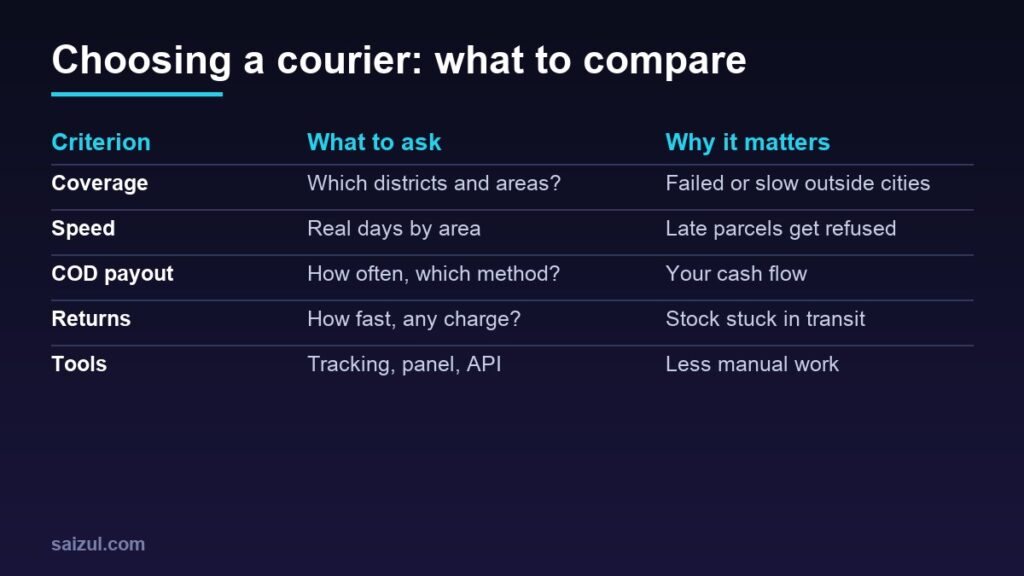
For an online shop in Bangladesh, the courier is part of your product. The customer does not see your warehouse or your supplier. They see whether the parcel arrived on time, whether the rider was polite and whether it arrived in one piece. For cash on delivery orders, the courier also holds your money until it pays you. Yet many sellers choose a courier on one thing only: the delivery charge per parcel. A cheaper rate is no saving if parcels arrive late, returns take weeks to come back or payouts are slow and hard to reconcile. This guide sets out the criteria worth comparing, the questions to ask, and how to test a courier before you commit.
From my own work: When sellers I work with have delivery problems, switching courier is not always the answer. Sometimes the courier is fine in Dhaka and weak in one region, and the better fix is to use two couriers, each where it performs best. That only becomes clear once you compare real results by area.
This guide does not list prices. Rates change often and depend on weight, area, volume and your agreement, so get current rates directly from each courier. Use the criteria below to compare what you get for the money.
1. Coverage: where they really deliver
- Ask which districts, upazilas and areas they deliver to, and which they deliver to through a partner or a pickup point instead of to the door.
- Check the areas where most of your customers are, not just the national claim. Steadfast’s website, for example, lists coverage of 64 districts, 495 upazilas and 330 municipalities (Steadfast services), and Pathao Courier says it offers home delivery in 64 districts (Pathao Courier). Claims like these tell you the network’s reach; your own trial tells you how well it works in your customers’ areas.
- Ask about hard-to-reach areas and whether those have longer delivery times or extra charges.
2. Delivery speed and reliability
- Ask for typical delivery times inside your city, to other cities and to rural areas, and how they handle delays.
- Ask whether same-day or next-day delivery is available in your city, and the cut-off time. Pathao’s site, for instance, says same-day collection and delivery is available in Dhaka metropolitan areas only, for entries made before 12:00 PM (Pathao Courier).
- Ask how many delivery attempts the rider makes and whether the customer can reschedule.
- During your trial, record the real days from pickup to delivery by area. Slow delivery increases refused cash on delivery parcels, because buyers change their minds.
3. Pickup and drop-off
- Do they pick up from your location, how often and at what times? Is there a minimum number of parcels?
- Can you drop parcels at a hub if you miss pickup?
- Do riders scan parcels at pickup so you have proof of handover?
Steadfast’s site, for example, advertises daily pickup from the seller’s location with each parcel scanned out (Steadfast services). Whatever a courier advertises, confirm the actual pickup time for your address.
4. Cash on delivery collection and payouts
For most Bangladeshi online shops, this is the most important criterion after delivery itself. The courier collects cash from your buyers and pays you later, minus its charges.
- Payout frequency: daily, a few times a week, weekly or on request? Faster payouts mean less of your money sits with the courier.
- Payout methods: bank account, mobile financial services such as bKash, or both. Pathao’s site describes payouts to a bank account or a personal bKash account, with automatic daily payouts and on-demand withdrawals through its InstaPay service (Pathao Courier). Steadfast’s site describes next-day payouts to a bank account (Steadfast services).
- COD charge: whether a separate fee applies to cash collected, and how it is calculated.
- Statements: can you download a payout statement that lists each consignment, the amount collected and the charges? Without it, reconciliation is guesswork.
My guide to cash on delivery management shows how to reconcile courier payouts every week.
5. Returns and exchanges
- How quickly do refused or returned parcels come back to you? Stock in transit cannot be sold.
- Is there a return charge, and does it differ by area? Pathao’s site, for example, mentions a return charge outside Dhaka (Pathao Courier).
- Do they offer exchange deliveries, where the rider delivers a new item and collects the old one?
- Can you see the reason for each failed delivery in the panel?
- How do they handle a returned parcel that arrives damaged or opened?
Write your own returns rules to match what the courier can actually do; see returns and refunds policy.
6. Tracking and customer updates
- Does the customer receive SMS updates and a tracking link without needing an account?
- Can you see live status for every parcel in a merchant panel or app?
- Can you share tracking links in your WhatsApp or Messenger confirmation? See WhatsApp Business for e-commerce.
Clear tracking reduces “where is my parcel?” messages, which saves your team time; see customer service for online stores.
7. Integration with your shop
- If you have a website, ask whether the courier offers an API or a plugin for your platform, so orders can be sent to the courier and status can come back automatically. Steadfast’s site mentions an API and plugins for this (Steadfast services). For other couriers, ask directly.
- Check whether you can bulk upload orders from a spreadsheet if you do not have a website.
- Ask whether labels can be printed from the panel.
- If you plan to switch platforms later, see WooCommerce vs Shopify and confirm the courier supports both.
8. Packaging rules, damage and lost parcels
- Ask about weight and size limits and how volumetric weight is calculated.
- Ask what they will not carry, such as liquids, fragile items or certain categories.
- Ask how claims work for lost or damaged parcels: how to report, by when, what proof they need and what they pay.
- Get these terms in writing, from the merchant agreement or the courier’s official terms.
9. Support and account management
- Is there a named contact or a merchant support line, and what hours is it open?
- How fast are complaints and payout disputes resolved?
- Do they have a plan for festival peaks such as Eid, with extra pickups and published cut-off dates? See Eid marketing for online shops.
Step by step: run a two-week trial
- Shortlist two or three couriers that cover your main areas.
- Open merchant accounts and read each one’s terms on payouts, returns and claims.
- Split your orders for two weeks, sending similar parcels to similar areas through each.
- Record for each parcel: pickup date, delivery date, result, return date if returned and payout date.
- Compare delivery success rate, average days to delivery by area, days to payout and days for returns to come back.
- Note how each handled questions and problems.
- Choose a main courier, and consider keeping a second for areas or situations where it performs better.
Common mistakes
- Choosing on the delivery charge alone.
- Trusting national coverage claims without testing your customers’ areas.
- Not reading the terms for returns, claims and payouts.
- Never reconciling payout statements.
- Depending on one courier with no backup during festival peaks.
- Typing every order by hand when an integration or bulk upload is available.
Quick checklist
- Coverage confirmed for the areas where most of your customers are.
- Real delivery times measured by area during a trial.
- Pickup times, cut-offs and proof of handover confirmed.
- Payout frequency, methods, COD charges and statements understood.
- Return speed, return charges and exchange options checked.
- Customer tracking and a merchant panel that shows failure reasons.
- API, plugin or bulk upload options for your shop.
- Written terms for damage, loss and claims.
- A main courier and a backup.
Need help with this on your own site or business?
I build and secure WordPress sites, web apps and AI automations end to end, in Bangla and English: a free discovery call, a written scope with a fixed quote, a focused first version, then testing, deployment and monitoring.
See the portfolio and the AI agent services, or tell me what you need.
FAQ
Which is the best courier service in Bangladesh for an online shop?
There is no single best one for every shop. The best choice depends on where your customers are, your parcel types and volume, and how each courier performs on delivery speed, payouts and returns. A short trial with two or three couriers gives you real answers.
Should I use more than one courier?
Many shops do. A main courier keeps things simple, and a second one gives you a backup for busy seasons or areas where the first performs poorly.
How often do couriers pay cash on delivery money?
It depends on the courier and your agreement. Some advertise daily or next-day payouts, and some offer on-demand withdrawals. Check the current terms on the courier’s own website and in your merchant agreement.
Can a courier connect to my WooCommerce store?
Some Bangladeshi couriers offer an API or plugins to send orders and receive status updates automatically. Ask each courier what it supports for your platform before you sign up.
Sources

Md Saizul Amin
Digital Systems Strategist · AI Agent Developer · 9+ years in digital & ITMd Saizul Amin is a digital systems strategist and AI automation engineer from Dhaka, Bangladesh. With 9+ years across IT, web development and digital marketing, he writes practical guides on technology, business, education and online growth — and builds the same kinds of systems (AI agents, websites, SEO and ad campaigns) for clients in Bangladesh, the UK and the USA.
Specialist in
Credentials & experience
- 🎓B.Sc. in Computer Science & EngineeringBangladesh University of Business & Technology (BUBT), 2017–2021
- 🤖AI Automation Engineer · Web Developer · SEO SpecialistUnique Mark Limited, Birmingham UK — 2024 to present
- 🌱IT SpecialistGreen Fund Initiative Inc., USA — 2024 to present
- 🏥Junior IT Consultant — Ministry of Health (DGHS)Built the first national Shareable Health Record website; supported 6,000+ facilities
- 🧭Head of ITWEDO Bangladesh — led IT for 50+ staff, 2021–2023