In this article
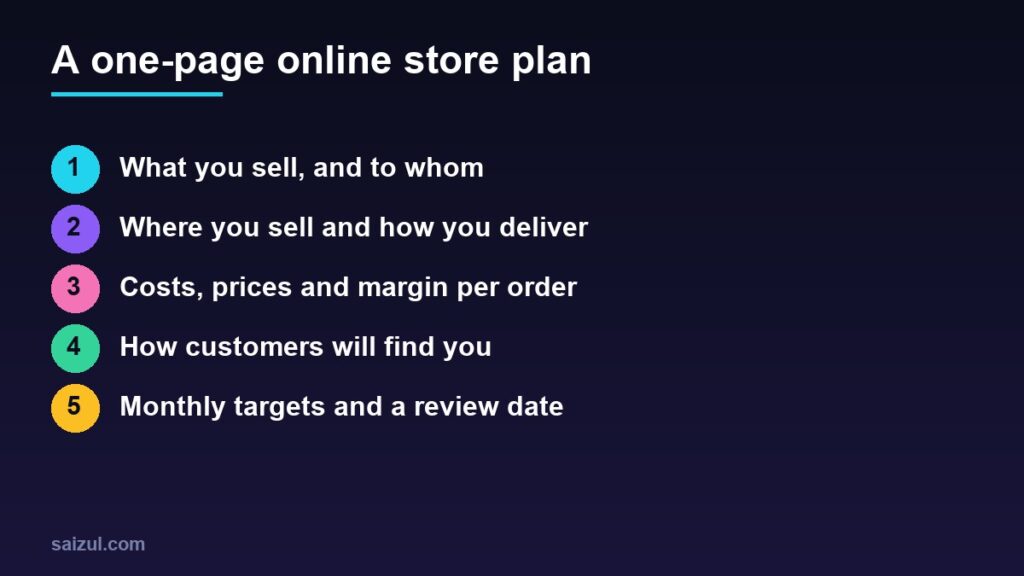
Most people who start an online store skip the business plan. They picture a thick document for bank managers and investors, full of market research and five-year forecasts, and they would rather spend the time sourcing stock and posting on Facebook. But a plan for a small online store does not need to be long. It needs to answer a few hard questions honestly: who will buy, why from you, what each order really costs, how buyers will find you and what you will do if sales are slow. This guide gives a simple structure you can fill in on one or two pages and then use every month, not file away.
From my own work: When a new store owner asks me to build their website, I usually ask a few planning questions first: what the best-selling product will be, what a typical order is worth and how they expect to get the first hundred visitors. The owners who have thought about those answers tend to get far more out of the website, whatever its budget.
Why a small online store needs a plan
GOV.UK describes a business plan as a written document that describes your business, and says it can help you clarify your idea, spot potential problems, set out your goals and measure your progress (write a business plan). For a small online store, those last two matter most. A plan turns “let’s see how it goes” into targets you can check, so you can tell early whether a product, a price or a sales channel is working.
- It forces you to do the maths before you buy stock, not after.
- It keeps you focused on a small range and one or two channels, instead of trying everything at once.
- It helps if you need money from a bank, a partner or family, because it shows you have thought it through.
- It gives you a baseline to compare against every month.
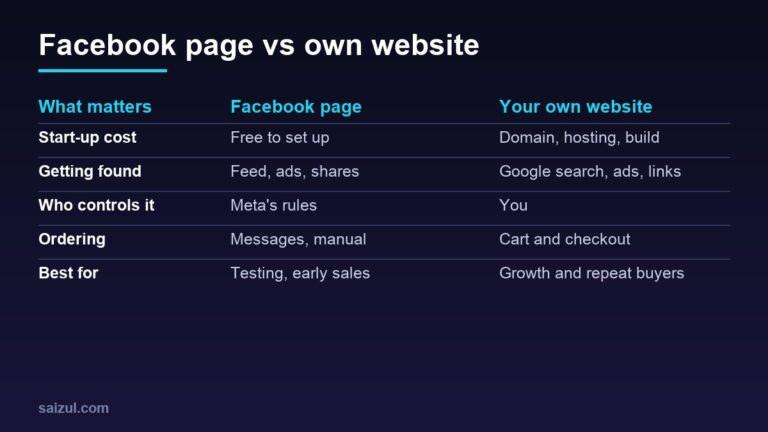
If you have not decided yet whether to sell through Facebook, a marketplace or your own site, start with my guide on how to start an e-commerce business in Bangladesh. This article is the next step: writing the plan down.
Section 1: A short summary (write it last)
business.gov.au advises writing the summary last and keeping it short, covering your business, your market, your goals and what sets you apart (develop your business plan). For an online store, three or four sentences are enough:
- What you sell and the price range.
- Who buys it and where they are.
- Where you sell: Facebook and WhatsApp, a marketplace, your own website, or a mix.
- Your main goal for the next six or twelve months.
Section 2: Products and customers
Describe your starting range and your customer as specifically as you can. “Women aged 18 to 60” is not a customer. “Working women in Dhaka and Chattogram who want comfortable cotton kurtis for the office, bought on their phone in the evening” is.
- Starting range: list the 10 to 30 products you will launch with, not everything you might sell one day.
- Why you: one or two honest reasons a buyer would choose you, such as quality, size range, faster delivery or better photos and information.
- Competitors: search for your product on Facebook, Google and Daraz. Note three competitors, their prices, delivery charges and what their reviews complain about.
- Demand: check whether people search for what you sell. My guide to keyword research for small business shows how.
Section 3: Where you will sell and how orders get delivered
| Part of the plan | Questions to answer |
|---|---|
| Sales channels | Facebook page, Instagram, WhatsApp, a marketplace, your own website? Which one first? |
| Payments | Cash on delivery, bKash or Nagad, cards through a gateway? What do your buyers prefer? |
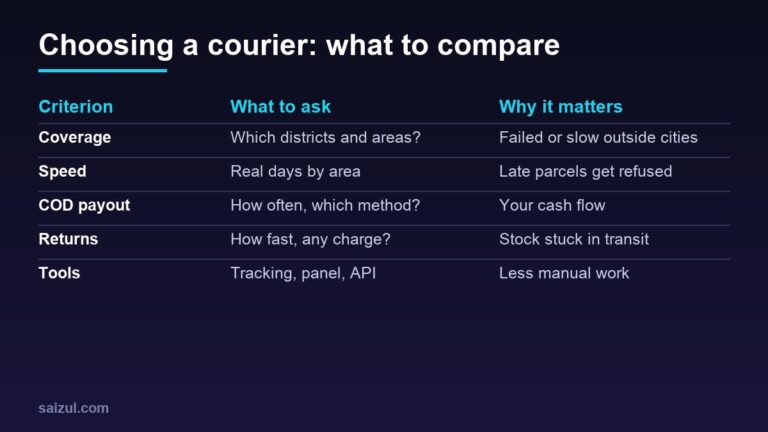
| Delivery | Which courier, what charge inside and outside your city, how long it takes |
| Stock | Where it is kept, how much you will buy first, how you will track it |
| Returns | What you accept, who pays the return delivery, how refunds are made |
Useful guides for this section: accepting online payments in Bangladesh, cash on delivery management, inventory management and WooCommerce vs Shopify if you plan your own store.
Section 4: The numbers that decide profit
This is the section people avoid and the one that matters most. You do not need a spreadsheet model with dozens of tabs. You need three small tables.
Start-up costs (one time)
- First stock order.
- Website or store setup, domain and hosting if you use your own site. See what a small business website costs.
- Packaging, labels and a basic photo setup.
- Any registration, licence or account fees in your country.
- A launch marketing budget.
Monthly running costs
- Advertising, hosting and software subscriptions.
- Internet, phone and packing materials.
- Staff or your own time, if you plan to pay yourself.
Profit per order
For your three best expected products, work out the selling price minus product cost, packaging, delivery cost you pay, payment or marketplace fees, an allowance for returns and refused cash on delivery parcels, and the advertising cost per order. What is left is your real margin. My guide on how to price products for an online store walks through this calculation.
From these, you can estimate how many orders a month you need just to cover running costs. If that number looks unrealistic, change the plan now: a different product, a higher price, or lower costs.
Section 5: How customers will find you
Write down two or three channels you will focus on in the first three months, with a rough budget and what you will do each week. For example:
- Organic social media: three posts a week from a content calendar.
- Paid ads: a small monthly test budget for Facebook ads or Google Ads.
- Search: well-written product pages that can rank over time; see product page SEO.
- Repeat buyers: WhatsApp or email follow-ups after delivery.
For the first weeks, my guide to getting your first customers has more ideas.
Section 6: Operations, legal and risks
- Who does what: sourcing, photos, posting, replying to messages, packing, courier handover, accounts.
- Registration: list what your business needs where you operate. In Bangladesh, the government’s DBID platform says new businesses should apply for a Digital Business Identification number before starting business on a digital platform, including a web or social media page, that the service is free and that processing can take up to 60 working days (DBID application information). Check the current requirements, and whether you also need a trade licence or tax registration, before launch.
- Risks: a supplier delay, a courier problem, a slow first month, a product that gets many returns. Write one line on what you would do for each.
Section 7: Targets for the first 6 to 12 months
Set a few monthly targets you can measure without guesswork:
- Orders per month and average order value.
- Return or refused-delivery rate.
- Cost per order from ads.
- Share of orders from repeat customers.
- Profit after all costs.
Start modest. A plan that expects slow growth and reaches it is more useful than one that expects instant success and is ignored after the first month.
Keep the plan alive: review it monthly
business.gov.au recommends reviewing and updating your plan regularly, and notes that it will need to change as your business grows (develop your business plan). A simple routine:
- On the first day of each month, fill in last month’s real numbers next to your targets.
- Note the best and worst selling products, and why.
- Check your margin per order again, because delivery, ad and supplier costs change.
- Decide one or two changes for next month, and write them in the plan.
- Keep old versions so you can see how far you have come.
If you use Google Analytics, its reports help with this; see Google Analytics 4 for beginners.
Common mistakes
- Writing a long plan to impress someone, then never opening it again.
- Leaving out delivery, fees, returns and ad costs from the margin.
- Launching with too many products and too little stock of the best ones.
- Planning to be on every platform from day one.
- Setting targets with no way to measure them.
- Ignoring registration and policy pages until a payment gateway or customer asks for them.
Quick checklist
- A short summary of what you sell, to whom and where.
- A starting range of 10 to 30 products and three named competitors.
- Decisions on sales channels, payments, delivery, stock and returns.
- Start-up costs, monthly costs and real profit per order.
- Two or three marketing channels with a budget and a weekly routine.
- Registration, roles and main risks written down.
- Monthly targets and a fixed date each month to review them.
Need help with this on your own site or business?
I build and secure WordPress sites, web apps and AI automations end to end, in Bangla and English: a free discovery call, a written scope with a fixed quote, a focused first version, then testing, deployment and monitoring.
See the portfolio and the AI agent services, or tell me what you need.
FAQ
How long should a business plan for an online store be?
For a small store, one or two pages is enough. What matters is that it covers products and customers, channels, the numbers, marketing, operations and measurable targets, and that you review it every month.
Do I need a business plan if I only sell on Facebook?
It still helps. Selling on Facebook has the same costs and risks as any store: stock, delivery, returns, ads and your time. A short plan shows whether each order really makes money.
What is the most important part of the plan?
The numbers. Work out the real profit per order after product cost, packaging, delivery, fees, returns and advertising. Many online stores are busy but not profitable because this was never checked.
How often should I update my business plan?
Review it monthly against your real numbers and update it whenever something important changes, such as a new channel, a new supplier or a big change in delivery or ad costs.
Sources

Md Saizul Amin
Digital Systems Strategist · AI Agent Developer · 9+ years in digital & ITMd Saizul Amin is a digital systems strategist and AI automation engineer from Dhaka, Bangladesh. With 9+ years across IT, web development and digital marketing, he writes practical guides on technology, business, education and online growth — and builds the same kinds of systems (AI agents, websites, SEO and ad campaigns) for clients in Bangladesh, the UK and the USA.
Specialist in
Credentials & experience
- 🎓B.Sc. in Computer Science & EngineeringBangladesh University of Business & Technology (BUBT), 2017–2021
- 🤖AI Automation Engineer · Web Developer · SEO SpecialistUnique Mark Limited, Birmingham UK — 2024 to present
- 🌱IT SpecialistGreen Fund Initiative Inc., USA — 2024 to present
- 🏥Junior IT Consultant — Ministry of Health (DGHS)Built the first national Shareable Health Record website; supported 6,000+ facilities
- 🧭Head of ITWEDO Bangladesh — led IT for 50+ staff, 2021–2023