In this article
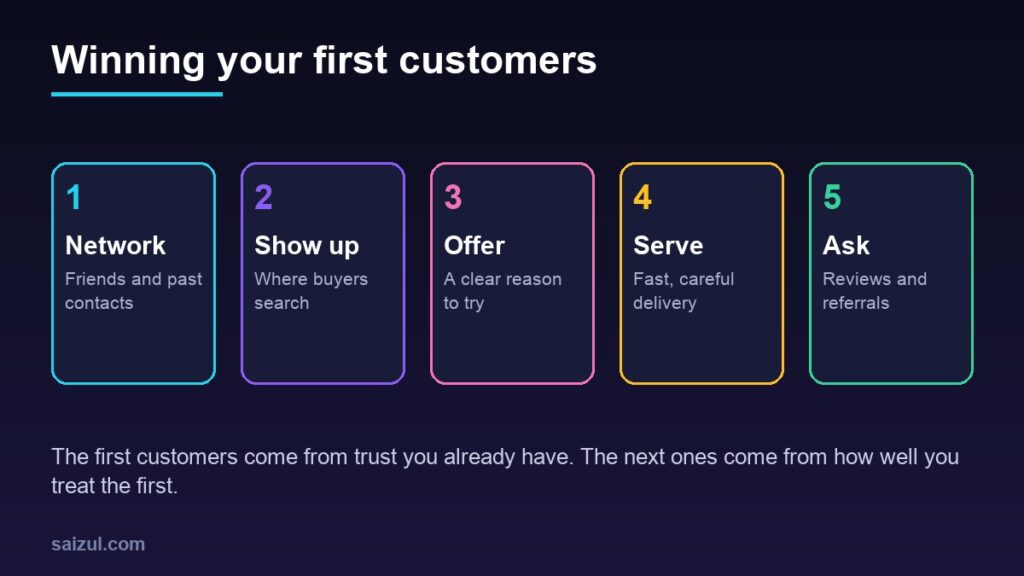
The hardest customers to win are the first ones. Nobody has heard of you, there are no reviews, and the page has twelve followers, most of them relatives. Many new online businesses respond by spending their whole budget on boosted posts in week one, then wonder why the messages that arrive never turn into orders. There is a better order of work: start with people who already trust you, appear where buyers are already looking, give them one clear reason to try you, and make the first orders so smooth that they bring the next ones. This guide walks through that plan.
From my own work: When I help a new business owner plan a launch, the early orders almost always come from their own circle: former colleagues, a school group, people from their area. The owners who do well treat those first orders as practice and as a source of honest feedback, not only as sales.
Before you look for customers
Check three things first, because customers will notice quickly if they are missing:
- A specific customer. “Everyone who wears clothes” is not a customer. “Working women in Dhaka who want office-friendly cotton kurtis under a set budget” is. A narrow starting point makes every later step easier.
- A product or service you can deliver reliably. Stock on hand or a clear lead time, a delivery partner, and a way to accept payment, including cash on delivery if your buyers expect it.
- A price that leaves a margin after delivery, packaging, payment fees and returns. My guide on how to price products for an online store shows the calculation.
If you are still setting up, read how to start an e-commerce business in Bangladesh first.
Step 1: Start with people who already know you
Your first ten customers will most likely come from your own network. That is not a weakness; it is how most businesses start.
- Write a list of 50 to 100 people you could message personally: friends, former classmates and colleagues, neighbours, community and alumni groups.
- Send a short personal message, not a copied broadcast. Say what you have started, who it is for, and ask whether they or someone they know might need it.
- Ask for feedback as much as for orders. “Would you buy this? What would stop you?” gives you information you cannot get from ads.
- Make it easy to pass on. A single link or a photo with the price and how to order is easier to forward than a long explanation.
One rule matters here: if friends, family or staff post reviews or recommendations, they should say how they know you. The US Federal Trade Commission’s endorsement guidance is clear that family, friendship and employment connections should be disclosed, and the same honesty protects your reputation anywhere.
Step 2: Show up where buyers are already searching
You do not need every channel. Pick the two or three where your customer already looks for products like yours.
| Channel | Works well for | First action |
|---|---|---|
| Facebook page and groups | Clothing, food, gifts, local services | Complete page, pinned “how to order” post |
| Google Business Profile | Businesses that meet customers in person | Verified profile with real photos |
| Google free product listings | Stores with a website and product pages | Merchant Center account and product feed |
| Repeat buyers and quick questions | Business profile and catalogue | |
| Marketplaces | Sellers who want existing traffic | A few well-presented listings |
- Google Business Profile is only for businesses that have a location customers visit or that travel to customers (Business Profile guidelines). If you only ship parcels, skip it rather than inventing an address. If you qualify, follow my Business Profile optimization guide.
- Google free listings let products appear on Google at no cost, for example in the Shopping tab and Google Images, though Google does not guarantee they will be shown (about free listings). You need a website, a return policy and accurate product data. See my Merchant Center setup guide.
- Facebook groups can work if you follow each group’s rules and genuinely help. Answer questions in your area of knowledge; do not drop the same sales post into twenty groups.
- WhatsApp is where many customers prefer to order and reorder. My WhatsApp Business guide covers the setup.
Step 3: Give people a clear reason to try you
A new seller has to reduce the risk of buying from a stranger. A good first offer does that without destroying your margin.
- Make the risk smaller: cash on delivery, a clear exchange policy, or a small trial size.
- Make the value clearer: real photos and a short video in daylight, size or ingredient details, and the full price including delivery.
- Make it time-limited if you discount: a launch offer for the first few weeks, stated honestly. A permanent “launch” discount teaches customers to wait.
- Answer the obvious questions in advance: delivery time, delivery charge, payment options and what happens if something is wrong.
Good product text helps here; see how to write product descriptions that sell.
Step 4: Post useful content, not only prices
People buy from a new business when they can see it is real. Show the process: sourcing, packing, the kitchen, the workshop, the delivery handover. Answer common questions in posts. A short video showing the product clearly does more than a stack of flat photos with “inbox for price”. My guide to growing a Facebook page organically has a weekly plan.
If you have a website, write a few pages around what customers search before buying, such as sizes, care instructions or price ranges. Keyword research for small business shows how to find those questions.
Step 5: Add a small ad budget only after the basics work
Ads multiply what is already there. If your page has no reviews, unclear prices and slow replies, ads simply bring more people to a weak experience. Once friends-and-network orders are coming in and the process works, a small test campaign aimed at your specific customer can bring the next group. Start with a budget you can afford to lose while learning, and judge it by orders, not likes. Facebook ads for beginners explains the setup.
Step 6: Treat the first orders as your best marketing
- Reply fast. A new buyer who waits hours for a price reply often buys elsewhere.
- Confirm every order with the item, total and expected delivery date.
- Pack carefully and add a small thank-you note with your page or WhatsApp link.
- Follow up after delivery to ask whether everything was right, and fix problems quickly and politely.
Step 7: Ask for reviews and referrals
A few days after delivery, ask each customer the same way for an honest review on your page or Business Profile. Never pay for positive reviews or offer rewards only for good ones; the FTC guidance above treats incentives tied to positive reviews as a problem, and platforms remove fake reviews. My guide on getting more Google reviews explains a safe routine.
Referrals work well for new businesses. A simple “if a friend orders using your name, you both get free delivery” is easy to explain and easy to track. Then keep those customers coming back with the ideas in customer retention strategies for online stores.
Common mistakes
- Spending the whole budget on ads before the page, prices and replies are ready.
- Trying every platform at once and doing none of them well.
- Hiding the price and asking everyone to “inbox”.
- Asking friends to post reviews as if they were strangers.
- Giving up after a slow first month. Early growth is usually slow and uneven.
Quick checklist
- A specific first customer and a price with a margin.
- A personal message sent to your own network.
- Two or three channels set up properly.
- A clear first offer that reduces the risk of trying you.
- Fast replies, order confirmation and careful packing.
- An honest review and referral request after every delivery.
Need help with this on your own site or business?
I build and secure WordPress sites, web apps and AI automations end to end, in Bangla and English: a free discovery call, a written scope with a fixed quote, a focused first version, then testing, deployment and monitoring.
See the portfolio and the AI agent services, or tell me what you need.
FAQ
How long does it take to get the first customers?
It varies by product and network. Many new sellers get a few orders from their own contacts in the first weeks; steady orders from strangers usually take longer and depend on reviews and consistent posting.
Should I run ads from day one?
Usually not. Make sure the page, prices and reply process work with a few real orders first, then add a small test budget.
Is it fine to ask friends for reviews?
Friends who really bought and used the product can share their honest experience, but they should mention that they know you. Do not ask anyone to pretend to be a stranger.
Do I need a website to start?
No. Many sellers start with a Facebook page and WhatsApp. A website becomes useful when you want Google traffic, free product listings and a channel you fully own.
Sources

Md Saizul Amin
Digital Systems Strategist · AI Agent Developer · 9+ years in digital & ITMd Saizul Amin is a digital systems strategist and AI automation engineer from Dhaka, Bangladesh. With 9+ years across IT, web development and digital marketing, he writes practical guides on technology, business, education and online growth — and builds the same kinds of systems (AI agents, websites, SEO and ad campaigns) for clients in Bangladesh, the UK and the USA.
Specialist in
Credentials & experience
- 🎓B.Sc. in Computer Science & EngineeringBangladesh University of Business & Technology (BUBT), 2017–2021
- 🤖AI Automation Engineer · Web Developer · SEO SpecialistUnique Mark Limited, Birmingham UK — 2024 to present
- 🌱IT SpecialistGreen Fund Initiative Inc., USA — 2024 to present
- 🏥Junior IT Consultant — Ministry of Health (DGHS)Built the first national Shareable Health Record website; supported 6,000+ facilities
- 🧭Head of ITWEDO Bangladesh — led IT for 50+ staff, 2021–2023