In this article
Most small business owners already know their keywords; they just have not written them down. The words a customer uses on the phone, in a Facebook comment or at the counter are very often the same words they type into Google. Keyword research is the work of collecting those words, checking which ones people search for, and deciding which page on your site should answer each one. You do not need a paid tool to do it well. This guide is written for shop owners, service businesses and online sellers who want a method they can repeat in an afternoon.
From my own work: When I plan content for a small business site, the most useful keyword list rarely comes from a tool. It comes from asking the owner and the sales staff which questions customers repeat every week, and then checking those questions in Google.
What a keyword is, in plain terms
A keyword is simply the phrase someone types or speaks into a search box: “cotton panjabi price”, “AC servicing in Mirpur”, “how to clean a leather bag”. Your job is not to repeat these phrases everywhere. It is to make sure you have a useful page for the searches that matter to your business. If you are completely new to the subject, read my general keyword research for beginners guide first; this one focuses on the realities of a small business.
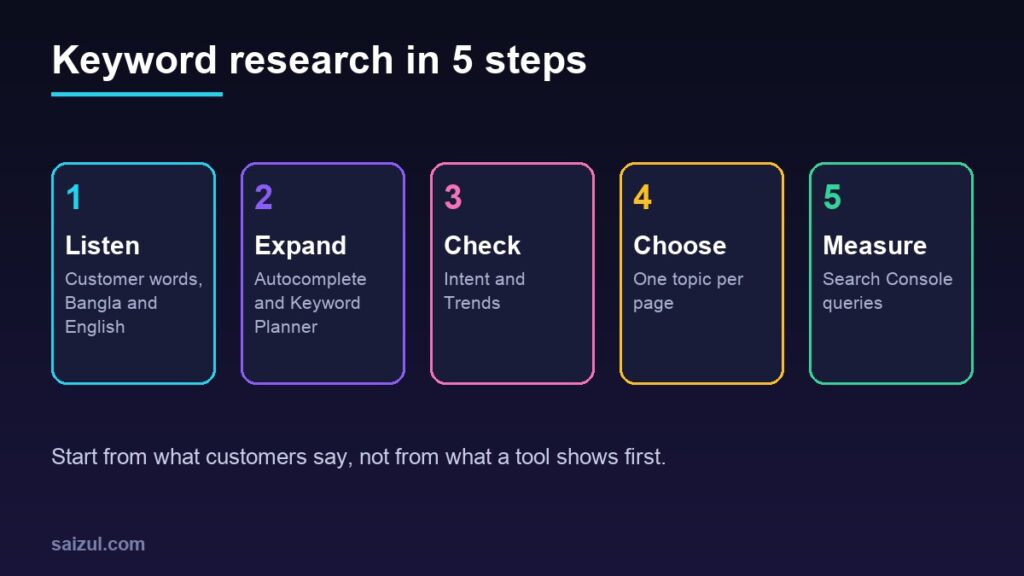
Step 1: Collect the words customers already use
Google itself advises thinking about the words users might search for, and notes that people who know a topic well often use different words from beginners (SEO Starter Guide). Your customers are the best source of that vocabulary.
- Messages and calls: scroll through Messenger, WhatsApp and email and note the exact phrases people use when they first contact you.
- Staff: ask whoever answers customers which five questions come up most often.
- Reviews: customers describe your product in their own words, including words you never use.
- Both languages: in Bangladesh many people search in English, in Bangla and in Bangla written with English letters. Note all three versions, for example “price in BD” and “দাম”.
- Place names: for local services, write down the areas and cities you actually serve.
Step 2: Expand the list with free Google tools
- Autocomplete: type the start of a phrase into Google and note the suggestions. Try adding letters after the phrase (“panjabi a”, “panjabi b”) to see more.
- People also ask and related searches: these show the questions and variations Google connects with your topic.
- Keyword Planner: inside Google Ads, “Discover new keywords” suggests ideas from words or a website, and “Get search volume and forecasts” checks a list you already have (Use Keyword Planner). You need a Google Ads account with the setup and billing details completed, but you do not have to run ads to use it. Treat the numbers as estimates.
- Search Console: if your site is live, the Performance report lists the queries you already appear for. My Search Console guide shows where to find them.
Step 3: Check intent and seasonality
The same product can be searched with very different goals. Search each important phrase yourself and look at what Google already shows on the first page.
| Intent | Example | Page that fits |
|---|---|---|
| Buy now | “buy leather wallet online BD” | Product or category page |
| Compare | “leather vs synthetic wallet” | Guide or comparison article |
| Learn | “how to clean a leather wallet” | Blog post |
| Local | “wallet shop near Dhanmondi” | Location page and Google Business Profile |
If the first page is full of product listings, a blog post will struggle to rank for that phrase, and the other way round. For local searches, the local SEO guide matters as much as your website.
Use Google Trends to see when interest rises, for example before Eid or the winter season. Remember that Trends shows relative interest on a scale of 0 to 100, not the number of searches (Google Trends data FAQ). It is ideal for comparing two phrases or spotting a season, not for estimating traffic.
Step 4: Choose realistic targets
A new or small site will not beat national marketplaces for one-word searches like “shoes”. Look for phrases that are specific enough for you to be the best answer:
- Add detail: material, size, use case, area or audience (“handmade leather wallet for men”).
- Answer questions: question searches often have weaker competition and attract buyers who are still deciding.
- Check the first page: if it is all large brands with in-depth pages, choose a narrower phrase for now.
- Prefer relevance over volume: a phrase with few searches that matches what you sell can bring more orders than a popular phrase that does not.
Step 5: Map one main topic to each page
Put your list in a simple sheet and give each group of similar phrases one page. Two pages chasing the same search compete with each other.
| Main phrase | Similar phrases | Intent | Page |
|---|---|---|---|
| leather wallet for men | men’s leather wallet, gents wallet | Buy | Category page |
| how to clean leather wallet | leather wallet care | Learn | Blog post |
Then use the main phrase naturally in the title, the first paragraph, one heading and the meta description. Do not repeat it again and again; Google’s guide warns that excessive repetition is tiring for readers and that keyword stuffing breaks its spam policies. The on-page SEO checklist covers the rest, and product page SEO covers shop pages.
Step 6: Measure and repeat
After a page has been live for a few weeks, open Search Console, filter by that page and look at the queries. You will usually find phrases you did not plan for. Add them to the page where they fit, or create a new page if they need a different answer. Repeat the whole process every few months, and before every big season.
Quick checklist
- Customer phrases collected from messages, calls, staff and reviews.
- English, Bangla and mixed-script versions noted.
- List expanded with autocomplete, related searches and Keyword Planner.
- Intent checked by searching each important phrase yourself.
- Seasonal phrases checked in Google Trends.
- One main phrase per page, recorded in a sheet.
- Search Console queries reviewed every month.
Need help with this on your own site or business?
I build and secure WordPress sites, web apps and AI automations end to end, in Bangla and English: a free discovery call, a written scope with a fixed quote, a focused first version, then testing, deployment and monitoring.
See the portfolio and the AI agent services, or tell me what you need.
FAQ
Do I need a paid tool for keyword research?
No. For a small business, customer conversations, Google autocomplete, Keyword Planner, Google Trends and Search Console cover most needs. Paid tools save time on larger sites.
Is Keyword Planner free to use?
You need a Google Ads account with setup and billing details completed. You can research keywords there without running a campaign, but the volumes are estimates.
Should I target Bangla or English keywords?
Both, if your customers use both. Check how people actually search for your product and create content in the language that matches the search.
How many keywords should one page target?
One main topic, plus the natural variations of it. If two phrases need different answers, they need different pages.
How long before keyword work shows results?
It varies with competition and the age of the site. Expect weeks to months, and judge progress in Search Console rather than by checking rankings every day.
Sources

Md Saizul Amin
Digital Systems Strategist · AI Agent Developer · 9+ years in digital & ITMd Saizul Amin is a digital systems strategist and AI automation engineer from Dhaka, Bangladesh. With 9+ years across IT, web development and digital marketing, he writes practical guides on technology, business, education and online growth — and builds the same kinds of systems (AI agents, websites, SEO and ad campaigns) for clients in Bangladesh, the UK and the USA.
Specialist in
Credentials & experience
- 🎓B.Sc. in Computer Science & EngineeringBangladesh University of Business & Technology (BUBT), 2017–2021
- 🤖AI Automation Engineer · Web Developer · SEO SpecialistUnique Mark Limited, Birmingham UK — 2024 to present
- 🌱IT SpecialistGreen Fund Initiative Inc., USA — 2024 to present
- 🏥Junior IT Consultant — Ministry of Health (DGHS)Built the first national Shareable Health Record website; supported 6,000+ facilities
- 🧭Head of ITWEDO Bangladesh — led IT for 50+ staff, 2021–2023