In this article
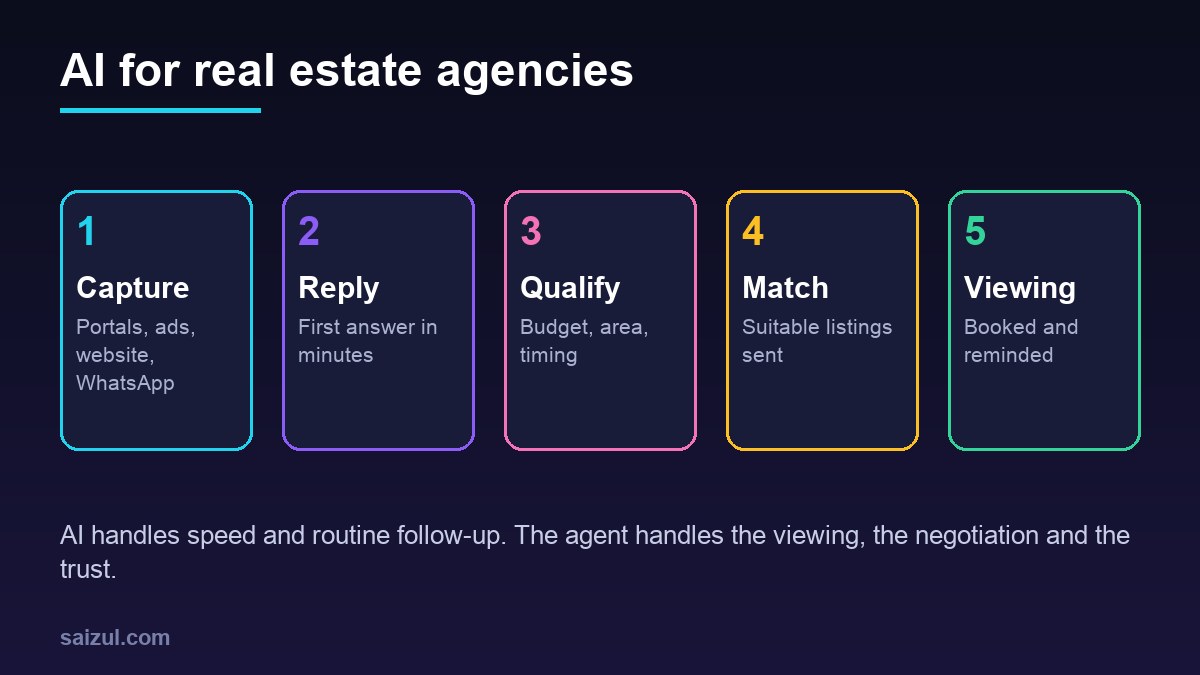
AI for real estate is most useful in the gap between a lead arriving and an agent calling back. A buyer or tenant enquires about a flat on a property portal, a Facebook ad or your website at 10 pm, and the agency replies the next afternoon, by which time the person has already spoken to three other agents. An AI agent can reply within minutes, ask the right questions, send matching listings, book a viewing and keep following up, while your agents focus on viewings, negotiation and closing. This guide covers practical use cases for agents, agencies and developers, how the workflow runs, the rules you must follow, estimated costs and a step-by-step rollout.
From my own work: When I map a property business’s lead flow, I usually find the same pattern: enquiries come from five or six places, nobody owns the first reply, and leads that do not convert in the first week are never contacted again. The AI is not the clever part. Putting every lead in one list with an owner and a next step is what changes results.
This article is the real estate version of my general guide to an AI lead generation agent. If you are new to the idea, what is an AI agent explains the basics in plain English.
Practical uses of AI for real estate
| Use case | What the AI does | Who benefits |
|---|---|---|
| Instant lead reply | Answers portal, ad, website and WhatsApp enquiries within minutes, day or night | Agencies with many leads and few agents |
| Qualification | Asks budget, area, property type, size, timing, buy or rent, financing | Agents who waste time on cold leads |
| Listing matching | Searches your listings and sends the closest matches with photos and links | Agencies with a large inventory |
| Viewing booking | Offers available slots, books, sends location and reminders | Busy agents and site offices |
| Follow-up | Checks in after viewings, sends new listings, revives old leads | Long buying cycles |
| Listing descriptions | Drafts descriptions and social posts from property details | Marketing teams |
| Landlord and tenant updates | Rent reminders, maintenance requests, renewal notices | Property managers |
| Developer project enquiries | Answers questions on payment plans, handover dates, unit types | Developers with sales teams |
How an AI real estate lead workflow runs
- Capture: every enquiry from portals, Facebook and Instagram lead ads, your website forms, WhatsApp and phone calls goes into one CRM or lead list. If a portal only sends email alerts, the system reads those emails and creates a lead.
- First reply: the AI sends a short, friendly reply on the channel the person used, mentions the property they asked about and asks one or two simple questions.
- Qualify: over a few messages the AI collects budget, preferred areas, size, timing and whether they are buying or renting. It does not push; it stops if the person asks to stop.
- Match: the AI searches your listing database and sends three to five close matches. It only sends listings that are actually available.
- Book: when the person is interested, it offers viewing slots from the agent’s calendar, confirms the booking and sends the location. My appointment booking automation guide covers reminders and no-shows.
- Hand over: the assigned agent gets a summary: who the person is, what they want, what they have seen and when the viewing is.
- Follow up: after the viewing, the AI asks for feedback and sends new matching listings over the following weeks, until the lead buys, rents or opts out.
The data your AI agent needs
An AI agent is only as good as the information it can see. Before building, make sure you have:
- A clean listing database: price, area, size, bedrooms, floor, facing, parking, status (available, booked, sold), photos and a link. Out-of-date listings cause the most embarrassing replies.
- Agent calendars: real availability, so bookings do not clash.
- Answers to common questions: service charges, booking money, documents needed, registration process, payment plans. Write them once and keep them current.
- Clear handover rules: which questions always go to a person, such as price negotiation, legal questions and complaints.
If your listings are also on your website, structured data such as the schema.org RealEstateListing type can help describe them consistently for search engines (Schema.org RealEstateListing).
Channels: WhatsApp, Messenger, website and phone
In many markets, including Bangladesh, the Gulf and South Asia, most property conversations happen on WhatsApp. Automated WhatsApp replies at scale need the WhatsApp Business Platform, for example through the Cloud API (WhatsApp Cloud API), and must follow WhatsApp’s business messaging policy, which covers consent and the kinds of messages you may send (WhatsApp Business Messaging Policy). My guide to a WhatsApp AI agent for business explains the setup.
Website chat works for people browsing listings. Messenger suits leads from Facebook ads. For phone calls, an AI voice agent can answer after-hours calls and take details, but tell callers they are speaking to an automated assistant and follow local call recording rules.
Example: a night-time flat enquiry, start to finish
Here is how a typical conversation might run, written as steps rather than a script, so you can adapt it to your market:
- A person clicks a Facebook ad for a three-bedroom flat at 11 pm and sends a WhatsApp message.
- Within a minute the assistant thanks them, confirms the project and flat size they asked about, mentions that it is an automated assistant, and asks whether they are looking to buy or rent.
- The person says buy. The assistant asks about budget range and preferred handover time, one question at a time.
- The budget is a little below the advertised flat. The assistant says so honestly and offers two available flats in a nearby area that fit the budget, with photos and links.
- The person likes one. The assistant offers three viewing slots from the agent’s calendar for the weekend and books one.
- The agent wakes up to a summary in the CRM: name, number, budget, timing, flats sent, the one they liked and the viewing time.
- The day before the viewing, the person gets a reminder with the map location. After the viewing, the assistant asks how it went and the agent takes over the negotiation.
Common mistakes to avoid
- Letting the AI quote prices or availability from an old spreadsheet.
- Sending long, pushy sequences to people who only asked one question.
- No clear owner for a lead once the AI hands it over.
- Measuring messages sent instead of viewings booked and deals closed.
- Skipping the weekly review of real conversations during the first months.
Rules: fair housing, consent and honesty
Property is a regulated area, and automated messages can create problems quickly if they are badly designed.
- Fair housing and non-discrimination: the AI must never filter, steer or treat people differently by religion, ethnicity, family status, disability or other protected traits. In the US this is a legal duty; the National Association of REALTORS publishes fair housing resources for agents (NAR Fair Housing). Qualify only on budget, needs and timing.
- Consent: only message people who enquired or agreed to be contacted, and stop immediately when they ask.
- Honesty: do not let the AI invent facts about a property, a price or a legal status. If it does not know, it should say so and pass to an agent.
- Personal data: keep only what you need, protect it and delete old leads after a set period. The GDPR principles are a good model even outside Europe (GDPR Article 5).
- Disclosure: tell people when they are chatting with an automated assistant.
What AI for real estate costs (2026 estimates)
These are estimates for planning, and depend on lead volume, channels and how many systems need to connect.
| Scope | Includes | Estimated build cost (USD) |
|---|---|---|
| Lead capture and instant reply | All sources into one CRM, first reply on WhatsApp or email, agent alerts | 1,500 to 5,000 |
| Qualifying AI agent | Conversation, qualification, FAQ answers, handover summary | 4,000 to 12,000 |
| Full agent with listings and booking | Listing search, matching, calendar booking, follow-up sequences, reports | 8,000 to 25,000+ |
| Custom real estate CRM | Leads, listings, viewings, deals, commissions, owner portal | 12,000 to 45,000+ |
Monthly running costs include AI model usage, WhatsApp conversation charges, hosting and maintenance. My AI agent cost guide explains each line in detail.
How to measure if it works
- Time to first reply: compare before and after. This is usually the first number to improve.
- Qualified lead rate: share of leads with budget, area and timing captured.
- Viewings booked per 100 leads.
- No-show rate for viewings with and without reminders.
- Deals by source, so you know which portal or ad is worth paying for.
- Handover quality: ask agents weekly whether summaries were accurate.
Step-by-step rollout
- List every lead source and how leads arrive today.
- Put all leads into one CRM with an owner and a status. See CRM automation for small business.
- Clean the listing data and mark sold or rented units.
- Write the FAQ answers and handover rules.
- Launch instant replies on one channel, usually WhatsApp, with agents reviewing conversations daily.
- Add qualification and listing matching once replies are reliable.
- Add viewing booking and follow-up sequences.
- Review numbers monthly and adjust messages.
AI for real estate checklist
- All lead sources connected to one list.
- Listing data current, with status and photos.
- Agent calendars connected for bookings.
- FAQ answers written and approved.
- Handover rules for price, legal and complaint questions.
- Non-discrimination rules built into prompts and reviewed.
- Consent and opt-out handled on every channel.
- Automated assistant disclosure in the first message.
- Weekly review of conversations for the first two months.
Need help with this on your own site or business?
I build and secure WordPress sites, web apps and AI automations end to end, in Bangla and English: a free discovery call, a written scope with a fixed quote, a focused first version, then testing, deployment and monitoring.
See the portfolio and the AI agent services, or tell me what you need.
FAQ
How can AI help real estate agents?
AI can reply to property enquiries within minutes, ask qualifying questions, send matching listings, book viewings and follow up over weeks. Agents then spend their time on viewings, negotiation and closing rather than routine messages.
Will AI replace real estate agents?
No. Buyers and tenants still want a trusted person for viewings, negotiation and paperwork. AI removes slow replies and forgotten follow-ups, which helps agents handle more leads well.
Can an AI agent answer leads from property portals?
Often yes. If a portal sends leads by email or offers an integration, the system can create a lead and reply on WhatsApp or email. Check each portal’s terms and integration options first.
Is it legal to use AI chat for property enquiries?
Generally yes, if you follow consent, data protection, advertising and non-discrimination rules where you operate, and you tell people they are chatting with an automated assistant. Check local regulations for your market.
How much does an AI real estate assistant cost?
A simple capture-and-reply setup may start around 1,500 US dollars, while a full agent with listing search, booking and follow-up can reach 25,000 or more. These are estimates; running costs are extra.
Sources

Md Saizul Amin
Digital Systems Strategist · AI Agent Developer · 9+ years in digital & ITMd Saizul Amin is a digital systems strategist and AI automation engineer from Dhaka, Bangladesh. With 9+ years across IT, web development and digital marketing, he writes practical guides on technology, business, education and online growth — and builds the same kinds of systems (AI agents, websites, SEO and ad campaigns) for clients in Bangladesh, the UK and the USA.
Specialist in
Credentials & experience
- 🎓B.Sc. in Computer Science & EngineeringBangladesh University of Business & Technology (BUBT), 2017–2021
- 🤖AI Automation Engineer · Web Developer · SEO SpecialistUnique Mark Limited, Birmingham UK — 2024 to present
- 🌱IT SpecialistGreen Fund Initiative Inc., USA — 2024 to present
- 🏥Junior IT Consultant — Ministry of Health (DGHS)Built the first national Shareable Health Record website; supported 6,000+ facilities
- 🧭Head of ITWEDO Bangladesh — led IT for 50+ staff, 2021–2023