In this article
From my own builds: I’m Saizul Amin, an AI agent developer and automation engineer. I run AI agent systems in production on self-hosted n8n and Docker (Messenger, WhatsApp, Telegram and email), so the advice below comes from operating them, not from reading about them. Last reviewed: October 2026.
“How much does an AI agent cost?” is the question I get most, and the honest answer starts with another question: what should it do, in which channels, and how many conversations a month? A single-channel FAQ agent and a multi-agent system with voice, documents and CRM integration are very different projects, and quotes for the same idea can vary several-fold.
I build and run AI agents on self-hosted n8n and Docker for businesses, so this guide breaks cost into the parts that really exist, shows how to estimate the running cost yourself, and lists what to ask any provider. I deliberately do not quote fixed price tables: model prices and platform fees change, and your scope decides the rest.
The five layers of AI agent cost
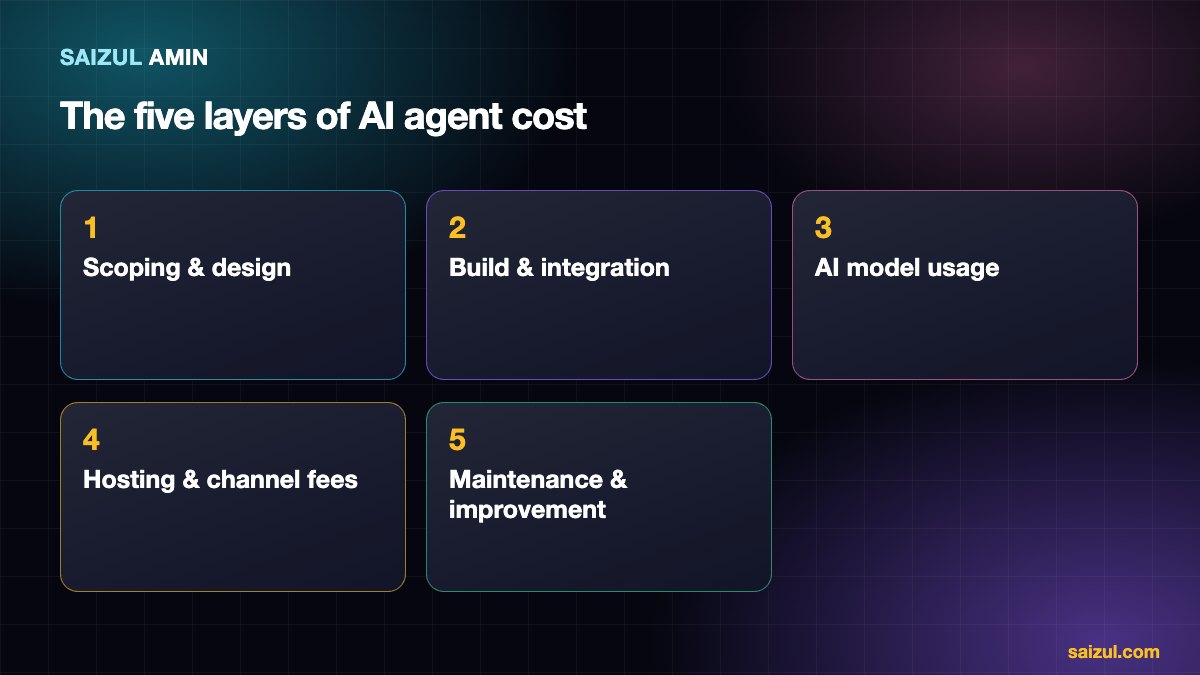
| Layer | What it covers | One-off or recurring |
|---|---|---|
| 1. Scoping and design | Understanding the process, choosing channels, writing the conversation design and rules, defining handoff and success metrics | One-off |
| 2. Build and integration | Workflow, prompts, tools (calendar, sheets, CRM, APIs), knowledge base ingestion, channel setup, testing | One-off |
| 3. AI model usage | Tokens processed for every message, plus embeddings for knowledge search | Recurring, scales with volume |
| 4. Hosting and channel fees | Server or workflow platform, vector database if used, WhatsApp or other per-message fees, domain, monitoring | Recurring |
| 5. Maintenance and improvement | Updating knowledge, fixing integrations when APIs change, reviewing conversations, tuning prompts, security updates | Recurring |
What makes an AI agent cheaper or more expensive
- Number and type of channels. One channel (for example WhatsApp) is simpler than WhatsApp, Messenger, web chat and email together. Voice adds speech-to-text and text-to-speech work.
- Number of integrations. Reading a Google Sheet is easy; two-way sync with a CRM, booking system and payment gateway is not.
- Knowledge size and quality. A neat 10-page FAQ is quick. Hundreds of messy documents need cleaning, structuring and a retrieval pipeline (see RAG explained).
- Languages. Bangla and mixed Banglish need more testing than English-only.
- Autonomy and risk. An agent that only answers FAQs is cheaper to make safe than one that books, changes orders or touches money.
- Volume. More conversations means more model usage and channel fees.
- Quality bar. Evaluation sets, human review workflows and monitoring dashboards add effort and add reliability.
Your options for getting one
| Option | Upfront | Running | Best for |
|---|---|---|---|
| Off-the-shelf chatbot SaaS | Low | Monthly subscription, often per conversation or seat | Simple FAQ, standard channels, no deep integration |
| DIY with a no-code tool | Your time | Tool plus model fees | Technical owners with time to learn and test |
| Custom build on an open platform (for example n8n) | Project fee | Hosting plus model usage; you own the system | Custom logic, integrations, data control, growth |
| Fully bespoke software | Highest | Engineering and infrastructure | Product-grade systems with unusual requirements |
For most small and mid-size businesses, a custom agent on an open workflow platform gives the best balance: you are not locked into per-conversation SaaS pricing, and the system grows with you. I compare the tools in n8n vs Zapier vs Make.
Estimate the running cost yourself
Model cost is predictable if you do the arithmetic. Use this formula:
monthly model cost =
  conversations per month
  x model calls per conversation
  x average tokens per call (input + output)
  x price per token
Worked structure (replace the figures with your own, and take the price per million tokens from your provider’s current pricing page):
- Estimate conversations per month from your current inbox (for example 2,000).
- Assume model calls per conversation: a short support chat might be 4 to 6 replies, each one a model call.
- Estimate tokens per call: your instructions and retrieved context are sent every time, so they dominate. A tight prompt and 3 retrieved chunks might be 1,000 to 2,000 tokens in; replies are a few hundred out.
- Multiply to get total tokens per month, then multiply by the provider’s price per million tokens (input and output are usually priced differently).
Ways to reduce it: use a smaller, cheaper model for routing and FAQs, keep prompts short, retrieve fewer and better chunks, cap replies, and cache answers to frequent questions. In practice, for typical small-business volumes, model fees are often a small part of the total compared with the people-time the agent saves, but always calculate with your own numbers.
Add the channel and hosting costs: WhatsApp charges per message under Meta’s pricing (check the current rates on the official documentation), and a self-hosted workflow server is a small fixed monthly cost (see my n8n self-hosting guide).
Is it worth it? Work out the payback
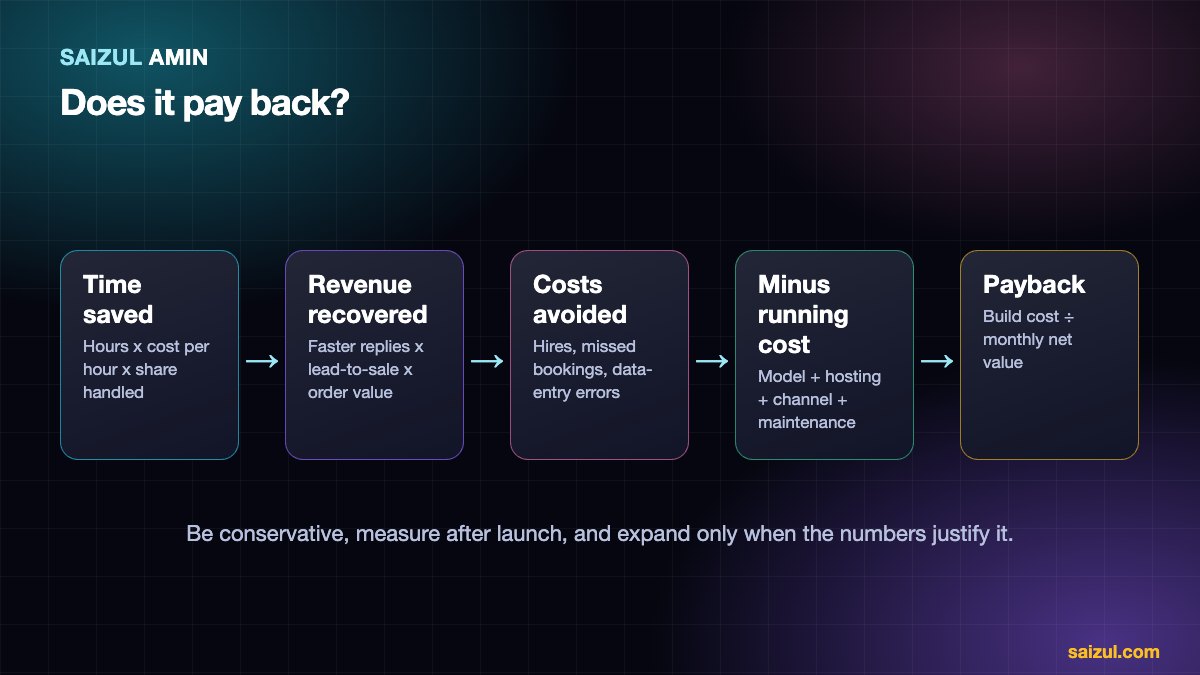
A simple payback model:
- Time saved: hours a month your team spends on repetitive replies and data entry × their cost per hour × the share the agent handles (a conservative 40 to 60 percent is a sensible starting assumption for FAQ-heavy inboxes).
- Revenue recovered: enquiries that used to wait overnight or get lost × your lead-to-sale rate × average order value. Fast replies often matter more than the time saved.
- Costs avoided: a part-time hire you no longer need, missed bookings, errors in manual entry.
- Subtract the running cost, then divide the build cost by the monthly net value to get months to payback.
Be conservative and measure after launch. Some projects pay back in a few months; others should not be built until the process or volume justifies it.
Costs people forget
- Preparing your knowledge: pricing sheets, policies and FAQs need to exist, be current and be consistent.
- Testing time: running real past conversations through the agent is where quality comes from.
- Human handoff: someone must receive and answer the escalations.
- API changes: channels and tools change; budget for maintenance.
- Compliance and privacy: a clear privacy policy, data handling and provider terms.
What a good quote includes
- A written scope: channels, tools, languages, what the agent can and cannot do.
- The handoff and guardrail design.
- Testing and acceptance criteria (for example a set of real conversations it must handle).
- Who owns the workflows, prompts, accounts and data (it should be you).
- Running cost estimate with the formula above, not just the build price.
- Support and maintenance terms after launch.
Red flags
- A price with no scope, or “unlimited” everything.
- No mention of testing, handoff or monitoring.
- Promises of 100 percent accuracy or “replaces your whole team”.
- The provider keeps your accounts and credentials, so you cannot leave.
- A demo with perfect, scripted questions only.
The cheapest way to start
Pick one job, one channel and one human fallback. Launch a narrow first version, read the real conversations for two weeks, then expand. This keeps the first budget small and shows the true running cost before you commit more. The path is outlined in what is an AI agent and how to build one with n8n.
Want this built for your business?
I design, build, deploy and maintain custom AI agents and automations, on infrastructure I operate myself (self-hosted n8n and Docker), in Bangla and English.
- Customer-support and sales agents on WhatsApp, Facebook Messenger, Telegram, web chat and email.
- Knowledge (RAG) assistants that answer from your documents with sources.
- Workflow automation: lead capture, CRM and sheet sync, reporting, document processing and monitoring.
- Hosting and DevOps for n8n and Docker: security, backups, updates and monitoring.
The process: a free discovery call, a written scope and fixed quote, a focused first version, testing on your real conversations, then deployment with monitoring. See live examples on the AI agent services page, browse the portfolio, or tell me about the job you want automated.
Frequently asked questions
Why won’t you give a single price?
Because it depends on scope. After a discovery call I give a written scope with a fixed quote, plus an estimate of monthly running cost so there are no surprises.
Is it cheaper to build it myself?
It can be, if you have the time and skills, and the system is simple. The risk is hidden time cost and an unreliable result; many people prototype themselves and bring in help for production.
Do I pay per conversation?
With SaaS chatbots usually yes. With a custom build on your own workflow server you pay your model provider and channel fees directly, with no per-conversation markup.
How long does it take?
A focused single-channel agent can often be live in days to a few weeks. Larger, multi-integration systems take longer.
What does maintenance cost?
Typically a small monthly amount for monitoring, updates and improvements, depending on how much changes. A good agent keeps improving from real conversations.
Sources and further reading
How this article was written
I wrote this myself from hands-on experience building and running AI agents and automations for clients. Product behaviour, policies and pricing models were checked against the official documentation linked above in October 2026. Tools, policies and prices change quickly; if you notice something out of date, email info@saizul.com and I will correct it.
About the author
Saizul Amin is an AI agent developer, automation engineer and digital growth partner based in Bangladesh. He has built 7 production AI systems on self-hosted n8n, developed 50+ websites and managed 150K+ USD in advertising spend for clients across markets including the UK, the USA and Bangladesh. Learn more about Saizul, see his work, or get in touch.

Md Saizul Amin
Digital Systems Strategist · AI Agent Developer · 9+ years in digital & ITMd Saizul Amin is a digital systems strategist and AI automation engineer from Dhaka, Bangladesh. With 9+ years across IT, web development and digital marketing, he writes practical guides on technology, business, education and online growth — and builds the same kinds of systems (AI agents, websites, SEO and ad campaigns) for clients in Bangladesh, the UK and the USA.
Specialist in
Credentials & experience
- 🎓B.Sc. in Computer Science & EngineeringBangladesh University of Business & Technology (BUBT), 2017–2021
- 🤖AI Automation Engineer · Web Developer · SEO SpecialistUnique Mark Limited, Birmingham UK — 2024 to present
- 🌱IT SpecialistGreen Fund Initiative Inc., USA — 2024 to present
- 🏥Junior IT Consultant — Ministry of Health (DGHS)Built the first national Shareable Health Record website; supported 6,000+ facilities
- 🧭Head of ITWEDO Bangladesh — led IT for 50+ staff, 2021–2023