In this article
An AI voice agent for business is software that answers or makes phone calls, understands what the caller says, replies in a natural voice and takes simple actions, such as booking an appointment or checking an order, before handing over to a person when needed. It works best on short, repeated calls with clear answers, and it needs careful attention to consent, recording and disclosure rules. This guide covers the use cases, how a voice agent works, the rules to check, the honest limits and a safe way to start.
From my own work: In voice projects I have worked on, the hardest part was rarely the AI. It was call quality, background noise, callers switching between Bangla and English mid-sentence, and deciding the exact moment to transfer to a person. Testing with real recorded calls, with permission, taught more than any demo.
New to agents in general? Start with what is an AI agent. If you want the technical side of building one, my developer guide on production AI voice agents with Twilio, FastAPI and Deepgram goes into the code. This article is for business owners deciding whether and where to use one.
AI voice agent for business: practical use cases
Inbound calls
- Reception and routing: answer every call, ask what it is about and transfer to the right person or department.
- Bookings: check availability and book, move or cancel appointments for clinics, salons, repair services or consultants.
- Order and delivery status: look up an order by number or phone and read back the status.
- After-hours answering: take messages, answer common questions and log urgent cases for a call back.
- FAQ calls: opening hours, location, prices, documents required.
Outbound calls (with permission)
- Appointment reminders and confirmations for people who agreed to be called.
- Order confirmation for cash-on-delivery orders, where the customer expects a call.
- Follow-up on a request the customer made, such as a quote or call-back.
Cold sales calls with an AI voice are the riskiest use, legally and for your reputation. I do not recommend starting there.
How does an AI voice agent work?
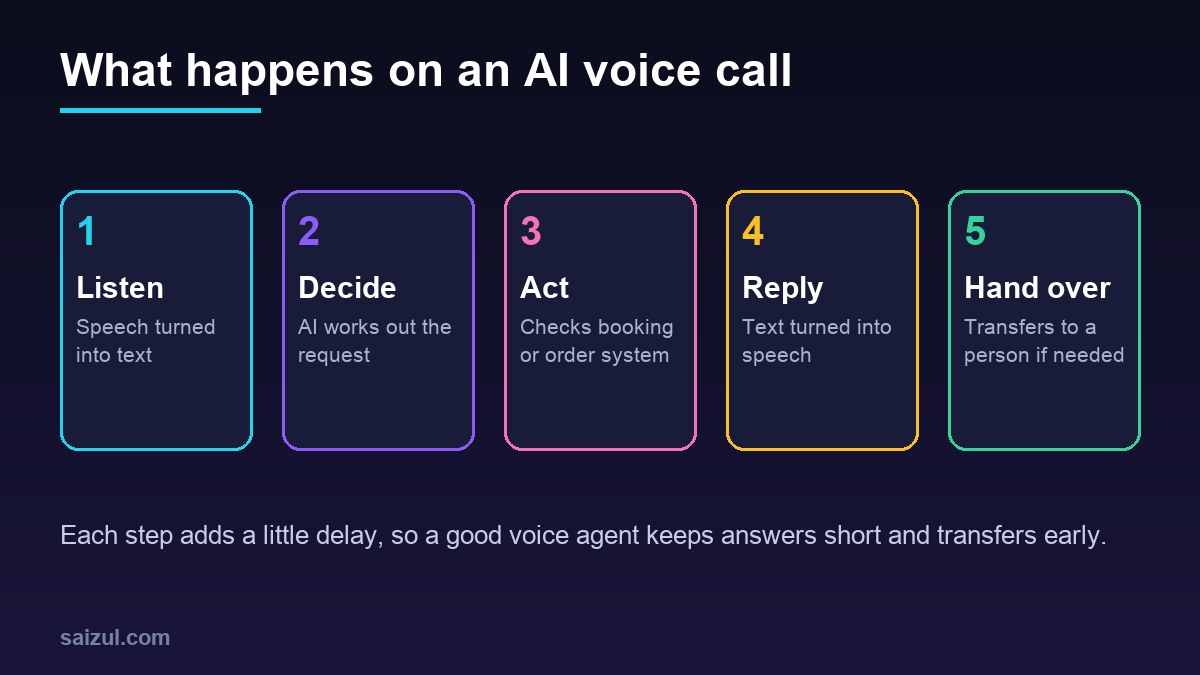
- Phone line: a phone number from a telephony provider, or a connection to your existing number, sends the call audio to the system.
- Speech to text: the caller’s words are turned into text in near real time.
- The agent: a language model reads the text with your instructions and knowledge, and decides what to say or do.
- Tools: it may check your booking calendar, order system or CRM, within limits you set.
- Text to speech: the reply is turned into a natural voice and played to the caller.
- Handover and logging: it can transfer the call, send a summary to staff and save a transcript.
Some newer systems handle speech in and out directly, without separate steps, which can reduce delay. Either way, the parts that decide quality are the same: clear audio, short answers, reliable tools and a fast handover. The same ideas apply as for text agents in my guide to an AI agent for small business.
Consent, recording and disclosure rules to check
Rules differ by country, and sometimes by state or province. Treat this section as a list of questions to check with a local lawyer, not legal advice.
Telling callers they are speaking to an AI
Say at the start of the call that the caller is speaking with an automated assistant, and how to reach a person. In the EU, the AI Act’s transparency rules say people should be made aware when they interact with a machine, with these rules coming into effect in August 2026 according to the European Commission (European Commission: AI Act).
Outbound calls with an AI voice
In the United States, the FCC confirmed in February 2024 that the Telephone Consumer Protection Act’s restrictions on “artificial or prerecorded voice” cover current AI technologies that generate human voices, so callers must have the prior express consent of the called party unless an emergency purpose or exemption applies. The ruling also notes identification and, for telemarketing, opt-out requirements (FCC Declaratory Ruling FCC 24-17). If you call customers in other countries, check their equivalent telemarketing and consent rules before launching.
Recording and transcripts
Many voice agents record calls or keep transcripts. Some places require only one party to consent to recording; others require everyone on the call to agree. Telephony providers point this out themselves: Twilio’s recording documentation warns that you need to comply with laws about obtaining consent to record and recommends checking with legal counsel (Twilio: Recordings). A simple, safe habit is to announce recording at the start of every call.
Questions to answer before launch
- Which countries are we calling or receiving calls from, and what do their rules say?
- Do we have documented consent for every outbound number?
- Do we announce the AI and the recording at the start?
- Where are recordings and transcripts stored, for how long, and who can access them?
- Does our privacy policy explain this?
Limits of AI voice agents today
- Delay: even small pauses feel long on the phone. Long answers and slow tool lookups make it worse.
- Accents, noise and mixed languages: speech recognition quality varies. Test with your real callers, including Bangla and mixed Bangla and English, before deciding.
- Interruptions: people talk over the agent. Good systems stop and listen, weaker ones keep talking.
- Wrong but confident answers: OWASP lists misinformation among the top risks for LLM applications, along with prompt injection and excessive agency (OWASP Top 10 for LLM Applications). A caller can try to talk the agent into something, so limit what it can do.
- Emotional calls: complaints, emergencies and upset callers need a person.
- Identity checks: do not let the voice agent change accounts, payments or personal data based only on what the caller says.
How to start with an AI voice agent: step by step
Step 1: Pick one call type
Listen to a sample of your calls (or read call logs) and pick the most frequent simple type, such as “book or move an appointment” or “where is my order”.
Step 2: Write the script and the handover rules
Write what a good staff member says, the questions they ask, the systems they check and when they transfer. Keep answers short enough to say in one breath.
Step 3: Check the legal points
Confirm disclosure, recording and consent rules for your countries, and update your privacy policy.
Step 4: Build and test internally
Have staff call it from different phones, in noisy places, with different accents and languages. Try to break it.
Step 5: Launch on part of your calls
Start with after-hours calls or overflow when staff are busy. Read transcripts daily at first.
Step 6: Measure and decide
Track calls fully handled, transfer rate and reasons, average call length, bookings made, complaints and caller feedback. Compare costs with the staff time saved. For budgets, see how much an AI agent costs.
Common mistakes
- Starting with cold outbound sales calls.
- Hiding that the caller is speaking to an AI.
- No easy way to reach a person, such as saying “agent” or pressing a key.
- Long, chatty answers that waste callers’ time.
- Testing only in a quiet office with clear speech.
- Recording calls without announcing it.
- Giving the agent power to change payments or accounts.
Quick checklist
- One frequent, simple call type chosen.
- Script, questions and transfer rules written.
- AI disclosure and recording notice at the start of each call.
- Consent documented for outbound calls; local rules checked.
- Agent permissions limited; no payment or account changes.
- Tested with real accents, noise and languages.
- Fast transfer to a person, with a summary sent to staff.
- Recordings and transcripts stored securely with a retention period.
- Daily transcript review at first, then weekly.
- Results measured against staff time and caller satisfaction.
Need help with this on your own site or business?
I build and secure WordPress sites, web apps and AI automations end to end, in Bangla and English: a free discovery call, a written scope with a fixed quote, a focused first version, then testing, deployment and monitoring.
See the portfolio and the AI agent services, or tell me what you need.
FAQ
Can an AI voice agent speak Bangla?
Speech recognition and voice generation for Bangla exist and are improving, but quality varies by provider and by accent. Test with real callers, including mixed Bangla and English, before you decide.
Is it legal to use an AI voice for business calls?
It depends on the country and the type of call. In the US, the FCC treats AI voices as artificial voices under the TCPA, so outbound calls generally need prior express consent. Check local rules for disclosure, consent and recording with a lawyer.
Can an AI voice agent transfer calls to a person?
Yes. A good setup transfers the call when the caller asks, when the agent is unsure or for sensitive topics, and sends staff a short summary so the caller does not have to repeat everything.
Will callers know they are talking to an AI?
They should. Tell them at the start of the call that they are speaking to an automated assistant and how to reach a person. In the EU, the AI Act transparency rules point the same way.
What is the best first use for an AI voice agent?
A frequent, simple inbound call type, such as booking appointments, order status or after-hours messages, where the answers come from your own systems and a person can take over easily.
Sources

Md Saizul Amin
Digital Systems Strategist · AI Agent Developer · 9+ years in digital & ITMd Saizul Amin is a digital systems strategist and AI automation engineer from Dhaka, Bangladesh. With 9+ years across IT, web development and digital marketing, he writes practical guides on technology, business, education and online growth — and builds the same kinds of systems (AI agents, websites, SEO and ad campaigns) for clients in Bangladesh, the UK and the USA.
Specialist in
Credentials & experience
- 🎓B.Sc. in Computer Science & EngineeringBangladesh University of Business & Technology (BUBT), 2017–2021
- 🤖AI Automation Engineer · Web Developer · SEO SpecialistUnique Mark Limited, Birmingham UK — 2024 to present
- 🌱IT SpecialistGreen Fund Initiative Inc., USA — 2024 to present
- 🏥Junior IT Consultant — Ministry of Health (DGHS)Built the first national Shareable Health Record website; supported 6,000+ facilities
- 🧭Head of ITWEDO Bangladesh — led IT for 50+ staff, 2021–2023