In this article
From my own builds: I’m Saizul Amin, an AI agent developer and automation engineer. I run AI agent systems in production on self-hosted n8n and Docker (Messenger, WhatsApp, Telegram and email), so the advice below comes from operating them, not from reading about them. Last reviewed: October 2026.
Most people first meet AI as a chat window: you type, it answers, the conversation ends. An AI agent is what you get when the same kind of model is given a job, a set of tools and permission to act until the job is done. It does not only tell you how to book an appointment. It checks the calendar, books the slot, writes the lead into your sheet and sends the confirmation.
I build and run AI agents for businesses, so this guide is based on systems that are live, not on slides. I will keep the jargon low, show where agents genuinely help, and be honest about where they still go wrong.
What is an AI agent, in one sentence?
An AI agent is software that uses a language model to decide what to do next, calls tools (APIs, databases, calendars, messaging apps) to do it, and keeps looping until a goal is met, all inside rules that you define.
Three words matter in that sentence: decide, tools and rules. Without the first, you only have a script. Without the second, you only have a chatbot that talks. Without the third, you have a risk to your business.
AI agent vs chatbot vs automation
These terms get mixed up constantly. This table is the simplest way I have found to separate them:
| Rule-based chatbot | Workflow automation | AI chatbot | AI agent | |
|---|---|---|---|---|
| How it decides | Fixed menu or keywords | If this, then that | Language model, answers only | Language model plans the next step |
| Handles unexpected input | Breaks or repeats | Breaks | Usually yes | Yes, within its rules |
| Takes actions in other systems | No | Yes, but fixed steps | Rarely | Yes, chooses which tool to use |
| Typical example | “Press 1 for sales” | New form entry creates a CRM contact | FAQ assistant on a website | Books a customer, logs the lead, escalates complaints to a human |
In practice the best systems combine them: a dependable automation handles the predictable plumbing, and an agent handles the parts that need judgement or natural language.
The five parts of every working AI agent
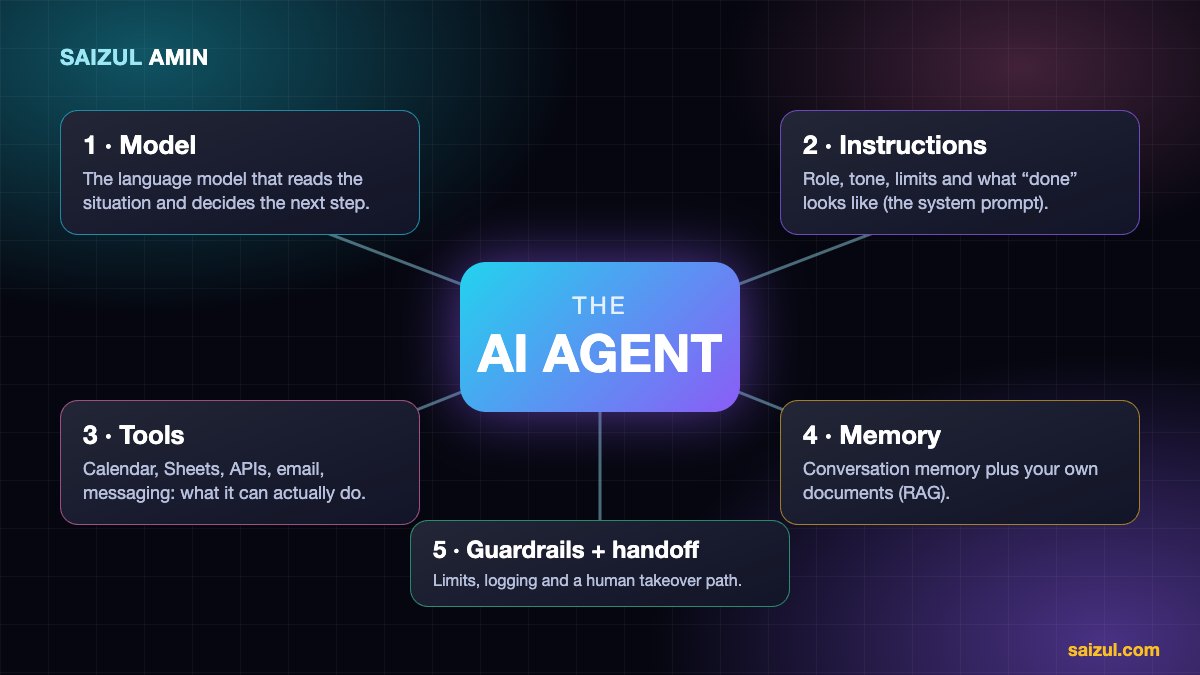
- Model. The language model that reads the situation and decides. Different jobs suit different models; I have used Gemini, GPT-style models, Claude and fast open-weight models served through providers such as Groq and OpenRouter.
- Instructions. The system prompt: who the agent is, how it speaks, what it must never do, and what “done” looks like. Vague instructions are the number one cause of a bad agent.
- Tools. The things it can actually do: look up a price, check availability, write to Google Sheets, send an email, call your internal API. An agent is only as useful as its tools.
- Memory. Short-term memory keeps the conversation coherent. Long-term knowledge (often called RAG, retrieval-augmented generation) lets it answer from your own documents instead of guessing.
- Guardrails and handoff. Limits on what it may do, plus a clean way to pass the conversation to a human. This part decides whether you can trust the agent with real customers.
What AI agents do well today
These are the use cases where I see agents earn their keep, with examples from systems I run in production.
1. Customer conversations on the apps people already use
One of my live agents answers on Facebook Messenger in fluent Bangla, remembers where the conversation stands, saves lead details into Google Sheets and hands the chat to a person the moment the customer asks for one. Customers do not need to install anything or learn a new interface.
2. Booking and enquiry handling
A WhatsApp agent can answer pricing questions, check availability in the chat and confirm a booking, then route the lead to the right mailbox or sheet. This removes the “I will reply in the morning” gap that loses many small-business enquiries.
3. Research and reporting on a schedule
Agents can gather, compare and summarise information every morning (competitor pages, prices, new leads) and deliver one short brief instead of an hour of manual checking.
4. Reading documents and moving data
Invoices, forms and PDFs arrive in messy formats. An agent can extract the fields, validate them and place clean rows in a sheet or accounting tool, flagging anything it is unsure about.
5. Teams of specialised agents
I run a Telegram setup with three specialised agents on different models. You can talk to one directly, or switch to a “council” mode where all three answer in parallel and the results are merged into one structured reply. Splitting roles like this often produces more reliable output than one giant prompt.
Where AI agents still go wrong
Anyone who tells you agents are magic has not run one for a month. These are the issues I plan for on every project:
- Confident wrong answers. Models can invent prices, policies or availability. The fix is grounding (answer only from your data), a clear “I don’t know, let me get a person” fallback, and tools that fetch live facts instead of relying on memory.
- Cost surprises. Every message and every tool call uses model tokens, and a badly designed loop can burn through them. Set iteration limits, use a cheaper model for simple routing, and watch usage from day one.
- Privacy. Know which provider sees which data. Keep sensitive fields out of prompts when you can, and consider self-hosting the workflow layer so conversation logs stay on your own server.
- Over-automation. Refunds, complaints, medical or legal questions should keep a human in the loop. An agent that escalates well is better than one that answers everything.
- Brittle integrations. APIs change. Plan for monitoring and alerts, not a “build once, forget forever” mindset.
Does your business need an AI agent?
A quick test I use in discovery calls. An agent is probably worth it when most of these are true:
- The task repeats many times a week and follows a describable process.
- The inputs are digital: messages, emails, forms, files, spreadsheet rows.
- A wrong answer is recoverable, or a human reviews the risky cases.
- Speed matters, for example customers lose interest if you reply hours later.
It is probably not the right moment if the task happens once a month, the process is not written down anywhere, or a single mistake would be costly and no one can review it. In those cases, improve the process first.
How to start: five steps that keep risk low
- Pick one job. “Answer common questions on WhatsApp and capture leads” beats “automate my business”.
- Write the happy path and ten awkward cases. The awkward cases (angry customer, wrong language, off-topic question) are where agents are tested.
- Choose the channel your customers already use. For many Bangladeshi businesses that is Messenger or WhatsApp rather than a website widget.
- Launch a narrow first version with human handoff. Let it earn trust before you widen its permissions.
- Measure and expand. Read real conversations weekly, fix the prompt and tools, then add the next job.
What does an AI agent cost?
I will not quote a number without knowing the job, because the drivers vary a lot: model usage (per message), hosting (a self-hosted server versus per-task fees on a SaaS platform), build time for integrations, and ongoing maintenance. A focused single-channel agent is a very different project from a multi-agent system with voice and document processing. After a short discovery call I send a written scope and a fixed quote, so there are no open-ended hourly surprises.
AI agent development services: what I build for clients
I design, build, deploy and maintain custom AI agents for businesses. Everything below runs on infrastructure I operate myself (self-hosted n8n and Docker, with the model and channels chosen for your job), and I work in both Bangla and English.
- Customer-support and sales agents for WhatsApp, Facebook Messenger, Telegram, website chat and email: answer questions, qualify leads, book calls and hand over to a human.
- Voice and call agents that listen and speak: voice-note replies, booking conversations, speech-to-text summaries.
- Knowledge (RAG) assistants grounded in your own documents, price lists and SOPs, with a safe “I don’t know” fallback.
- Document and data agents that read invoices, forms and PDFs and push clean data into Google Sheets, your CRM or accounting tool.
- Marketing, ads and SEO agents for content pipelines, comment moderation, reporting and ad-account audits.
- Back-office and multi-agent systems where several specialised agents (researcher, writer, checker, publisher) work as one team.
The process is simple: a free discovery call, a written scope and fixed quote, a focused first version, testing against your real conversations, then deployment with monitoring. You can see live examples on the AI agent services page, browse the portfolio, or tell me about the job you want automated.
Frequently asked questions
Is ChatGPT an AI agent?
ChatGPT is a chatbot product. It can behave in an agent-like way when it is given tools and allowed to take multi-step actions, but a business agent is usually built around your tools, data and rules: your calendar, your price list, your CRM, your tone of voice.
Will AI agents replace my staff?
In the projects I deliver, agents take over the repetitive first-line work (instant replies, data entry, scheduling) so people can spend time on conversations that need judgement. The goal is usually faster response and fewer missed leads, not an empty office.
Is it safe to give an agent access to customer data?
It can be, if you control what data enters the prompt, choose providers deliberately, keep logs on infrastructure you control, and keep a human in the loop for sensitive cases. Treat it like onboarding a new employee: limited access first, more later.
How long does it take to build a simple AI agent?
A focused agent for one channel and one job can often be live in days to a few weeks, depending on integrations and how clear your process is. Testing with real past conversations takes longer than people expect, and it is the part that matters most.
Can an AI agent speak Bangla?
Yes. Current models handle Bangla well enough for customer conversations when the prompt and examples are written for it, and I have agents in production that reply in Bangla. I always test with real local phrasing, mixed Bangla-English messages and typos before launch.
If you want to go deeper on the build side, read my step-by-step guide to building an AI agent with n8n, or compare tools in n8n vs Zapier vs Make.
Sources and further reading
How this article was written
I wrote this myself from hands-on experience building and running AI agents for clients. Product behaviour and pricing models were checked against the official documentation linked above in October 2026. Tools change quickly, so if you spot something out of date, email info@saizul.com and I will correct it.
About the author
Saizul Amin is an AI agent developer, automation engineer and digital growth partner based in Bangladesh. He has built 7 production AI systems on self-hosted n8n, developed 50+ websites and managed 150K+ USD in advertising spend for clients across markets including the UK, the USA and Bangladesh. Learn more about Saizul, see his work, or get in touch.

Md Saizul Amin
Digital Systems Strategist · AI Agent Developer · 9+ years in digital & ITMd Saizul Amin is a digital systems strategist and AI automation engineer from Dhaka, Bangladesh. With 9+ years across IT, web development and digital marketing, he writes practical guides on technology, business, education and online growth — and builds the same kinds of systems (AI agents, websites, SEO and ad campaigns) for clients in Bangladesh, the UK and the USA.
Specialist in
Credentials & experience
- 🎓B.Sc. in Computer Science & EngineeringBangladesh University of Business & Technology (BUBT), 2017–2021
- 🤖AI Automation Engineer · Web Developer · SEO SpecialistUnique Mark Limited, Birmingham UK — 2024 to present
- 🌱IT SpecialistGreen Fund Initiative Inc., USA — 2024 to present
- 🏥Junior IT Consultant — Ministry of Health (DGHS)Built the first national Shareable Health Record website; supported 6,000+ facilities
- 🧭Head of ITWEDO Bangladesh — led IT for 50+ staff, 2021–2023