
In this article
Custom software development cost depends far more on what the software has to do than on the technology used to build it. A small internal tool with a few screens can be built for a few thousand US dollars, while a multi-branch system with accounting, inventory, mobile apps and AI features can run well into six figures. This guide gives realistic estimated ranges by project type for 2026, explains the factors that move a quote up or down, compares pricing models, lists the costs that appear after launch and shows a simple method to set your own budget before you talk to a developer.
From my own work: When a client asks me for a price before we have talked about the work, I can only give a very wide range. After a one-hour call where we list the screens, the users and the systems it must connect to, the range usually narrows a lot. The most expensive projects I have seen were not the biggest ones. They were the ones where the scope kept changing during the build.
If you have not yet decided whether to build at all, read my guides on build vs buy software and custom software vs SaaS first. This article assumes you have a real reason to build and want to know what it will cost.
Custom software development cost by project type (2026 estimates)
The table below shows rough ranges I use for first conversations. They are estimates, not quotes. They assume a small, experienced team or a senior freelancer, a web-based system and a focused first version. Prices in Bangladesh are often lower than in the US, UK or EU for the same work, but quality and experience vary widely in every market.
| Project type | Typical first version | Estimated build cost (USD) | Typical time |
|---|---|---|---|
| Simple internal tool | A few forms, a list view, one or two reports, login | 2,000 to 8,000 | 2 to 6 weeks |
| Customer or partner portal | Accounts, orders or bookings, status pages, notifications | 8,000 to 30,000 | 1 to 3 months |
| Custom CRM or sales system | Leads, pipeline, tasks, quotes, WhatsApp or email links | 8,000 to 40,000 | 2 to 4 months |
| Operations or ERP-style system | Inventory, purchasing, sales, branches, accounting export | 25,000 to 120,000+ | 4 to 12 months |
| Business system plus mobile app | Web admin panel plus an Android and iOS app | 20,000 to 100,000+ | 3 to 9 months |
| AI agent or AI feature added | Chat, document reading or task automation on your data | 3,000 to 40,000 | 3 weeks to 4 months |
For AI work specifically, my AI agent cost guide breaks down model usage, integration and testing costs in more detail. For a marketing website rather than a business system, see small business website cost.
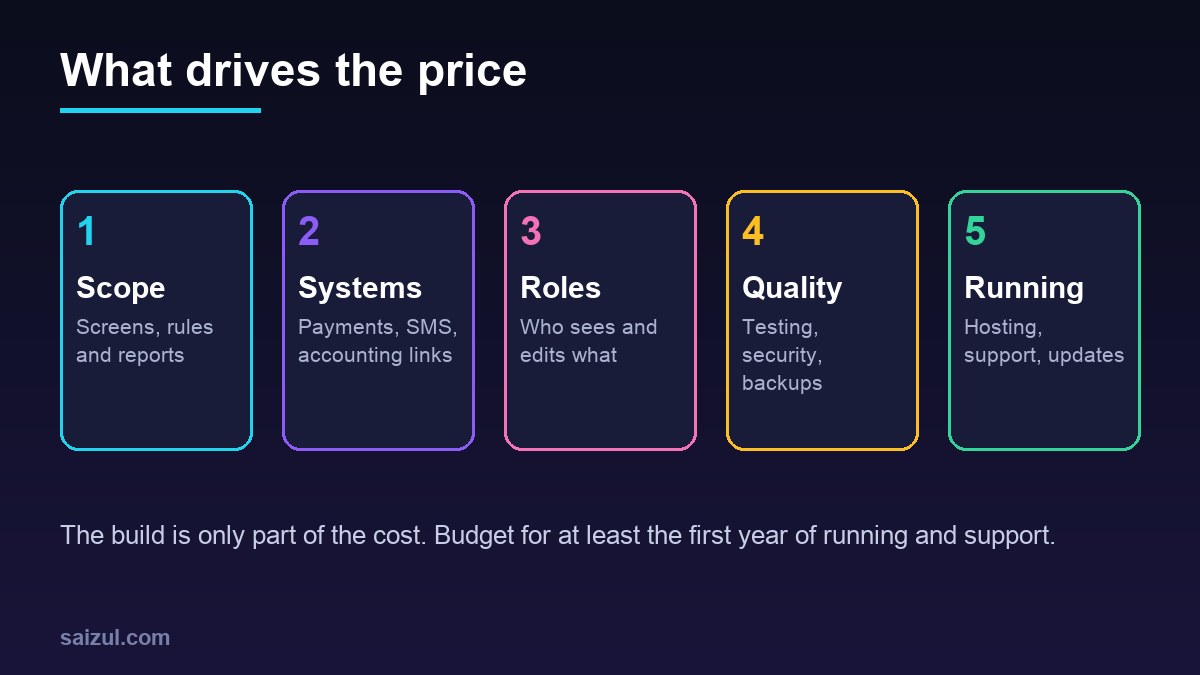
What drives custom software development cost?
1. Scope: screens, rules and reports
Every screen, form, business rule and report takes time to design, build and test. A system with 10 screens and simple rules is a very different job from one with 60 screens, approval chains and custom reports. The fastest way to lower the price is to cut the first version down to what people need every day.
2. Integrations with other systems
Connecting to payment gateways, SMS or WhatsApp providers, courier services, accounting software, Google Workspace or an old database often takes longer than building the screens. Each integration needs authentication, error handling and testing against the other system’s rules. Old systems with no documented API are the most expensive.
3. Users, roles and permissions
One type of user is simple. Owners, managers, branch staff, accountants, delivery riders and customers, each seeing different data, multiplies the testing. Multi-branch or multi-company setups add another layer.
4. Data migration
Moving years of data from spreadsheets or an old system means cleaning duplicates, fixing formats and checking totals. Budget real time for it. It is rarely a one-day job.
5. Quality, security and testing
Testing, code review, backups, logging and security checks are not optional extras. A useful reference is the OWASP Application Security Verification Standard, which sets out security requirements in levels so you can choose how strict a project needs to be (OWASP ASVS). Systems that handle money, health or personal data need the stricter end.
6. Design and usability
A plain, well-organised admin panel costs less than a polished customer-facing app with custom design. Spend design money where customers see it, and keep internal tools simple and fast.
7. Team location and seniority
Hourly rates differ by country and experience. A senior developer may cost more per hour but finish faster and leave fewer bugs. Compare total cost and track record, not the hourly number alone.
Pricing models: fixed price, hourly or monthly team
| Model | How it works | Good for | Risk to watch |
|---|---|---|---|
| Fixed price | Agreed price for a written scope | Clear, stable first versions | Every change becomes a change request |
| Hourly or daily | Pay for time actually spent | Unclear scope, research, small fixes | Budget can drift without weekly reports |
| Monthly retainer or team | Fixed monthly fee for a set capacity | Ongoing products and improvements | Paying for capacity you do not use |
| Phased fixed price | Fixed price per phase, re-scoped after each | Most business projects | Needs discipline to keep phases small |
I usually recommend a phased approach: a fixed-price discovery and first version, then smaller fixed or monthly phases. This follows the same idea as agile delivery in the GOV.UK Service Manual, which describes building in small steps, testing with real users and improving based on what you learn (GOV.UK Service Manual).
Costs after launch that owners often forget
- Hosting and infrastructure: a small business system can run on a modest server or cloud plan; larger systems need databases, backups and monitoring. Cloud providers publish calculators so you can estimate this, for example the Google Cloud pricing calculator (Google Cloud Pricing Calculator).
- Maintenance and updates: frameworks, libraries and servers need security updates. A common rule of thumb is 15 to 25 percent of the build cost per year for maintenance and small improvements. Treat that as an estimate and adjust for how actively you use the system.
- Third-party fees: SMS, WhatsApp messages, payment gateway fees, email sending, maps and AI model usage are usually billed per use.
- Support time: someone has to answer staff questions, fix data mistakes and handle small requests.
- Training: short videos and a written guide save many support calls.
- New features: once people use the system, they will ask for more. Keep a budget line for it.
My website maintenance checklist covers many of the same routine tasks for web systems.
How to set a budget for custom software: step by step
- Write the problem in money terms. For example: “Three staff spend about two hours a day copying orders between systems” or “We lose some orders because stock is wrong”. This gives you a ceiling for what the software is worth.
- List the must-have features for version one. Keep a separate “later” list. Be strict.
- List the users and roles. Who logs in, what each person must see and do.
- List every integration. Payment, SMS, WhatsApp, courier, accounting, existing database.
- Write a short requirements document. Even two to five pages makes quotes far more accurate and comparable.
- Get two or three quotes on the same document. Ask each developer to list assumptions and what is not included.
- Add a contingency. Ten to twenty percent for things nobody saw coming is sensible for most projects.
- Add the first year of running costs before you decide.
How to lower the cost without lowering quality
- Start with one department or one process instead of the whole business.
- Use proven building blocks for login, payments, email and file storage instead of building them from scratch.
- Use a ready-made admin panel framework for internal screens.
- Keep reports simple at first; export to a spreadsheet for edge cases.
- Automate around an existing tool where possible, for example connecting your current accounting software instead of replacing it.
- Decide quickly. Slow feedback from the business side stretches timelines and invoices.
- Freeze the scope of each phase. New ideas go to the next phase list.
How to compare quotes fairly
Two quotes for the same idea can differ by three or four times, and the cheapest is not always the best value. Check:
- Is the scope the same, feature by feature?
- Are testing, deployment, data migration and training included?
- Who owns the source code, the server accounts and the domain?
- What warranty period is offered for bugs after launch?
- What does support cost per month after the warranty?
- Can they show similar work and let you speak to a past client?
- How will progress be shown: weekly demos, a test link, written updates?
My guide on how to hire an AI automation developer or agency lists more questions and red flags that apply to any software project.
Custom software budget checklist
- Problem and expected savings written down in money and hours.
- Version-one feature list and a separate later list.
- Users, roles and permissions listed.
- Integrations listed with the provider names.
- Data migration size and sources known.
- Security level agreed, especially for payments and personal data.
- Pricing model chosen and payment milestones linked to working features.
- Source code ownership and account access in the contract.
- Hosting, third-party fees and maintenance budgeted for year one.
- Ten to twenty percent contingency added.
Need help with this on your own site or business?
I build and secure WordPress sites, web apps and AI automations end to end, in Bangla and English: a free discovery call, a written scope with a fixed quote, a focused first version, then testing, deployment and monitoring.
See the portfolio and the AI agent services, or tell me what you need.
FAQ
How much does custom software cost for a small business?
For a focused first version, many small business tools fall roughly between 2,000 and 30,000 US dollars in 2026, depending on screens, users and integrations. These are estimates. A short requirements document gives you a much tighter quote.
Is custom software cheaper in Bangladesh?
Hourly rates in Bangladesh are often lower than in the US, UK or EU, so the same scope can cost less. Quality varies in every country, so judge by past work, communication and how clearly the developer explains scope and risks.
Why do software quotes vary so much?
Developers make different assumptions about scope, testing, design and support. Ask every bidder to quote on the same written document and to list what is included and excluded. The gaps usually explain the difference.
Is fixed price or hourly better for custom software?
Fixed price suits a clear, stable scope. Hourly suits research and small changes. For most business systems, a phased fixed price with small phases gives the best balance of control and flexibility.
How much should I budget for maintenance each year?
A common rule of thumb is 15 to 25 percent of the build cost per year for updates, fixes and small improvements, plus hosting and per-use fees. Adjust it to how much the system changes and how critical it is.
Sources

Md Saizul Amin
Digital Systems Strategist · AI Agent Developer · 9+ years in digital & ITMd Saizul Amin is a digital systems strategist and AI automation engineer from Dhaka, Bangladesh. With 9+ years across IT, web development and digital marketing, he writes practical guides on technology, business, education and online growth — and builds the same kinds of systems (AI agents, websites, SEO and ad campaigns) for clients in Bangladesh, the UK and the USA.
Specialist in
Credentials & experience
- 🎓B.Sc. in Computer Science & EngineeringBangladesh University of Business & Technology (BUBT), 2017–2021
- 🤖AI Automation Engineer · Web Developer · SEO SpecialistUnique Mark Limited, Birmingham UK — 2024 to present
- 🌱IT SpecialistGreen Fund Initiative Inc., USA — 2024 to present
- 🏥Junior IT Consultant — Ministry of Health (DGHS)Built the first national Shareable Health Record website; supported 6,000+ facilities
- 🧭Head of ITWEDO Bangladesh — led IT for 50+ staff, 2021–2023