In this article
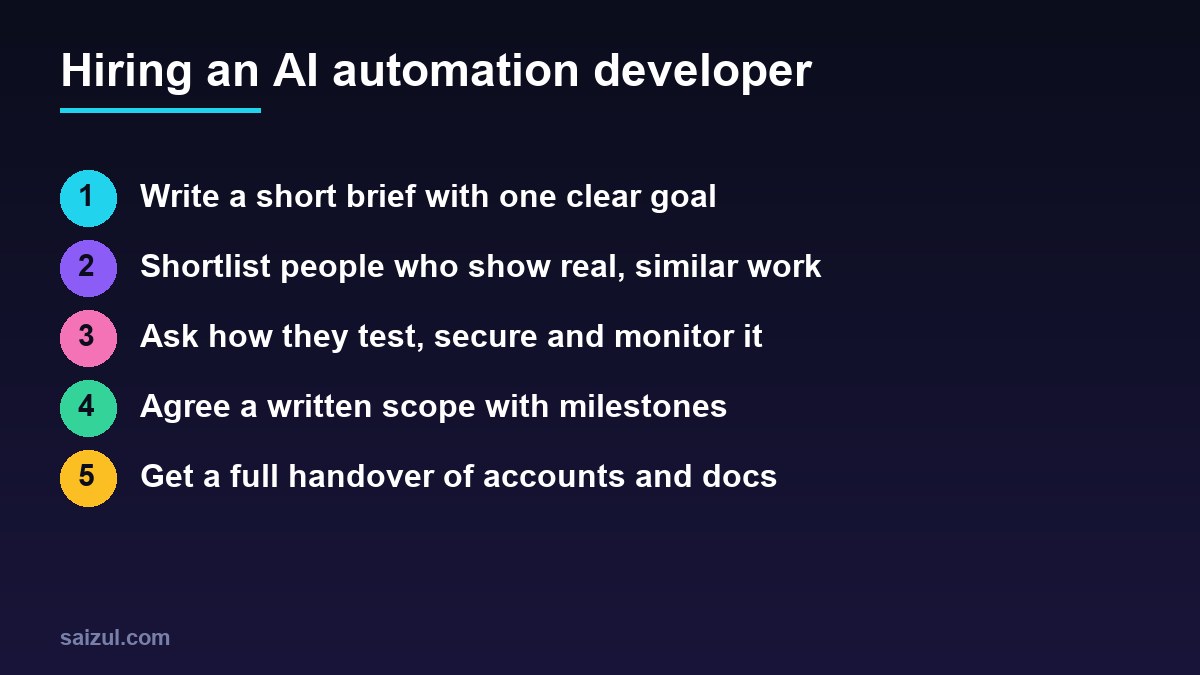
To hire an AI automation developer well, start with a short brief that describes one business problem, shortlist people who can show similar working projects, and ask how they test, secure and monitor what they build. Then agree a written scope with milestones and acceptance tests, and insist on a handover where you own every account, workflow and piece of code. This guide gives you the questions to ask, the red flags to watch for and what good scope and handover documents contain.
From my own work: Several projects I have taken over started as automations built by someone else on that person’s own accounts, with no notes. The business could see that things ran, but nobody could say how, or change anything safely. Most of my first week on those jobs went into finding out what existed before any new work could begin.
Many of the same rules apply to any software hire, so my guide on how to hire a web developer is worth reading too. This article focuses on what is different about AI agents and automation.
What does an AI automation developer do?
An AI automation developer connects your tools and adds AI where it helps. Typical work includes:
- Workflows in tools such as n8n, Zapier or Make that move data between your apps.
- Chatbots and AI agents on your website, WhatsApp or Messenger.
- AI steps that read emails, documents or messages and turn them into structured data.
- Voice agents for calls, and systems where several agents share a task.
- Custom APIs, dashboards and integrations with your CRM, store or accounting software.
Some people are strong at no-code workflows, others at custom code, and others at AI design and testing. Know which kind of work your project needs.
Should you hire a freelancer or an agency?
| Question | Freelancer | Agency |
|---|---|---|
| Who does the work? | Usually the person you speak to | A team, sometimes with a project manager between you |
| Best for | Focused projects, direct communication | Larger projects needing several skills at once |
| Main risk | Availability if they are ill or busy | Junior staff doing the work, higher overhead |
| Ask about | Backup plan and documentation | Who exactly will build and support it |
Step 1: Write a one-page brief
- The problem: what takes time or goes wrong today, in plain words.
- The goal: what should be true when this is finished.
- Current tools: store, CRM, email, sheets, chat channels.
- Volume: roughly how many messages, orders or records per day.
- Languages: for example, Bangla and English.
- Limits: what the system must never do, such as issue refunds without approval.
- Budget range and timeline.
If you are not sure what to automate, start with my list of AI automation workflows for small business. For budgets, see how much an AI agent costs.
Questions to ask before you hire an AI automation developer
About experience
- Can you show a working project similar to mine, and explain what you built yourself?
- What went wrong in that project, and how did you fix it?
- Which tools would you use for this, and why those instead of others?
About AI quality and safety
- How will you test the AI before customers use it? Ask for a test set of real examples with expected answers.
- What happens when the AI is unsure or the request is sensitive? Where is the handover to a person?
- How will you protect against prompt injection and limit what the agent can do? Both are on the OWASP Top 10 for LLM Applications, as prompt injection and excessive agency (OWASP Top 10 for LLM Applications).
- Which customer data will be sent to which AI service, and under what terms?
About reliability
- How will I know when something fails? Who gets the alert?
- Where will it be hosted, and who pays for the hosting?
- What are the expected monthly running costs for tools and AI usage at my volume?
About ownership and support
- Will everything be built in accounts that I own?
- What documentation will I receive?
- What support is included after launch, and what does ongoing maintenance cost?
A good developer answers these plainly and does not mind being asked. A framework such as NIST’s AI Risk Management Framework, which is voluntary, can help you think about who is responsible for which risk (NIST AI RMF).
Red flags to watch for
- Promises of full automation, “no humans needed”, or guaranteed accuracy.
- No questions about your process, data or exceptions before quoting.
- A demo that only shows the happy path, never what happens on bad input.
- Building everything in their own accounts, with no plan to transfer.
- Unclear running costs, or “we will see after launch”.
- No testing plan and no error alerts.
- Asking for your owner passwords instead of creating limited access.
- Large upfront payment with no milestones.
Step 2: What a good scope looks like
A scope is the written agreement on what will be built. For an AI automation project it should include:
- Goal and success measures: for example, share of enquiries answered without a person, response time, hours saved.
- In scope: each workflow, channel and integration, listed by name.
- Out of scope: what is not included, written down so nobody is surprised.
- AI behaviour: topics it may answer, topics it must hand over, tone and languages.
- Data and access: which systems it reads and writes, and with what permissions.
- Testing and acceptance: the test examples it must pass before launch.
- Milestones and payments: tied to delivered, working parts.
- Running costs: estimated monthly tool, hosting and AI usage costs, and who pays them.
- Support: a period after launch for fixes, then a maintenance option.
- Ownership: you own the code, workflows, prompts and data.
Step 3: During the build
- Give limited, separate access: a user for the developer, not your owner login.
- Ask for a short demo at each milestone using your real examples.
- Keep a shared list of decisions and changes.
- Test with your own team before customers see anything.
Step 4: What a good handover includes
- Accounts: the automation platform, hosting, AI service, API keys and domains in your name, with billing on your card.
- Code and workflows: in a repository or export you own. If the code was kept in the developer’s GitHub account, it can be moved to yours; GitHub’s documentation explains that issues, pull requests and commit history move with a transferred repository (GitHub: Transferring a repository).
- Documentation: what each workflow does, its trigger, the systems it touches, and how to switch it off.
- Prompts and knowledge: the AI instructions and the documents it answers from, and how to update them.
- Monitoring: where alerts go and what to do when one arrives.
- A walkthrough session, ideally recorded, for the person who will own the system.
- Access removal for the developer when the support period ends, unless you agree ongoing maintenance.
Common mistakes
- Hiring on price alone without seeing similar work.
- No written scope, only a chat thread.
- Letting the system run on someone else’s accounts.
- Skipping testing with real examples.
- No budget for maintenance after launch.
Quick checklist
- One-page brief with one clear goal.
- Shortlist based on similar, working projects.
- Answers on testing, handover to people, security and running costs.
- Written scope with in and out of scope, acceptance tests and milestones.
- Limited access for the developer, never owner passwords.
- All accounts, code, workflows and prompts owned by you.
- Documentation, alerts and a recorded walkthrough at handover.
- A support period and a maintenance plan.
Need help with this on your own site or business?
I build and secure WordPress sites, web apps and AI automations end to end, in Bangla and English: a free discovery call, a written scope with a fixed quote, a focused first version, then testing, deployment and monitoring.
See the portfolio and the AI agent services, or tell me what you need.
FAQ
How much does it cost to hire an AI automation developer?
It depends on the number of workflows, integrations, AI complexity and support needed. Ask for a written scope and a fixed quote per milestone, plus an estimate of monthly running costs, so you can compare offers fairly.
What should I ask an AI automation agency?
Ask to see similar working projects, how they test AI answers, how the system hands over to a person, who will do the work, what monthly costs to expect, and whether everything will be built in your accounts.
Should I own the n8n workflows and code?
Yes. The workflows, code, prompts, accounts and data should belong to your business, so you can change developer later without starting again.
What is a red flag when hiring an AI developer?
Promises of full automation with no human handover, no testing plan, building in their own accounts, unclear running costs and asking for owner passwords are all warning signs.
Sources

Md Saizul Amin
Digital Systems Strategist · AI Agent Developer · 9+ years in digital & ITMd Saizul Amin is a digital systems strategist and AI automation engineer from Dhaka, Bangladesh. With 9+ years across IT, web development and digital marketing, he writes practical guides on technology, business, education and online growth — and builds the same kinds of systems (AI agents, websites, SEO and ad campaigns) for clients in Bangladesh, the UK and the USA.
Specialist in
Credentials & experience
- 🎓B.Sc. in Computer Science & EngineeringBangladesh University of Business & Technology (BUBT), 2017–2021
- 🤖AI Automation Engineer · Web Developer · SEO SpecialistUnique Mark Limited, Birmingham UK — 2024 to present
- 🌱IT SpecialistGreen Fund Initiative Inc., USA — 2024 to present
- 🏥Junior IT Consultant — Ministry of Health (DGHS)Built the first national Shareable Health Record website; supported 6,000+ facilities
- 🧭Head of ITWEDO Bangladesh — led IT for 50+ staff, 2021–2023