In this article
An AI quotation generator reads a customer enquiry, works out what is being asked for, prices it from your own price list and rules, and drafts a clear quote or estimate for a person to approve and send. For contractors, interior and fit-out firms, printers, fabricators, manufacturers, IT and marketing agencies, event companies and distributors, quoting is often the slowest step in sales: the enquiry sits in an inbox for days while someone senior works out the numbers, and the customer accepts a faster competitor. This guide explains how the system works, what data it needs, where AI helps and where fixed rules must stay in charge, how approvals and follow-ups run, estimated costs and a rollout checklist.
From my own work: When a business asks me to speed up quoting, I usually find the pricing already exists, just in one person’s head and a spreadsheet only they understand. Writing those rules down is most of the project. Once the rules are clear, the AI part, reading messy enquiries and drafting the quote, is the easier half.
Quoting sits between lead capture and invoicing. If leads are still scattered, start with CRM automation for small business. For the basics of what an AI agent is and does, see what is an AI agent.
What an AI quotation generator actually does
It is not one magic model that “knows” your prices. It is a small system with clear parts:
| Part | What it does | AI or rules? |
|---|---|---|
| Enquiry reader | Reads emails, web forms, WhatsApp messages and attachments; extracts items, quantities, sizes, location and deadline | AI, with a person checking unclear cases |
| Clarifying questions | Asks the customer for missing details, such as size, material or delivery address | AI drafts, rules decide what is required |
| Product and service matching | Maps the request to items in your catalogue or service list | AI suggests, a person confirms when unsure |
| Pricing engine | Applies price lists, quantity breaks, labour rates, materials, delivery and tax | Rules only |
| Margin and risk checks | Flags low margin, unusual discounts, missing costs and large orders | Rules |
| Quote document | Branded PDF or online quote with terms, validity and payment schedule | Template, with AI writing the scope description |
| Approval | Routes the quote to the right person by value or discount | Rules |
| Follow-up | Reminders, questions, acceptance and deposit | Automation, with AI drafting replies |
The key design decision: the price comes from rules you can test, not from the model’s guess. Language models are good at reading messy requests and writing clear text, but they can produce confident wrong numbers. The OWASP Top 10 for LLM applications lists risks such as relying too much on model output (OWASP LLM Top 10), which is exactly what pricing must avoid.
The data you need before building
- Catalogue or service list: every item or service you quote, with a code, unit (piece, square foot, hour, day) and description.
- Price rules: base prices, quantity breaks, size or material multipliers, rush charges, minimum order, delivery or travel charges.
- Cost data: material and labour costs, so the system can check margin.
- Discount limits: how much each role may discount without approval.
- Tax rules: how VAT or sales tax applies to each item and customer type. In the UK, for example, HMRC’s VAT guide sets out the general rules (VAT Notice 700); check with your accountant for your country.
- Standard terms: validity period, payment schedule, delivery time, warranty and exclusions.
- Past quotes: a few dozen real quotes, won and lost, to test the system against.
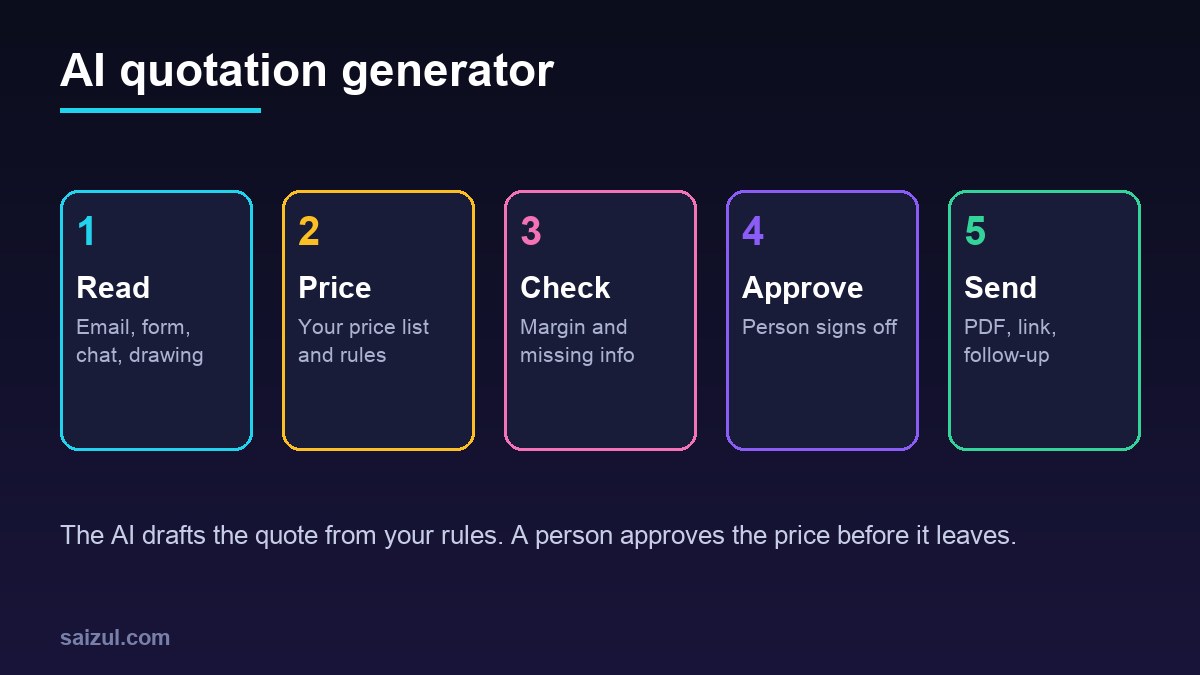
How a quote is produced, step by step
- Enquiry arrives by email, website form, WhatsApp or a sales rep’s notes. Attachments such as drawings, photos or spreadsheets are stored with it.
- AI extracts the request: items, quantities, sizes, materials, location and deadline, in a structured list. Anything it is unsure about is marked.
- Missing details: if a required field is empty, the system drafts a short question to the customer, for a person to send or for automatic sending on simple cases.
- Pricing: the rules engine prices each line and adds delivery, installation and tax.
- Checks: margin below target, discount above limit, a line with no price, or an order above a set value are flagged.
- Approval: small, standard quotes may go to a sales person; large or unusual ones go to a manager or the owner.
- Send: the quote goes out as a branded PDF or an online page with an accept button, validity date and payment terms.
- Follow-up: a polite check-in after a few days, a reminder before the quote expires, and a task for a person if the customer has questions.
- Accept: on acceptance, the system creates the order or job and can request a deposit. Payment platforms support this; Stripe, for example, documents quotes that convert into invoices or subscriptions (Stripe Quotes).
Examples by type of business
| Business | What the AI reads | What the rules price |
|---|---|---|
| Printing and signage | Size, material, quantity, finishing from a message or artwork file | Area-based rates, setup fee, quantity breaks, installation |
| Interior and renovation | Room list, measurements, finish level from a site visit form and photos | Rates per square foot by finish, materials allowance, labour days |
| Metal or wood fabrication | Dimensions and material from a drawing or sketch | Material weight, cutting and welding time, coating |
| Distributor or wholesaler | Product list pasted in an email, often with brand names spelled differently | Customer price group, stock, delivery charge |
| IT, web or marketing agency | Brief or call notes | Packages and add-ons, hourly or daily rates |
| Event and catering | Date, guests, venue, menu choices | Per-head pricing, staff, equipment hire, travel |
For businesses that quote from drawings or scanned documents, reading files is the same problem covered in AI document processing for business.
What the AI should never decide alone
- Final prices and discounts: always from rules, with approval above limits.
- Technical feasibility: whether a structure, install or deadline is possible needs a qualified person.
- Legal terms: contract wording should come from approved templates, not be rewritten per quote.
- Promises: delivery dates and warranties should match what operations can actually do.
The NIST AI Risk Management Framework is a useful reference for thinking about where human oversight is needed in AI systems (NIST AI RMF). For a quoting tool, the practical answer is simple: a named person approves every price that leaves the business, at least until months of reviewed quotes show the rules are reliable for small, standard jobs.
Follow-up and win rate
Many quotes are lost not on price but on silence. A follow-up sequence that stays polite helps:
- Day 2 or 3: “Did the quote cover everything you needed?”
- Halfway through validity: answer a likely question, such as delivery time or options.
- Two days before expiry: a reminder that prices are held until a date.
- After expiry: ask whether to update the quote, then stop.
Track every quote’s status: draft, sent, viewed, accepted, lost with reason. Lost reasons such as price, timing or chose another supplier are the most useful data the system will produce. Automating these steps is close to what I describe in lead generation automation.
Quoting tool, CRM add-on or custom AI quotation generator?
| Option | Good for | Watch out for |
|---|---|---|
| Quote templates in accounting or CRM software | Simple catalogues and fixed prices | No reading of messy enquiries, little rule logic |
| CPQ software (configure, price, quote) | Larger sales teams with configurable products | Cost, setup time, often built for one region |
| Custom AI quotation generator | Businesses whose pricing depends on sizes, materials, labour or customer groups, and enquiries arriving as free text | Rules must be written and maintained; needs testing against past quotes |
If your website lists products or packages with prices, structured data such as the schema.org Offer type can describe them consistently (Schema.org Offer), which also makes the same data easier to reuse in quotes.
AI quotation generator cost (2026 estimates)
These ranges are estimates for planning. They depend on how complex your pricing is, how many channels enquiries arrive from and which systems need to connect.
| Scope | Includes | Estimated cost (USD) |
|---|---|---|
| Quote template automation | Form or spreadsheet to branded PDF, email and follow-up reminders | 800 to 3,000 |
| Rules-based quote builder | Catalogue, price rules, margin checks, approvals, quote status tracking | 3,000 to 12,000 |
| AI quotation generator | Enquiry reading from email and chat, clarifying questions, rules engine, approvals, PDF and accept link | 6,000 to 25,000 |
| Running costs | AI model usage, hosting, e-sign or payment fees, maintenance | Varies with volume; budget monthly |
My AI agent cost guide explains model usage and maintenance in more detail.
Rollout plan
- Collect 30 to 50 past quotes and the enquiries that led to them.
- Write your pricing rules in plain language and turn them into a tested price calculator first.
- Check the calculator against past quotes and fix the differences.
- Add AI enquiry reading for one channel, usually email, with a person reviewing every extraction.
- Add approvals, branded PDFs and the accept link.
- Add follow-up reminders and lost-reason tracking.
- Review monthly: time to quote, win rate, margin and the most common corrections.
AI quotation generator checklist
- Catalogue and units cleaned and coded.
- Pricing, discount and tax rules written and tested.
- Required fields defined for each type of request.
- Prices always from rules, never from the model.
- Approval limits by quote value and discount.
- Approved terms and validity in the template.
- Follow-up schedule with clear stop rules.
- Quote status and lost reasons tracked.
- Tested against real past quotes before going live.
Need help with this on your own site or business?
I build and secure WordPress sites, web apps and AI automations end to end, in Bangla and English: a free discovery call, a written scope with a fixed quote, a focused first version, then testing, deployment and monitoring.
See the portfolio and the AI agent services, or tell me what you need.
FAQ
What is an AI quotation generator?
It is a system that reads customer enquiries, extracts what is being asked for, prices it from your own price list and rules, and drafts a quote for a person to approve and send, followed by reminders until the customer decides.
Can AI set the prices in my quotes?
It should not. AI is good at reading enquiries and writing descriptions, but prices should come from tested rules and price lists, with approval limits, so every number can be explained.
Which businesses benefit most from automated quoting?
Businesses that quote often and price by size, material, quantity, labour or customer group: printers, fabricators, contractors, interior firms, distributors, agencies and event companies.
Can it read drawings or photos?
It can often extract dimensions, item lists and notes from clear drawings, spreadsheets and photos, but a person should check those values before the quote is priced, especially for technical work.
How long does it take to build an AI quotation generator?
A rules-based quote builder can take four to eight weeks. Adding AI enquiry reading, approvals and follow-up usually brings it to two to four months, mostly spent writing and testing pricing rules.
Sources

Md Saizul Amin
Digital Systems Strategist · AI Agent Developer · 9+ years in digital & ITMd Saizul Amin is a digital systems strategist and AI automation engineer from Dhaka, Bangladesh. With 9+ years across IT, web development and digital marketing, he writes practical guides on technology, business, education and online growth — and builds the same kinds of systems (AI agents, websites, SEO and ad campaigns) for clients in Bangladesh, the UK and the USA.
Specialist in
Credentials & experience
- 🎓B.Sc. in Computer Science & EngineeringBangladesh University of Business & Technology (BUBT), 2017–2021
- 🤖AI Automation Engineer · Web Developer · SEO SpecialistUnique Mark Limited, Birmingham UK — 2024 to present
- 🌱IT SpecialistGreen Fund Initiative Inc., USA — 2024 to present
- 🏥Junior IT Consultant — Ministry of Health (DGHS)Built the first national Shareable Health Record website; supported 6,000+ facilities
- 🧭Head of ITWEDO Bangladesh — led IT for 50+ staff, 2021–2023