
In this article
Loan management software keeps every borrower, loan, repayment schedule, collection and overdue balance in one system, from the first application to the final instalment. For microfinance institutions, cooperatives and credit unions, NGO lending programmes, small finance companies and businesses that sell motorbikes, electronics or machinery on instalments, it replaces ledger books, collection sheets and spreadsheets that break every time a payment is late or a loan is rescheduled. The benefits are practical: correct schedules and interest every time, field officers collecting with receipts on a phone, overdue loans flagged on the day they fall due, and portfolio reports that match the cash and the accounts. This guide explains the modules that matter, how the loan cycle should work, how schedules and interest methods differ, how field collection apps work, how to manage overdue loans, how to protect borrower data, where automation and AI help, and when ready-made software is enough, with estimated costs and a checklist.
From my own work: When lenders show me their spreadsheets, the trouble usually starts with exceptions: a partial payment, a holiday that shifts a collection day, a rescheduled loan. Each one is fixed by hand and the totals slowly drift. Writing the rules for these cases down before building anything, and testing the schedule maths against real past loans, is the step I never skip.
If you sell on instalments and also send invoices, my guide on accounts receivable automation covers reminders and payment links. For collecting payments digitally, see how to accept online payments in Bangladesh.
Core modules of loan management software
| Module | What it does | Why it matters |
|---|---|---|
| Borrowers and groups | Borrower profile, ID, address, guarantor, photo, group or centre membership | One record per person across all loans |
| Loan products | Amount limits, term, interest method, fees, repayment frequency, grace period | Consistent rules for every loan of a type |
| Applications and approval | Application form, documents, checks, approval levels | Clear decisions with a record of who approved |
| Disbursement and schedules | Disbursement record and the full repayment schedule | Borrower and branch know every due date |
| Collections | Receipts at the branch, in the field or through digital payments | Every payment recorded once, with a receipt |
| Overdue management | Days past due, follow-up tasks, penalties if your policy allows | Problems seen early |
| Savings and deposits | Compulsory or voluntary savings where your licence allows | Common in microfinance and cooperatives |
| Accounting and reports | Journal entries, branch cash, portfolio and regulator reports | Books and portfolio always agree |
The loan cycle, step by step
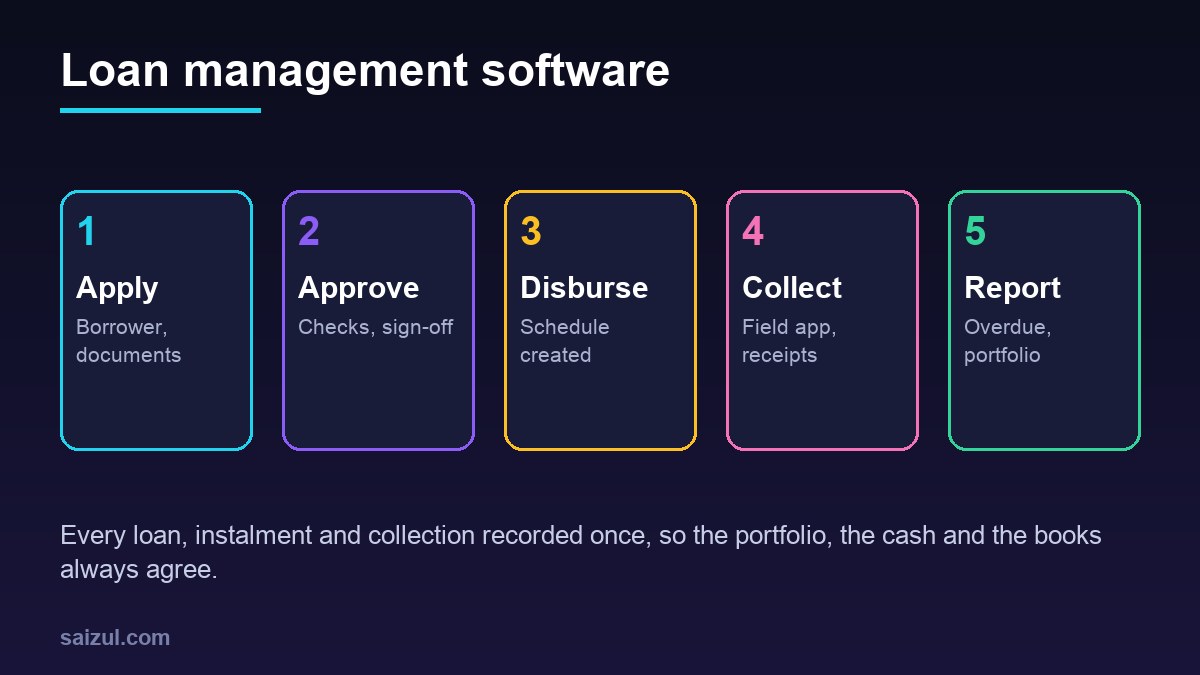
- Application: the officer captures borrower details, the loan purpose, amount, term and documents, often on a tablet in the field.
- Checks: identity, existing loans with you, household or business income, guarantor details and any credit information you are allowed to use.
- Approval: approval levels depend on amount, for example branch manager up to a limit and head office above it. Every approval is logged with name and time.
- Disbursement: cash, bank or mobile money disbursement is recorded, and the repayment schedule is generated and shared with the borrower.
- Collection: instalments are collected at group meetings, at the branch, by field officers or digitally, and matched to the schedule.
- Monitoring: overdue loans appear on the officer’s list the day after a missed instalment.
- Closure: when the loan is fully repaid, it is closed, documents are returned if needed and the borrower may become eligible for a repeat loan.
Repayment schedules and interest methods
The schedule engine is the heart of the system. It must produce exactly the numbers your policy says, including in odd cases.
| Method | How interest is calculated | Notes |
|---|---|---|
| Flat rate | On the original loan amount for the whole term | Simple to explain, but the effective rate is higher than the stated rate |
| Declining balance | On the outstanding principal each period | Interest falls as principal is repaid; widely used and easier to compare |
| Equal instalments | Same instalment each period, split between interest and principal | Common for monthly loans |
| Equal principal | Same principal each period plus interest on the balance | Higher early payments, lower later |
Also decide how the system treats weekly, fortnightly or monthly frequencies, holidays and meeting days, grace periods, early repayment, partial payments and rescheduling. Write each rule down, then test the software against real past loans before going live. Pricing and disclosure rules differ by country and licence, so confirm them with your regulator. In Bangladesh, microcredit organisations are licensed and supervised by the Microcredit Regulatory Authority (MRA), while banks and finance companies fall under Bangladesh Bank (Bangladesh Bank).
Field collection apps
Many borrowers pay in person, so the field app often matters more than the head office screens.
- Today’s collection list: each officer sees the groups and borrowers due today, with amounts and past arrears.
- Fast entry: select a borrower, enter the amount, confirm. Partial payments are allowed and recorded as such.
- Receipts: the borrower gets an SMS or printed receipt instantly, which builds trust and reduces disputes.
- Offline mode: rural areas often have weak signal, so collections are stored safely on the device and synced later.
- Cash reconciliation: at the end of the day, the officer’s collected total must match the cash handed over at the branch.
- Location and time: each collection is stamped with time and, if your policy allows, location, which helps audits.
Overdue loans and follow-up
Portfolio quality is usually measured by how much of the outstanding balance is overdue beyond a set number of days, often called portfolio at risk. The software should calculate it daily per officer, branch and product.
- Classify loans by days past due, such as 1 to 30, 31 to 90 and over 90 days.
- Create follow-up tasks automatically: a reminder message on day 1, an officer visit by day 7, a manager review later.
- Record every contact and promise to pay, with the date.
- Apply penalties or fees only if your policy and regulations allow them, and show them clearly to the borrower.
- Keep rescheduling and write-offs as approved actions with a full audit trail.
Treat borrowers with respect in every message. Organisations such as CGAP publish research on responsible finance and client protection (CGAP), and the World Bank tracks financial inclusion globally (World Bank).
Security, audit trail and borrower data
Lending software holds money records and personal data, so it is a target for fraud from outside and inside.
- Every user has their own login with a role: officer, branch manager, accountant, auditor, admin.
- No one can edit or delete a posted transaction; corrections are reversal entries with a reason.
- Approval limits are enforced by the system, not by trust.
- An audit log records who did what and when, and auditors get read-only access.
- Use multi-factor sign-in for managers and admins, encrypted backups and regular security testing against a standard such as the OWASP ASVS (OWASP ASVS).
- Collect only the borrower data you need and restrict who can see ID documents.
Where automation and AI help
- Reminders: SMS or WhatsApp reminders before each due date, and polite overdue notices after it. See my guide on a WhatsApp AI agent for business.
- Balance questions: borrowers ask an assistant for their balance or next due date and get an answer from live data after identity checks.
- Document reading: AI extracts details from ID cards and application forms for staff to verify. See AI document processing for business.
- Risk signals: reports highlight loans or officers with unusual patterns, such as repeated partial payments or many collections entered late.
- Daily summaries: management gets disbursement, collection and overdue figures each morning.
Keep approval decisions with trained people. If any scoring model is used, document how it works, check it for unfair bias and follow the rules that apply to your licence.
Ready-made vs custom loan management software
| Option | Good for | Watch out for |
|---|---|---|
| Ready-made lending software | Standard loan products and simple branch structures | Local interest rules, regulator report formats, Bangla support, per-loan fees |
| Open-source core banking or lending platform | Institutions with an IT team | Hosting, customisation and support are your responsibility |
| Custom loan management software | Instalment sellers, cooperatives and lenders with special products or field workflows | Higher upfront cost; schedule logic must be tested very carefully |
My build vs buy software guide explains the decision in more depth.
Loan management software cost (2026 estimates)
These ranges are estimates for planning, not quotes. Real prices depend on the number of branches, users, loans, products, integrations and your regulator’s reporting needs.
| Option | Typical scope | Estimated cost (USD) |
|---|---|---|
| Ready-made subscription | Borrowers, loans, schedules, collections, basic reports | Roughly 50 to 500 per month, often priced by active loans |
| Custom instalment tracker | Customers, instalment plans, collections, reminders | 4,000 to 12,000 |
| Custom loan management software | Products, approvals, schedules, field app, overdue, accounting, reports | 15,000 to 50,000+ |
| Reminder and AI assistant | Due-date reminders, balance answers, daily summaries | 1,500 to 6,000, plus messaging and usage fees |
Add hosting, SMS costs, security testing and yearly maintenance. My custom software development cost guide explains how to budget the first year.
Rollout plan
- Write down every loan product with its interest method, fees, frequency and rules for holidays, partial payments and rescheduling.
- Test the schedule engine against real past loans until every figure matches.
- Migrate active loans with their outstanding balances and arrears, and reconcile with your accounts.
- Pilot in one branch with the field app for one month.
- Roll out branch by branch, with daily cash reconciliation from the first day.
- Add reminders, AI features and regulator reports once the core data is reliable.
Loan management software checklist
- Loan products configured with clear, written rules.
- Schedules tested against real past loans.
- Approval levels enforced by amount.
- Field app with receipts, offline mode and daily cash reconciliation.
- Overdue classification and follow-up tasks every day.
- No editing of posted transactions; reversals with reasons.
- Audit log, role-based access and multi-factor sign-in for managers.
- Accounting entries and regulator reports from the same data.
- Encrypted daily backups and a tested restore.
Need help with this on your own site or business?
I build and secure WordPress sites, web apps and AI automations end to end, in Bangla and English: a free discovery call, a written scope with a fixed quote, a focused first version, then testing, deployment and monitoring.
See the portfolio and the AI agent services, or tell me what you need.
FAQ
What is loan management software?
It is software that manages borrowers, loan products, applications, approvals, repayment schedules, collections, overdue follow-up and reports, so a lender can track every loan from application to closure.
What is the difference between flat and declining balance interest?
Flat interest is calculated on the original loan amount for the whole term. Declining balance interest is calculated on the outstanding principal, so it falls as the loan is repaid. Software must apply whichever method your product uses.
Can field officers collect instalments with a phone app?
Yes. A field app shows the day’s collection list, records payments, sends receipts and works offline, then syncs with the branch. Cash collected must be reconciled each day.
Can a business that sells on instalments use loan management software?
Yes. Shops selling motorbikes, electronics, furniture or machinery on instalments often need a simpler version: customers, instalment plans, collections and reminders.
How long does it take to build loan management software?
A simple instalment tracker can take one to two months. A full system with approvals, field app, accounting and reports usually takes four to six months, including careful testing of schedules.
Sources

Md Saizul Amin
Digital Systems Strategist · AI Agent Developer · 9+ years in digital & ITMd Saizul Amin is a digital systems strategist and AI automation engineer from Dhaka, Bangladesh. With 9+ years across IT, web development and digital marketing, he writes practical guides on technology, business, education and online growth — and builds the same kinds of systems (AI agents, websites, SEO and ad campaigns) for clients in Bangladesh, the UK and the USA.
Specialist in
Credentials & experience
- 🎓B.Sc. in Computer Science & EngineeringBangladesh University of Business & Technology (BUBT), 2017–2021
- 🤖AI Automation Engineer · Web Developer · SEO SpecialistUnique Mark Limited, Birmingham UK — 2024 to present
- 🌱IT SpecialistGreen Fund Initiative Inc., USA — 2024 to present
- 🏥Junior IT Consultant — Ministry of Health (DGHS)Built the first national Shareable Health Record website; supported 6,000+ facilities
- 🧭Head of ITWEDO Bangladesh — led IT for 50+ staff, 2021–2023