In this article
Hiring a web developer is one of the bigger decisions a small business makes online. Get it right and you have a fast, secure site that brings in enquiries for years. Get it wrong and you may lose months and money, end up with a site you cannot edit, or discover that the developer registered your domain in their own name. Most bad outcomes are not caused by bad luck. They come from a vague brief, quotes that cannot be compared, no written agreement and no plan for handover. This guide walks through each step from the client’s side, so you know what to ask for and what to watch out for.
From my own work: I am a developer myself, so I see this from the other side. The projects that go smoothly are rarely the biggest or the most expensive. They are the ones where the client and I agreed in writing, at the start, what would be built, what it would cost, who would supply the content and who would own what at the end.
Step 1: Decide what kind of help you need
| Option | Suits | Watch out for |
|---|---|---|
| Freelancer | Small to medium sites, a clear scope, a direct relationship | Availability, holidays, what happens if they get busy or ill |
| Agency | Larger projects needing design, development and marketing together | Higher cost, and who actually does the work |
| Do it yourself with a builder | Very simple sites and tight budgets | Your own time, limits of the platform |
If you are not sure what budget is realistic, read how much a small business website costs first. For online stores, WooCommerce vs Shopify helps you decide the platform before you talk to developers.
Step 2: Write a clear brief
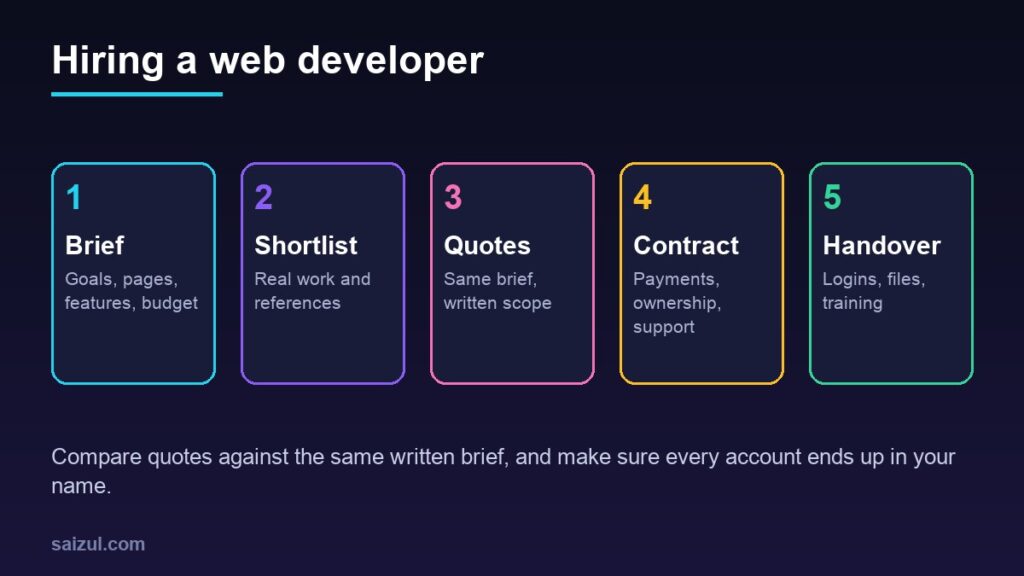
A brief is a short document, one to three pages, that every developer quotes against. Without it, each quote is based on a different guess. Include:
- About the business: what you do, who your customers are, where they are.
- Goal of the site: calls, quote requests, online orders, bookings. Pick the main one.
- Pages: a list, such as home, about, services or product categories, contact, policies.
- Features: online payments, booking, Bangla and English, WhatsApp button, blog, customer accounts.
- Content: who writes the text and supplies the photos. This is the most common cause of delays.
- Examples: two or three sites you like and why, and anything you do not want.
- Existing assets: your domain, hosting, logo, current site, email.
- Budget range and deadline, including any fixed launch date.
Step 3: Shortlist developers carefully
- Look at real, live sites they have built, not only screenshots. Open them on your phone and check the speed; see why speed matters for sales.
- Ask for one or two past clients you can contact, and ask them whether the project was on time and how support has been since.
- Check that they have built something similar to what you need, such as an online store with local payment gateways.
- Pay attention to how they communicate before you hire them: clear answers, reasonable response times and good questions about your business are good signs.
Step 4: Get and compare written quotes
Send the same brief to three developers and ask for a written proposal that lists:
- What is included, page by page and feature by feature, and what is not.
- The platform, theme and paid plugins or apps, and who pays their yearly licences.
- The timeline, with milestones.
- How many rounds of design and content changes are included.
- Ongoing costs after launch: hosting, domain renewal, maintenance and support.
The cheapest quote is often missing items that will be charged later, and the most expensive is not automatically the best. Compare what each one actually delivers.
Red flags to watch for
- Guaranteed rankings. Many developers also sell SEO. Google’s own advice is that no one can guarantee a number one ranking on Google, and that if someone guarantees first place in search results, you should find someone else (do you need an SEO?).
- Secrecy. Google also warns to be careful if a company is secretive or will not clearly explain what it intends to do. The same applies to development work.
- Registering your domain or hosting in their own name, or refusing to give you admin access.
- Pirated “nulled” themes or plugins offered to save money. They are a common source of malware.
- Full payment upfront for a large project with no milestones.
- No written scope, or vague answers about what is included.
- Unsolicited offers by email or message promising a complete website and top rankings for a very low price.
Step 5: Put it in a written agreement
For a small project, a simple written agreement or a detailed proposal that both sides accept by email is far better than nothing. It should cover:
- Scope: the pages and features from the proposal, and how extra work will be priced.
- Timeline and responsibilities: including when you will deliver the content.
- Payment schedule: commonly a deposit, a payment at a milestone such as design approval, and the balance at launch.
- Ownership: that you own the domain, hosting account, content and the finished site once paid, and which licences are in your name.
- Testing and launch: what “finished” means, and a short period after launch for fixing bugs.
- Support and maintenance: what happens after launch, at what cost. See my website maintenance checklist.
- Ending the agreement: what happens to work and payments if either side stops.
For larger or higher-value projects, ask a lawyer to review the contract. This article is practical guidance, not legal advice.
Step 6: Keep ownership of your domain and accounts
Your domain is the address of your website and usually your email. ICANN’s summary of registrants’ benefits and responsibilities says registrants must provide accurate contact information and update it promptly, must respond to their registrar’s inquiries within 15 days, and are entitled to instructions from the registrar on how to transfer, renew and restore registrations (registrants’ benefits and responsibilities). If the developer is listed as the registrant, those rights and duties are theirs, not yours.
- Register the domain yourself, or make sure it is registered in the business’s name with your email address. See how to choose a domain name.
- Open the hosting account in your name and give the developer their own access. See how to choose web hosting.
- Ask for your own administrator login on the website from the first day.
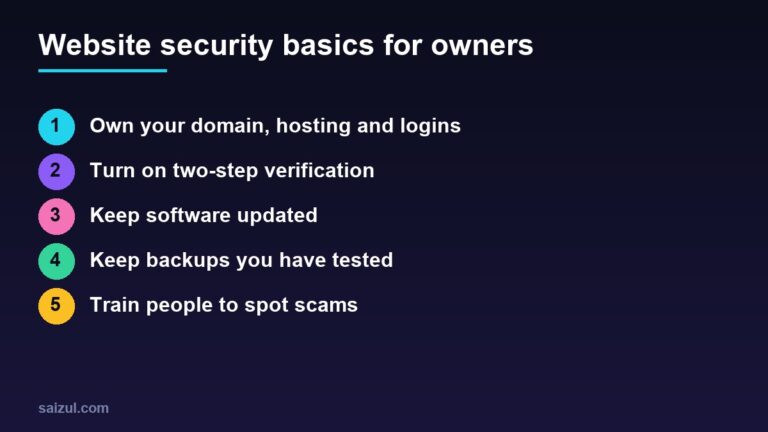
My guide to website security basics for business owners explains why this matters long after launch.
Step 7: Work well together during the project
- Name one person on your side who gives feedback and approves work.
- Collect feedback into one list per round instead of many separate messages.
- Deliver content on time; most delays start here.
- Ask to review the site on a staging link before it goes live.
- Agree changes to the scope in writing, with the cost, before the work is done.
Step 8: Plan the handover
Before you pay the final balance, check that you have:
- Admin access to the website, hosting, domain, DNS and any email accounts.
- Licence keys or accounts for paid themes and plugins, in your name where possible.
- A working backup and an explanation of how backups run.
- Google Search Console and Analytics set up with your account as owner; see Search Console for beginners.
- A short training session or video on updating pages, products and posts.
- A list of what still needs regular updates, and who will do them.
Common mistakes
- Hiring on price alone without a written brief.
- Letting the developer own the domain or hosting.
- Paying everything upfront.
- Leaving content to the last week.
- Agreeing changes by phone with no written record.
- No plan for updates, backups and security after launch.
Quick checklist
- A one to three page brief with goals, pages, features, content and budget.
- Three developers shortlisted from real, live work and references.
- Written quotes with scope, exclusions, timeline and ongoing costs.
- No ranking guarantees, secrecy or nulled software.
- A written agreement covering payments, ownership and support.
- Domain, hosting and admin access in your own name.
- Staging review, testing and a full handover before the final payment.
Need help with this on your own site or business?
I build and secure WordPress sites, web apps and AI automations end to end, in Bangla and English: a free discovery call, a written scope with a fixed quote, a focused first version, then testing, deployment and monitoring.
See the portfolio and the AI agent services, or tell me what you need.
FAQ
How much should I pay a web developer?
It depends on the scope, the platform and the developer’s experience. Get three written quotes against the same brief and compare what each includes, including ongoing costs, rather than the headline price alone.
Should I pay a web developer upfront?
For anything beyond a very small job, pay in stages: a deposit to start, a payment at an agreed milestone and the balance at launch, once you have checked the site and received all access.
Who should own my website domain?
You or your business. Register it with your own email address, or make sure you are listed as the registrant, and give the developer separate access if they need it.
Is a freelancer or an agency better?
A freelancer often suits a small or medium site with a clear scope and a direct relationship. An agency may suit larger projects that need several specialists. Judge both on real work, references and a clear written proposal.
Sources

Md Saizul Amin
Digital Systems Strategist · AI Agent Developer · 9+ years in digital & ITMd Saizul Amin is a digital systems strategist and AI automation engineer from Dhaka, Bangladesh. With 9+ years across IT, web development and digital marketing, he writes practical guides on technology, business, education and online growth — and builds the same kinds of systems (AI agents, websites, SEO and ad campaigns) for clients in Bangladesh, the UK and the USA.
Specialist in
Credentials & experience
- 🎓B.Sc. in Computer Science & EngineeringBangladesh University of Business & Technology (BUBT), 2017–2021
- 🤖AI Automation Engineer · Web Developer · SEO SpecialistUnique Mark Limited, Birmingham UK — 2024 to present
- 🌱IT SpecialistGreen Fund Initiative Inc., USA — 2024 to present
- 🏥Junior IT Consultant — Ministry of Health (DGHS)Built the first national Shareable Health Record website; supported 6,000+ facilities
- 🧭Head of ITWEDO Bangladesh — led IT for 50+ staff, 2021–2023