In this article
From my own builds: I’m Saizul Amin, an AI agent developer and automation engineer. I run AI agent systems in production on self-hosted n8n and Docker (Messenger, WhatsApp, Telegram and email), so the advice below comes from operating them, not from reading about them. Last reviewed: October 2026.
Every business has the same problem: the answers customers and staff need are buried in PDFs, price lists, SOPs, FAQs and emails. A general AI chatbot does not know any of it, and when it does not know, it guesses. RAG (Retrieval-Augmented Generation) is the standard fix: before the AI answers, the system first looks up the relevant parts of your documents and gives them to the model, so the answer is grounded in your facts.
I build knowledge assistants like this for businesses, with retrieval on a vector database (Pinecone is one I use) wired into n8n workflows and AI agents. This guide explains RAG in plain language, how to build one that is actually accurate, and when you should not use it.
What RAG is, in one paragraph
A language model is trained on public data up to a point in time. It knows nothing about your company’s prices, policies or product manuals, and it cannot see documents you wrote yesterday. RAG adds a retrieval step: the question is used to search your documents, the best matching passages are inserted into the prompt, and the model writes an answer from those passages, ideally with a citation. No retraining is needed, and you update the knowledge by updating the documents.
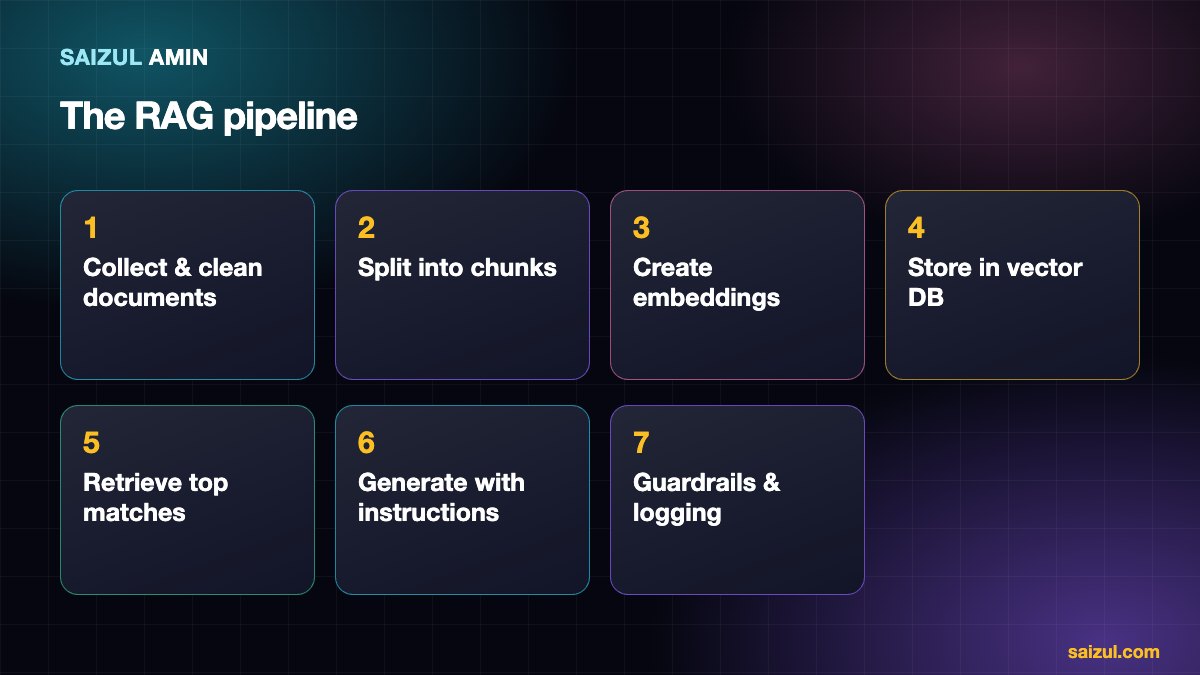
The RAG pipeline step by step
1. Collect and clean your documents
PDFs, Word files, web pages, spreadsheets, help-centre articles. This step decides your quality ceiling: out-of-date, contradictory or messy documents produce wrong answers. Remove duplicates, mark the latest version and add metadata (product, date, language, audience).
2. Split into chunks
Documents are cut into passages (chunks) because search works on small, focused pieces. A common starting point is a few hundred words per chunk with a small overlap so ideas are not cut in half. Respect structure: split by headings, keep tables intact and keep a title with each chunk.
3. Create embeddings
An embedding model converts each chunk into a list of numbers that represents its meaning. Questions are converted the same way, so “How do I get a refund?” lands near the chunk about the refund policy even without the same words. For Bangla or mixed-language content choose a multilingual embedding model and test it.
4. Store in a vector database
Embeddings and their text go into a vector store (Pinecone, Qdrant, pgvector in PostgreSQL, Chroma and others). It finds the closest chunks to a question quickly.
5. Retrieve
For each question, fetch the top few matching chunks (often three to eight). Better systems combine meaning search with keyword search and re-rank the results.
6. Generate with instructions
The model receives the question, the retrieved chunks and clear instructions:
Answer using ONLY the context below. If the answer is not in the context,
say you do not know and offer to connect the customer with a team member.
Quote the document name for each fact. Do not guess.

Context:
{retrieved chunks}

Question: {customer question}
7. Add guardrails and logging
Log the question, retrieved sources and answer. Set a similarity threshold below which the system says “I don’t know” instead of guessing, and a human handoff for important topics.
RAG vs prompting vs fine-tuning
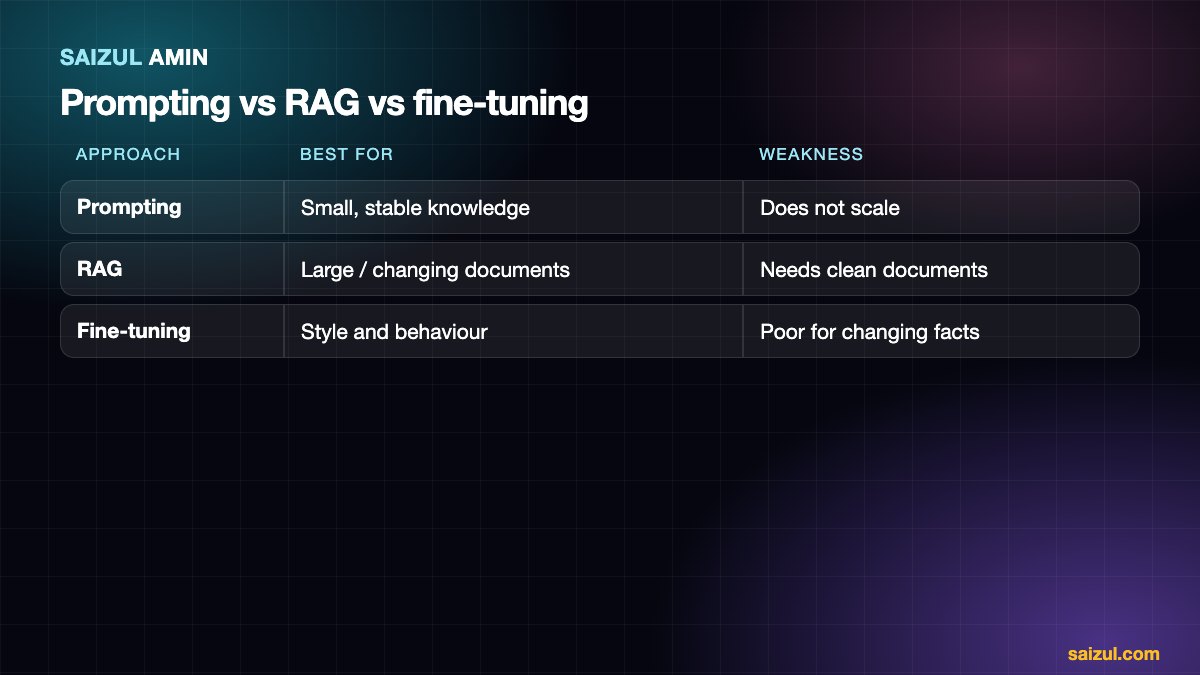
| Approach | Best for | Weakness |
|---|---|---|
| Prompting (paste the facts in the instructions) | Small, stable knowledge (a one-page FAQ) | Does not scale; every call carries the full text |
| RAG | Large or changing documents; answers with sources | Quality depends on document and retrieval quality |
| Fine-tuning | Style, format, behaviour or narrow repeated tasks | Poor for facts that change; costly; hard to update |
For “answer from our documents”, RAG is almost always the right first choice. Many production systems combine all three: good instructions, RAG for facts and sometimes a tuned model for tone.
Building one with n8n (the practical shape)
- Ingestion workflow: read files from Google Drive, a folder or a URL list, split them, embed them and write to the vector store. Run it on a schedule or when files change.
- Chat workflow: a chat or channel trigger (WhatsApp, Messenger, Telegram, web) goes into an AI Agent node that has the vector store as a tool, plus memory and a handoff path.
- Test set: write 30 to 50 real questions with the correct answers and the source document. Re-run it after every change.
The workflow side is covered in how to build an AI agent with n8n. A RAG tool is simply one more tool you give the agent.
How to make RAG accurate
- Fix the documents first. Most “AI mistakes” are document problems: old prices, two versions of a policy, scanned images with no text.
- Chunk by meaning, not by fixed length alone; keep titles and context in each chunk.
- Use metadata filters (language, product, region) so the system does not mix, for example, UK and Bangladesh policies.
- Hybrid search and re-ranking improve retrieval over embeddings alone.
- Make “I don’t know” a valid answer and measure how often it is used.
- Show sources so users can verify, and so you can debug.
- Evaluate. Track whether the right chunk was retrieved and whether the answer is supported by it (groundedness).
Risks to manage
- Hallucination: reduced, not eliminated. Keep guardrails and human review for high-stakes answers (medical, legal, financial).
- Prompt injection: a document or web page can contain instructions aimed at the AI. Treat retrieved text as data, restrict what tools the agent can call, and do not index untrusted content blindly.
- Privacy and access: do not put confidential documents in an index that every user can query. Filter by permission, and know which provider processes the text.
- Freshness: schedule re-indexing and remove retired documents.
- Cost: embeddings are cheap; the cost is mostly model calls per answer, plus vector storage. Limit retrieved context and cache frequent questions.
The NIST AI Risk Management Framework is a useful reference for thinking about these risks.
When you should not use RAG
- The knowledge fits in one page: put it in the instructions.
- You need exact calculations or live data: call a database or API as a tool instead.
- Your documents are poor or contradictory: fix them first or the bot will faithfully repeat the mess.
- You need a human decision: use the AI to prepare, not to decide.
Good business use cases
| Use case | Documents | Result |
|---|---|---|
| Customer support assistant | FAQs, policies, price lists, product manuals | Instant, consistent answers on WhatsApp or the website |
| Internal staff assistant | SOPs, onboarding docs, HR policies | Less time asking colleagues |
| Sales enablement | Product sheets, case studies, proposals | Faster, better-informed replies to leads |
| Education or training | Course materials, handbooks | A study assistant that cites the material |
Need this built for your business?
I design, build, deploy and maintain custom AI agents and automations for businesses, on infrastructure I operate myself (self-hosted n8n and Docker), in Bangla and English.
- WhatsApp, Messenger, Telegram and web-chat agents that answer, qualify leads, book and hand over to a human.
- Knowledge (RAG) assistants that answer from your own documents, with sources and a safe “I don’t know”.
- Voice, document and back-office agents, plus multi-agent teams for research, writing and reporting.
- Hosting and DevOps: secure n8n and Docker setups, backups, monitoring and updates.
The process: a free discovery call, a written scope and fixed quote, a focused first version, testing on your real conversations, then deployment with monitoring. See live systems on the AI agent services page, browse the portfolio, or tell me about the job you want automated.
Frequently asked questions
Is RAG the same as training the AI on my data?
No. Training changes the model. RAG leaves the model as it is and retrieves your documents at question time, which is simpler, cheaper and easy to update.
Will my data be used to train the AI?
That depends on the provider and plan. Check each provider’s data terms, use business or API plans that do not train on your data where possible, and keep sensitive documents out of the index if unsure.
How many documents do I need?
Even a handful of high-quality documents can work. Quality and structure matter more than quantity.
Can it work in Bangla?
Yes, with a multilingual embedding model and a language model that handles Bangla, and with testing on real Bangla questions.
How long does a RAG chatbot take to build?
A focused first version on a well-prepared document set can take days to a couple of weeks. Cleaning the documents and testing take most of the time.
Sources and further reading
- n8n documentation: Advanced AI
- Pinecone: What is Retrieval-Augmented Generation?
- NIST AI Risk Management Framework
How this article was written
I wrote this myself from hands-on experience building and running AI agents and automations for clients. Product behaviour, policies and pricing models were checked against the official documentation linked above in October 2026. Tools, policies and prices change quickly; if you notice something out of date, email info@saizul.com and I will correct it.
About the author
Saizul Amin is an AI agent developer, automation engineer and digital growth partner based in Bangladesh. He has built 7 production AI systems on self-hosted n8n, developed 50+ websites and managed 150K+ USD in advertising spend for clients across markets including the UK, the USA and Bangladesh. Learn more about Saizul, see his work, or get in touch.

Md Saizul Amin
Digital Systems Strategist · AI Agent Developer · 9+ years in digital & ITMd Saizul Amin is a digital systems strategist and AI automation engineer from Dhaka, Bangladesh. With 9+ years across IT, web development and digital marketing, he writes practical guides on technology, business, education and online growth — and builds the same kinds of systems (AI agents, websites, SEO and ad campaigns) for clients in Bangladesh, the UK and the USA.
Specialist in
Credentials & experience
- 🎓B.Sc. in Computer Science & EngineeringBangladesh University of Business & Technology (BUBT), 2017–2021
- 🤖AI Automation Engineer · Web Developer · SEO SpecialistUnique Mark Limited, Birmingham UK — 2024 to present
- 🌱IT SpecialistGreen Fund Initiative Inc., USA — 2024 to present
- 🏥Junior IT Consultant — Ministry of Health (DGHS)Built the first national Shareable Health Record website; supported 6,000+ facilities
- 🧭Head of ITWEDO Bangladesh — led IT for 50+ staff, 2021–2023