In this article
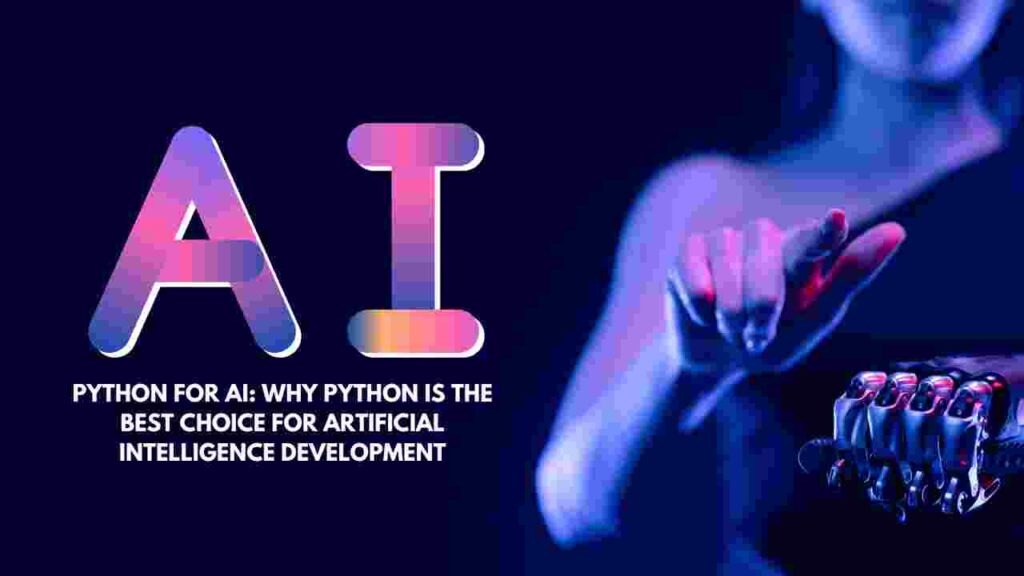
Artificial Intelligence (AI) is rapidly transforming industries worldwide, revolutionizing the way we interact with technology, solve problems, and enhance efficiency. When it comes to developing AI applications, one programming language stands out above the rest: Python. In this article, we will explore the significance of Python for AI, its benefits, libraries, applications, and why it has become the go-to language for AI development.
What is Python for AI?
Python for AI refers to the utilization of the Python programming language to develop artificial intelligence applications. Python’s simplicity, readability, and vast ecosystem of libraries make it an ideal choice for both beginners and experienced developers.
Python’s versatility allows developers to create a wide range of AI solutions, including machine learning models, natural language processing tools, computer vision systems, and robotics. Its open-source nature and strong community support contribute to continuous improvements and innovation in AI development.
Why Python is the Best Choice for AI Development
Python offers several advantages that make it a preferred choice for AI development.
1. Simplicity and Readability
Python’s syntax is straightforward and easy to understand, which allows developers to focus more on problem-solving rather than complex code structures. This simplicity accelerates the AI development process and improves collaboration between developers.
2. Comprehensive Libraries and Frameworks
Python offers a wide range of libraries and frameworks specifically designed for AI and machine learning development. Some of the most popular ones include:
- NumPy: A fundamental package for scientific computing.
- Pandas: Essential for data manipulation and analysis.
- TensorFlow: A powerful framework for deep learning and neural networks.
- Keras: A high-level neural networks API, compatible with TensorFlow.
- PyTorch: A flexible deep learning framework.
- Scikit-Learn: A comprehensive library for traditional machine learning techniques.
- OpenCV: A library for computer vision and image processing.
3. Robust Community Support
Python’s active community provides extensive documentation, tutorials, and forums, making it easier for developers to troubleshoot issues and enhance their skills.
4. Versatility and Flexibility
Python’s compatibility with various platforms and its ability to integrate with other programming languages make it a versatile choice for AI projects.
5. Scalability
Python’s scalability allows developers to create AI applications of varying complexity, from small-scale projects to large enterprise solutions.
Applications of Python in AI
Python is widely used across various domains of AI. Some of the prominent applications include:
1. Machine Learning
Python provides a wide range of libraries and frameworks for developing machine learning models, including supervised, unsupervised, and reinforcement learning.
2. Deep Learning
Python’s TensorFlow, Keras, and PyTorch libraries are extensively used for building deep learning models, including neural networks, convolutional neural networks (CNNs), and recurrent neural networks (RNNs).
3. Natural Language Processing (NLP)
Python’s libraries like NLTK, SpaCy, and Transformers facilitate the development of NLP applications, including text classification, sentiment analysis, and language translation.
4. Computer Vision
Python’s OpenCV library allows developers to build image recognition, object detection, and facial recognition systems.
5. Robotics
Python is often used in robotics for programming, simulation, and automation tasks. Libraries like PyRobot and ROS provide tools for robot development.
6. Predictive Analytics
Python’s data science libraries enable developers to build predictive analytics models to forecast trends and make data-driven decisions.
Popular Python Libraries for AI
| Library | Purpose |
| TensorFlow | Deep learning and neural networks |
| PyTorch | Flexible deep learning framework |
| Keras | High-level neural networks API |
| Scikit-Learn | Traditional machine learning algorithms |
| NumPy | Scientific computing |
| Pandas | Data manipulation and analysis |
| OpenCV | Computer vision and image processing |
| NLTK | Natural language processing |
| SpaCy | NLP with deep learning capabilities |
| Matplotlib | Data visualization |
Challenges of Using Python for AI
While Python offers numerous advantages for AI development, it is not without challenges.
1. Performance Limitations
Python is an interpreted language, which can result in slower execution speed compared to compiled languages like C++ or Java.
2. Memory Consumption
Python’s memory usage is relatively high, which may be problematic for resource-intensive AI applications.
3. Mobile Computing Challenges
Python is not the most suitable language for mobile computing, which may limit its applicability in AI-powered mobile applications.
4. Limited Support for Real-Time Processing
Python’s performance may be inadequate for real-time processing in some AI applications.
Conclusion
The use of Python for AI continues to grow due to its simplicity, versatility, and extensive ecosystem of libraries. From machine learning to natural language processing and robotics, Python has established itself as the dominant language for AI development.
By leveraging Python’s capabilities, developers can build innovative AI solutions that address real-world challenges across various industries. As AI technology continues to evolve, Python’s role in its advancement is expected to remain significant.

Md Saizul Amin
Digital Systems Strategist · AI Agent Developer · 9+ years in digital & ITMd Saizul Amin is a digital systems strategist and AI automation engineer from Dhaka, Bangladesh. With 9+ years across IT, web development and digital marketing, he writes practical guides on technology, business, education and online growth — and builds the same kinds of systems (AI agents, websites, SEO and ad campaigns) for clients in Bangladesh, the UK and the USA.
Specialist in
Credentials & experience
- 🎓B.Sc. in Computer Science & EngineeringBangladesh University of Business & Technology (BUBT), 2017–2021
- 🤖AI Automation Engineer · Web Developer · SEO SpecialistUnique Mark Limited, Birmingham UK — 2024 to present
- 🌱IT SpecialistGreen Fund Initiative Inc., USA — 2024 to present
- 🏥Junior IT Consultant — Ministry of Health (DGHS)Built the first national Shareable Health Record website; supported 6,000+ facilities
- 🧭Head of ITWEDO Bangladesh — led IT for 50+ staff, 2021–2023