In this article
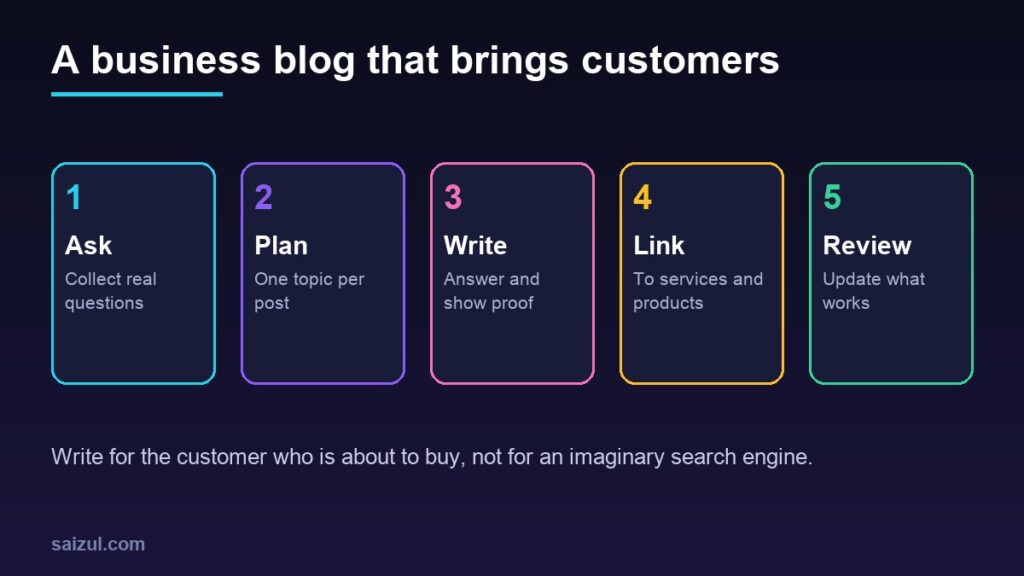
A business blog is not a diary and it is not a news page. Done well, it is a library of answers to the questions your customers ask before they buy: how much it costs, which option suits them, how long it takes, what can go wrong. Each answer can be found in Google, shared on Facebook or sent in a WhatsApp reply, and it keeps working long after you publish it. This guide shows how to start one without wasting months on posts nobody reads.
From my own work: On the business sites I manage, the posts that bring enquiries are rarely the clever ones. They are plain answers to questions the owner hears every week, written with the owner’s own experience and linked to the right service page.
Why a business blog is worth the effort
- Search visibility: your service pages can only target a few phrases. Blog posts cover the many specific questions around them.
- Trust: a customer who reads a clear, honest answer from you is more likely to contact you than a competitor with only a price list.
- Sales support: your team can send a link instead of typing the same explanation again.
- Ownership: a social media post fades in days. A page on your own site stays yours.
Be realistic about time. A new blog usually takes months, not weeks, to bring steady traffic. It is a long-term asset, not a quick campaign.
Step 1: Put the blog on your own website
Host the blog on your business domain, for example yourbusiness.com/blog/, not on a free platform with someone else’s name in the address. That way every visit and every link helps your own site.
- On WordPress, the blog is built in. My guide on starting a WordPress blog covers the setup.
- Use short, readable URLs such as
/blog/ac-servicing-cost/. Google’s SEO Starter Guide recommends words in URLs that are useful to people. - Show the author’s name with a short bio, and keep an About page that explains who runs the business.
- Connect the site to Google Search Console from day one so you can see which searches find you.
Step 2: Find topics from real customer questions
You do not need expensive tools to start. Your best topic list is already in your inbox, Messenger and call log.
- For two weeks, write down every question customers ask before buying.
- Group similar questions. Each group can become one post.
- Check how people phrase them. Type the question into Google and look at the suggestions and the “People also ask” box.
- Prioritise questions asked by people close to buying, such as cost, comparison and “which one should I choose”.
| Post type | Example for a furniture shop | Why it works |
|---|---|---|
| Cost guide | How much does a custom wardrobe cost? | Buyers search this right before choosing |
| Comparison | Board vs solid wood: which lasts longer? | Helps a buyer decide |
| How-to | How to measure a room for a sofa | Useful before ordering |
| Problem | Why wooden doors swell in the rainy season | Shows expertise, leads to repair jobs |
For a deeper method, see my keyword research guide for beginners.
Step 3: Write posts that are actually helpful
Google’s guidance on people-first content is a good writing brief for any business. In plain terms:
- Answer the question early. Give the short answer in the first paragraphs, then the detail.
- Show first-hand experience. Your own photos, real examples, what you have seen go wrong. This is something a competitor copying generic text cannot add.
- Be specific. Ranges, steps, materials, timelines. Say when the answer depends on something and explain what.
- Forget word counts. Google says it has no preferred length. Write as much as the question needs.
- Use clear structure. Short paragraphs, descriptive headings, a list where steps are involved, and a unique title for every post.
A simple outline works for most posts: the question, the short answer, the details, common mistakes, when to call a professional, and a link to your service.
Step 4: Link posts to what you sell
A blog post that brings a visitor but no next step is only half done.
- Link from each post to the most relevant service or product page using descriptive link text.
- Link related posts to each other, so a reader can continue.
- Add one clear call to action at the end: call, WhatsApp, request a quote or view the product.
What to avoid
- Publishing many thin posts quickly to cover keywords. Google’s spam policies treat mass-produced pages made mainly to rank as scaled content abuse, however they were produced.
- Copying or lightly rewording articles from other sites.
- Changing the date to look fresh without updating the content.
- Writing only company news that customers are not searching for.
Step 5: Keep a schedule you can maintain
Consistency beats volume. Two good posts a month for a year are worth more than twenty rushed posts in one month followed by silence. Keep a simple sheet with the topic, target question, status and publish date. Every few months, open Search Console, find posts that get impressions but few clicks, and improve their titles and content.
How to tell if it is working
- Search Console: impressions and clicks per post, and the queries that find them.
- Analytics: visits from organic search and clicks on your contact buttons. My GA4 setup guide shows how to track them.
- Ask new customers how they found you. Many will mention a specific article.
Quick checklist
- Blog on your own domain, with an author name and bio.
- A list of at least ten real customer questions.
- Short answer first, details and real examples after.
- Unique title and readable URL for every post.
- Links to the related service page and one call to action.
- A schedule you can keep for a year.
Need help with this on your own site or business?
I build and secure WordPress sites, web apps and AI automations end to end, in Bangla and English: a free discovery call, a written scope with a fixed quote, a focused first version, then testing, deployment and monitoring.
See the portfolio and the AI agent services, or tell me what you need.
FAQ
How often should a small business post on its blog?
As often as you can publish something genuinely useful. For most small businesses two to four good posts a month is a realistic and effective pace.
How long should a blog post be?
Long enough to answer the question properly. Google has no preferred word count, so let the topic decide the length.
Should I write in Bangla or English?
Write in the language your customers search in. If you serve both, keep each post in one language rather than mixing them on the same page.
When will my blog start bringing traffic?
Usually after a few months of consistent publishing. New sites take longer; posts that answer specific questions tend to show results first.
Sources

Md Saizul Amin
Digital Systems Strategist · AI Agent Developer · 9+ years in digital & ITMd Saizul Amin is a digital systems strategist and AI automation engineer from Dhaka, Bangladesh. With 9+ years across IT, web development and digital marketing, he writes practical guides on technology, business, education and online growth — and builds the same kinds of systems (AI agents, websites, SEO and ad campaigns) for clients in Bangladesh, the UK and the USA.
Specialist in
Credentials & experience
- 🎓B.Sc. in Computer Science & EngineeringBangladesh University of Business & Technology (BUBT), 2017–2021
- 🤖AI Automation Engineer · Web Developer · SEO SpecialistUnique Mark Limited, Birmingham UK — 2024 to present
- 🌱IT SpecialistGreen Fund Initiative Inc., USA — 2024 to present
- 🏥Junior IT Consultant — Ministry of Health (DGHS)Built the first national Shareable Health Record website; supported 6,000+ facilities
- 🧭Head of ITWEDO Bangladesh — led IT for 50+ staff, 2021–2023