In this article
Many small businesses never have a customer walk through the door. An AC technician goes to the flat, a caterer delivers to the venue, a home tutor visits the student, a pest control team visits the office. These businesses still need to appear when someone searches “AC repair near me” or “catering service in Mirpur”. Local SEO works a little differently for them, and many owners get the setup wrong at the very first step. This guide covers the setup and the website work that makes the difference.
From my own work: When I audit profiles for home-service businesses, the most common problem is not a lack of keywords. It is a home address shown publicly, a business name stuffed with service words, or a service area drawn far wider than the team can actually cover.
What counts as a service-area business
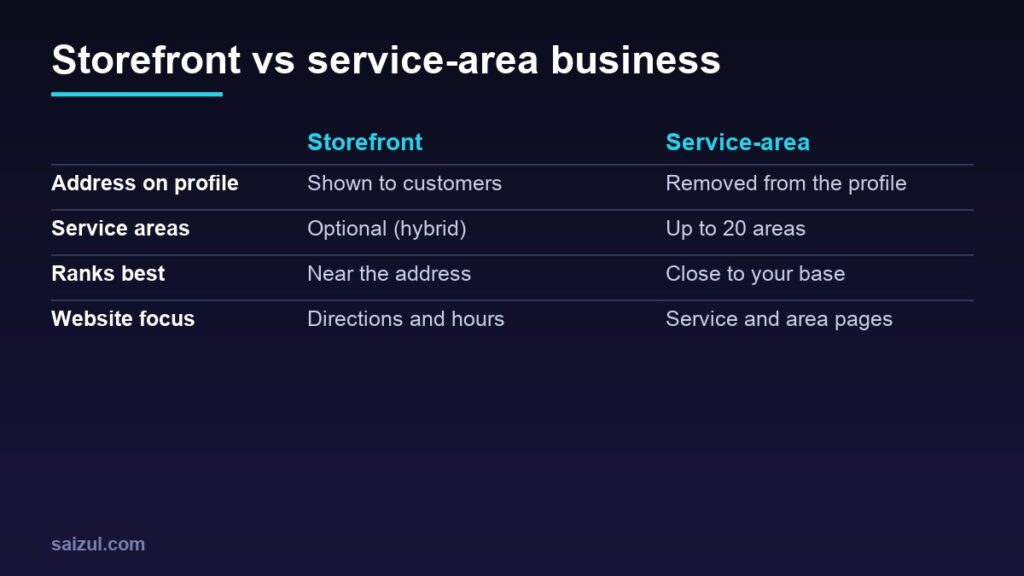
Google separates businesses into three groups (guidelines for representing your business):
- Storefront: customers come to you, for example a shop, salon or clinic.
- Service-area business: you go to customers and do not serve them at your address, for example a plumber working from home.
- Hybrid: you do both, for example a repair workshop that also does home visits.
Online sellers who only ship parcels and never meet customers are a separate case. A Business Profile is meant for businesses that have in-person contact with customers, either at a location or at the customer’s place. If you only sell online, focus on your website and on Google Merchant Center instead.
Step 1: Set up the profile the right way
- Use your real business name. The name on the profile should match what you use on your signboard, invoices and website. Adding service words or area names (“Rahim AC Service Best AC Repair Dhaka”) is against the guidelines and can get the profile suspended.
- Remove the address if customers do not come to you. Google’s help page is direct about this: if you don’t serve customers at your address, remove it from the profile (manage your service areas). You still need a real address for verification; it just will not be shown.
- Keep both if you are hybrid. A workshop that receives customers and also travels should show the address and add service areas.
- Pick the right primary category. Choose the category that describes the main service, then add a few secondary categories that are genuinely true.
- Add a real phone number that someone answers during the hours you list.
The full checklist for categories, photos and posts is in my Google Business Profile optimization guide.
Step 2: Choose service areas you can really cover
You can add up to 20 service areas, by city, postal code or another area type. Google also says the area should not extend beyond about two hours of driving time from your base, and you cannot draw it as a radius (service areas).
- Start with the areas where you already have customers and can arrive on time.
- Add more only when you can actually serve them. A wide area looks attractive but leads to cancelled jobs and poor reviews.
- Understand what the service area does not do. It tells customers where you work; it does not guarantee that you appear in every one of those areas.
How ranking works when your address is hidden
Google ranks local results on three main factors: relevance, distance and prominence (tips to improve your local ranking). For a service-area business this has a practical meaning:
- Relevance comes from an accurate category, a clear description, a complete list of services and a website that explains them.
- Distance is still measured from where Google knows you are based, even though the address is hidden. Expect to be strongest close to your base.
- Prominence comes from reviews, links and mentions across the web. This is where you can grow in areas further away.
Google also states that you cannot pay for a better local ranking. Anyone who promises a guaranteed top position in Maps is selling something they cannot deliver.
Step 3: Build a website that explains services and areas
Your website does a lot of the work that a shop front would do. Keep it simple and honest:
- One page per main service, for example AC installation, AC servicing and gas refill. Each page should say what is included, typical time, price range or how pricing works, and which areas you cover.
- A short “areas we serve” section listing the same areas as your profile.
- Area pages only when you have something real to say. A page for a specific area is useful if it includes work you did there, local details or a team member based there. Dozens of near-identical pages that only swap the area name are treated as doorway pages under Google’s spam policies.
- Same name and phone number everywhere: website, profile, Facebook page and directory listings.
- Click-to-call and WhatsApp buttons on mobile, because most local searches end in a call or a message.
For the page-level basics such as titles and headings, use my on-page SEO checklist.
Step 4: Earn reviews and local mentions
Reviews matter even more when customers cannot visit you first. Ask every satisfied customer, right after the job is finished and checked, with your short review link. I explain a policy-safe system in how to get more Google reviews.
- Ask customers to mention the service and area naturally if they wish, but never write the review for them.
- Get listed in genuine local directories, trade associations and supplier “where to buy” pages.
- Add real job photos to the profile: before and after, the team in uniform, the vehicle.
Common mistakes
- Creating several profiles for different areas without a real staffed location in each.
- Using a virtual office or a friend’s shop address to look like a storefront.
- Listing the whole country as a service area.
- Changing the business name to chase a keyword.
Quick checklist
- Real business name, no extra keywords.
- Address removed if customers do not visit you; kept if you are hybrid.
- Service areas you can reach, within about two hours.
- One clear website page per main service.
- Same name and phone number everywhere.
- A steady flow of genuine reviews with replies.
For the wider picture, including storefront businesses, read the local SEO guide for small businesses.
Need help with this on your own site or business?
I build and secure WordPress sites, web apps and AI automations end to end, in Bangla and English: a free discovery call, a written scope with a fixed quote, a focused first version, then testing, deployment and monitoring.
See the portfolio and the AI agent services, or tell me what you need.
FAQ
Can I get a Google Business Profile without a shop?
Yes, if you visit customers in person. You set it up as a service-area business, verify it with your real address, and then remove the address from public view.
Will I rank in every area I add?
No. Service areas tell customers where you work. Ranking still depends on relevance, distance and prominence, so you are usually strongest near your base.
Can I use my home address?
Yes, for verification. If customers do not come to your home, remove the address from the profile so it is not shown publicly.
Should I create a page for every area?
Only where you have real, specific content for that area. Copying one page many times with a different area name can be treated as spam.
Sources

Md Saizul Amin
Digital Systems Strategist · AI Agent Developer · 9+ years in digital & ITMd Saizul Amin is a digital systems strategist and AI automation engineer from Dhaka, Bangladesh. With 9+ years across IT, web development and digital marketing, he writes practical guides on technology, business, education and online growth — and builds the same kinds of systems (AI agents, websites, SEO and ad campaigns) for clients in Bangladesh, the UK and the USA.
Specialist in
Credentials & experience
- 🎓B.Sc. in Computer Science & EngineeringBangladesh University of Business & Technology (BUBT), 2017–2021
- 🤖AI Automation Engineer · Web Developer · SEO SpecialistUnique Mark Limited, Birmingham UK — 2024 to present
- 🌱IT SpecialistGreen Fund Initiative Inc., USA — 2024 to present
- 🏥Junior IT Consultant — Ministry of Health (DGHS)Built the first national Shareable Health Record website; supported 6,000+ facilities
- 🧭Head of ITWEDO Bangladesh — led IT for 50+ staff, 2021–2023