In this article
The artificial intelligence landscape in 2026 has witnessed unprecedented competition among frontier models. While OpenAI’s GPT-4o and Anthropic’s Claude 3.5 Sonnet long dominated enterprise workflows, the emergence of DeepSeek V3—an open-weights mixture-of-experts (MoE) model trained at a fraction of Silicon Valley’s compute budgets—has drastically disrupted the economics of AI development.
For engineering leads, indie hackers, and automation architects, choosing between these three models is no longer just about raw reasoning scores; it is an optimization problem balancing cost per million tokens, coding precision (HumanEval / SWE-bench), time to first token (TTFT), and context window reliability. In this benchmark analysis, we evaluate empirical production metrics across all three flagship systems.
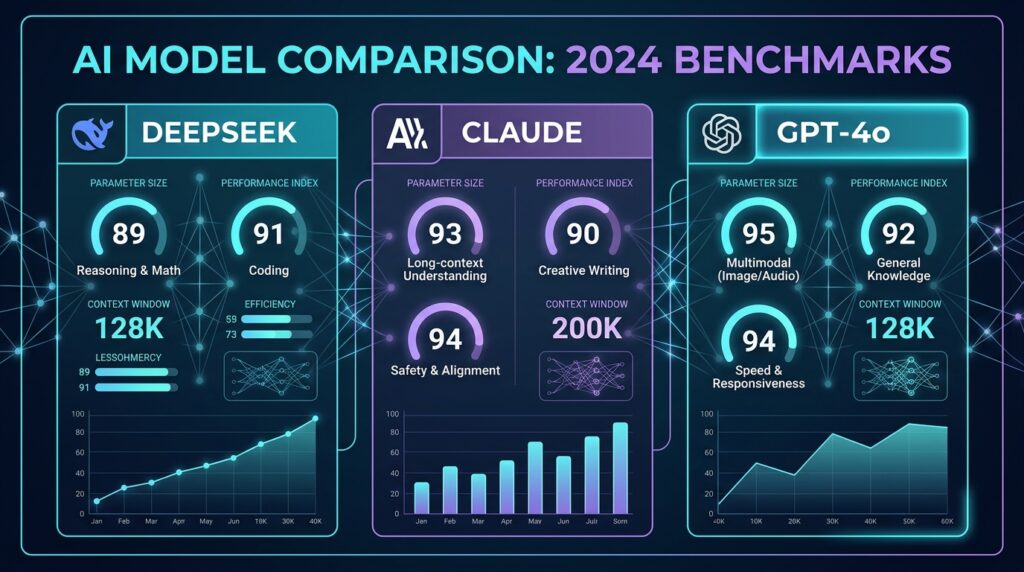
| Model | Input / Output Cost (1M Tokens) | Context Window | SWE-Bench Verified | Math / Reasoning (MATH 500) | Best Use Case |
|---|---|---|---|---|---|
| DeepSeek V3 (MoE) | $0.14 / $0.28 (Cache Miss) | 128K tokens | 49.2% | 90.2% | High-volume data processing & math |
| Claude 3.5 Sonnet | $3.00 / $15.00 | 200K tokens | 53.7% | 88.3% | Complex software engineering & frontend UI |
| OpenAI GPT-4o | $2.50 / $10.00 | 128K tokens | 46.8% | 83.7% | Multimodal audio/vision & low-latency chat |
1. Economic Disruption: The 10x-20x Cost Differential
The starkest difference among these models lies in their API pricing structure. DeepSeek utilizes an innovative Multi-head Latent Attention (MLA) architecture combined with FP8 mixed-precision training, activating only 37 billion parameters per token out of its total 671 billion parameters.
For an agentic workflow processing 50 million tokens per month (e.g., continuous document parsing, code review, or synthetic dataset generation):
- Claude 3.5 Sonnet: ~$450.00 / month
- GPT-4o: ~$350.00 / month
- DeepSeek V3: ~$18.00 / month (A 95% cost reduction)
2. Software Engineering and Code Generation
While DeepSeek V3 excels at competitive programming and algorithmic puzzles, Claude 3.5 Sonnet remains the undisputed industry gold standard for end-to-end full-stack software development. Sonnet demonstrates superior spatial reasoning when rendering complex UI components, strictly adheres to obscure library syntax, and avoids common hallucination patterns when refactoring legacy codebases across multiple files.
SWE-Bench Verified Benchmark (Real-world GitHub Issue Resolution):
Claude 3.5 Sonnet: ██████████████████████████ 53.7%
DeepSeek V3:       ███████████████████████░░░ 49.2%
GPT-4o:            ████████████████████░░░░░░ 46.8%
3. Multimodality and Latency (TTFT)
If your application requires processing live audio streams, real-time video, or rapid interactive voice bots, GPT-4o maintains a distinct edge. Its native omni architecture processes audio and visual tokens directly without intermediate Whisper speech-to-text transcoding, achieving sub-300ms latency windows critical for conversational voice agents.
4. Recommended Production Architecture: The Hybrid Routing Strategy
Enterprise systems in 2026 should never lock into a single vendor. The most resilient and cost-effective architecture deploys an intelligent model gateway:
- DeepSeek V3: Route all high-throughput extraction, classification, summarization, and data enrichment tasks.
- Claude 3.5 Sonnet: Route complex architecture planning, multi-file code synthesis, and final technical validation steps.
- GPT-4o: Route real-time voice interfaces, visual OCR diagrams, and multimodal inputs.
Frequently Asked Questions (FAQ)
Can DeepSeek V3 be self-hosted on private infrastructure?
Yes. DeepSeek V3 is an open-weights model. However, hosting its full 671B parameter checkpoint in FP8 requires high-end server clusters (e.g., 8x NVIDIA H800 / H100 GPUs). For smaller teams, quantized versions (such as DeepSeek-R1-Distill-Qwen) can run efficiently on single GPUs using Ollama or vLLM.
Is Claude 3.5 Sonnet safer for enterprise proprietary code?
Anthropic provides explicit enterprise zero-data-retention (ZDR) agreements via commercial API contracts and AWS Bedrock / Google Cloud Vertex AI integrations, ensuring your intellectual property is never utilized for future model training.
Looking to engineer cost-optimized AI model pipelines or deploy intelligent multi-model routing in production? Explore our engineering portfolio or connect for architectural advisory.
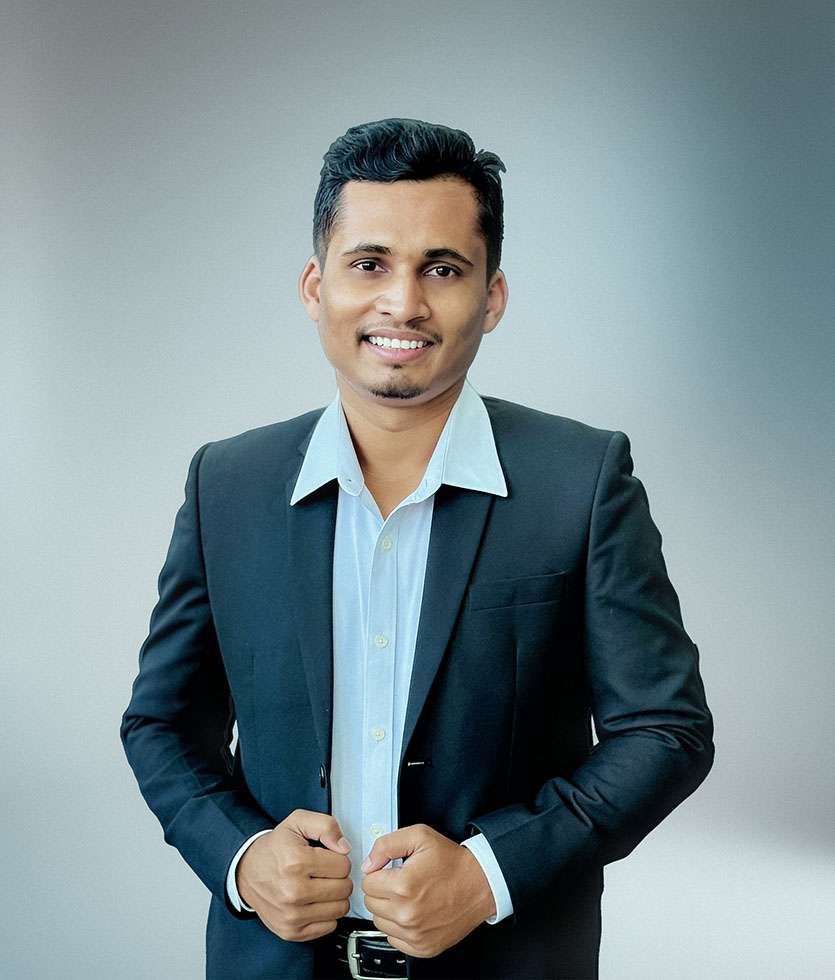
Md Saizul Amin
Digital Systems Strategist · AI Agent Developer · 9+ years in digital & ITMd Saizul Amin is a digital systems strategist and AI automation engineer from Dhaka, Bangladesh. With 9+ years across IT, web development and digital marketing, he writes practical guides on technology, business, education and online growth — and builds the same kinds of systems (AI agents, websites, SEO and ad campaigns) for clients in Bangladesh, the UK and the USA.
Specialist in
Credentials & experience
- 🎓B.Sc. in Computer Science & EngineeringBangladesh University of Business & Technology (BUBT), 2017–2021
- 🤖AI Automation Engineer · Web Developer · SEO SpecialistUnique Mark Limited, Birmingham UK — 2024 to present
- 🌱IT SpecialistGreen Fund Initiative Inc., USA — 2024 to present
- 🏥Junior IT Consultant — Ministry of Health (DGHS)Built the first national Shareable Health Record website; supported 6,000+ facilities
- 🧭Head of ITWEDO Bangladesh — led IT for 50+ staff, 2021–2023