In this article
Free online tools (merge a PDF, shrink a photo, convert a file, calculate a loan) are some of the most searched utilities on the web, and they are also easy to do badly: slow pages, forced sign-ups, files kept who-knows-where. I built ShobFree, a platform with 302 free tools in English and Bangla, as one product from idea to deployment. This is the practical architecture and the decisions that mattered.
Start with four product rules
- One task per page. A person searching “compress PDF” should land on a page that does exactly that, not a menu.
- No sign-up for core tools.
- Privacy by default: uploaded files are deleted automatically soon after the job (ShobFree removes them within minutes), and tools that do not need a server never upload anything.
- Bangla is first-class, not a translation bolted on.
Split tools by where they run
| Type | Examples | Runs in |
|---|---|---|
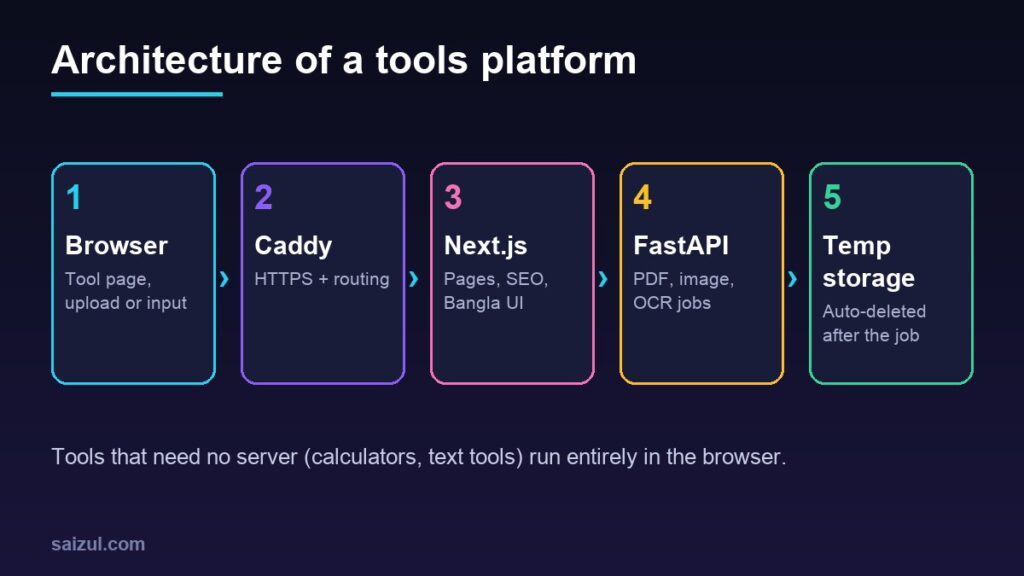
| Pure logic | BMI, age and loan calculators, text and unit converters, Bangla typing | The browser (no upload, instant, free to host) |
| File processing | Merge, split, compress, convert, OCR | A backend service with limits and short-lived storage |
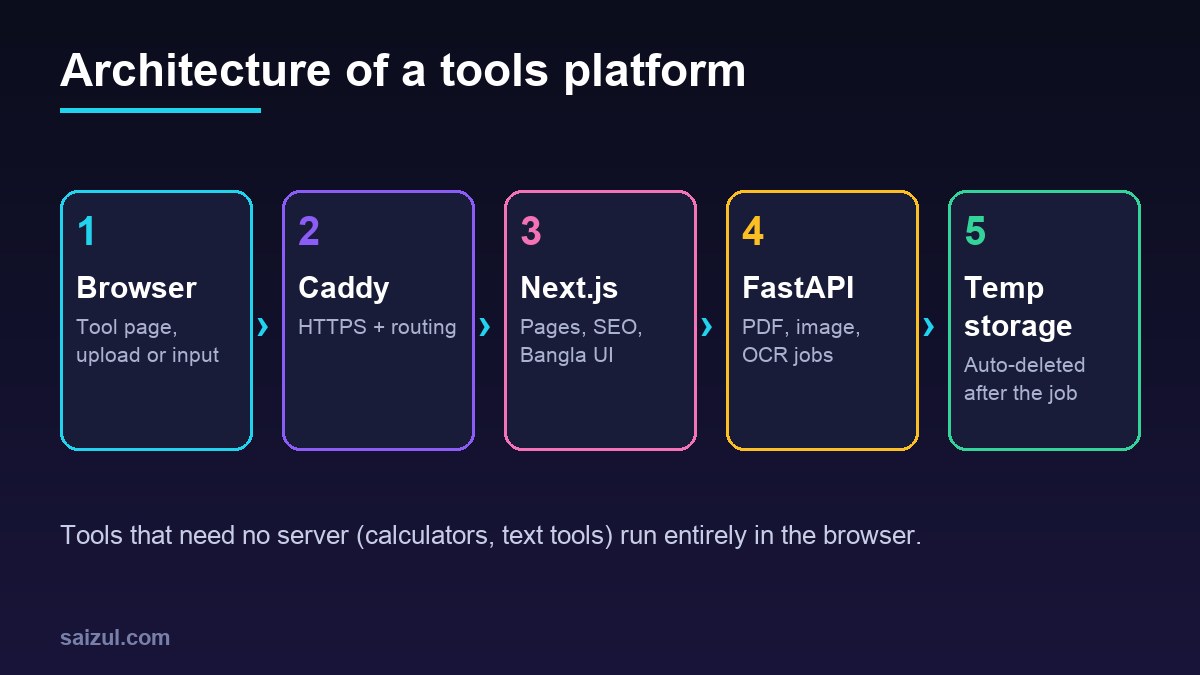
Keeping as many tools as possible client-side lowers cost, improves privacy and makes pages feel instant. Only the heavy jobs need a server.
The stack and why
- Next.js + React + TypeScript for the frontend: server-rendered, fast pages with clean URLs, which matters for search and for sharing.
- FastAPI (Python) for processing: Python has the strongest ecosystem for PDF, image and OCR work, and FastAPI makes typed, documented endpoints quick to build.
- Docker Compose behind Caddy: frontend and backend are separate containers, Caddy provides automatic HTTPS and routes traffic, and everything is reproducible on a VPS.
Build a tool framework, not 300 pages
The biggest time saver is a registry: every tool is a small definition (slug, title, category, inputs, options, copy, FAQs, related tools) rendered by shared components. Adding a tool becomes configuration plus the processing function, and every page gets the same layout, breadcrumbs, how-to steps and metadata. Consistency is also what makes a large site feel trustworthy.
Handling files responsibly
- Validate type and size before processing, and set hard limits (ShobFree accepts up to 50 MB per file).
- Process in an isolated temporary directory and return the result as a download.
- Run a cleanup job that deletes anything older than a few minutes, and never store file contents in logs.
- Use rate limits and timeouts so one heavy job cannot starve others.
- Say all of this on the page in plain language.
Make it findable without spam
Each tool page carries a clear title and description, a short “how it works” section, an explanation of options and links to related tools. A blog of step-by-step guides supports the tools. Quality per page is what separates a useful tool site from thin, scaled content (more in programmatic SEO for tool websites).
Deploy and operate
A small VPS with Docker Compose is enough to start. Back up configuration, monitor uptime and disk (temporary files and logs are the usual culprits), pin image versions and update on a schedule. For the operating side see my production Docker guide, which uses the same habits.
Lessons learned
- Decide what runs in the browser first; it simplifies everything else.
- Invest early in the shared framework and copy standards.
- Privacy claims must be true and visible; they are a feature.
- Bangla support touches fonts, input, numerals and copy; plan it from day one.
- Start with the tools people already search for, then expand.
Want something like this built for your business?
I design, build and deploy products and automations end to end: web apps and tool platforms, AI agents, workflow automation and the hosting behind them, in Bangla and English. The process is a free discovery call, a written scope and fixed quote, a focused first version, testing and deployment with monitoring.
See the ShobFree case study, the AI agent services and the portfolio, or tell me what you want to build.
FAQ
How long does it take to build a tools platform?
A framework and the first batch of tools can be live in weeks; the catalogue then grows continuously.
Is it expensive to host?
Not if client-side tools and efficient processing keep server work small. A modest VPS can serve a lot of traffic.
How do free tool sites earn?
Typically ads or optional upgrades. Keep the experience clean and respect user privacy.
Sources

Md Saizul Amin
Digital Systems Strategist · AI Agent Developer · 9+ years in digital & ITMd Saizul Amin is a digital systems strategist and AI automation engineer from Dhaka, Bangladesh. With 9+ years across IT, web development and digital marketing, he writes practical guides on technology, business, education and online growth — and builds the same kinds of systems (AI agents, websites, SEO and ad campaigns) for clients in Bangladesh, the UK and the USA.
Specialist in
Credentials & experience
- 🎓B.Sc. in Computer Science & EngineeringBangladesh University of Business & Technology (BUBT), 2017–2021
- 🤖AI Automation Engineer · Web Developer · SEO SpecialistUnique Mark Limited, Birmingham UK — 2024 to present
- 🌱IT SpecialistGreen Fund Initiative Inc., USA — 2024 to present
- 🏥Junior IT Consultant — Ministry of Health (DGHS)Built the first national Shareable Health Record website; supported 6,000+ facilities
- 🧭Head of ITWEDO Bangladesh — led IT for 50+ staff, 2021–2023